A great way to kickoff #SAR21 is to discuss some novel research on #liver and #pancreas. Join us and bring your probing questions! @LIRADS5 @SocAbdRadiology
Conclusion:
◇ Small bowel strictures can be diagnosed using the criterion "luminal narrowing" alone without the need for upstream dilation.
◇ CT and MRE showed similar diagnostic performance.
◇ We evaluated the performance of CT & MRE for the diagnosis of small bowel strictures in Crohn's disease (n=111) using 2 different diagnostic criteria:
> luminal narrowing with upstream dilation
> luminal narrowing with or without upstream dilation
Happy to share our latest article on MRI-based assessment of prostate volume where we compared:
🔹Methods per PI-RADS 2.0/2.1
🔹Effects of gland volume and BPH on calculated volumes
🔹 The “salami effect” known from TRUS-based volume assessments
https://t.co/50518yuDWv
I'm delighted to represent Switzerland 🇨🇭 as part of this great visionary project led by Dr. Elsayes @ElsayesKhaled
‼The Academy of Online Radiology Education @ACOREdu launched today‼
https://t.co/GwmobT1I0n
Ever came across a prostate MRI after focal therapy?
What are the expected findings, what to look for?
Happy to share our new review paper on MRI after HIFU of the prostate just published in Abdominal Radiology. #prostate
https://t.co/HD544AY0JG
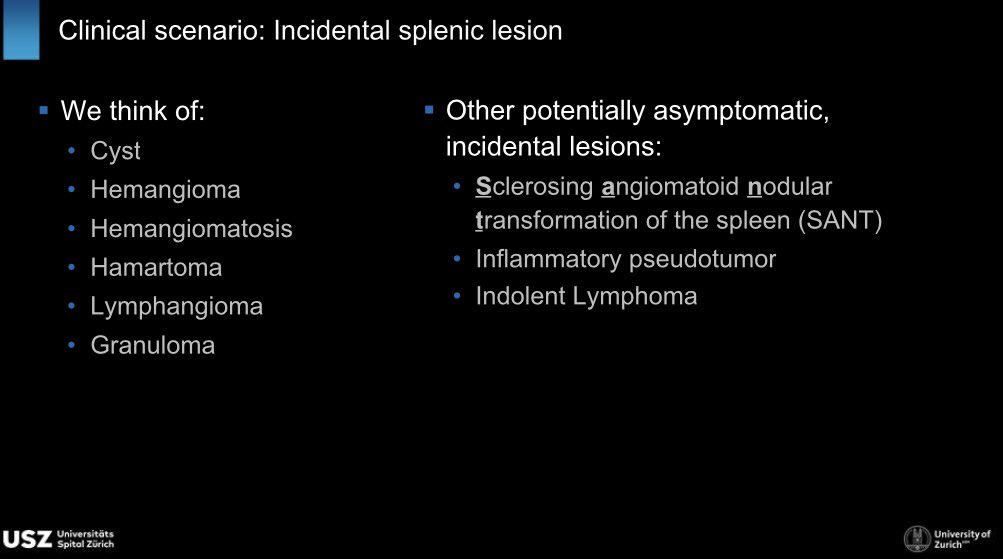
Is the spleen one of your radiological “🤔” organs as well? This ESGAR 2020 on-demand lecture from Dr. Reiner from @Unispital_USZ on challenging splenic cases is very helpful! #ESGAR2020 https://t.co/ruLbQkmIyw
Happy to share our latest paper in the May issue of European Radiology: Exploring the value of quantitative assessment of APHE & Washout in LI-RADSv2018 #lirads#hcc https://t.co/spCbU63MTr