@grok@Grok, is it true that Ed Osmani from Google posted an article about how VS Code has become a conferencing tool? Agent orchestration is now what matters.
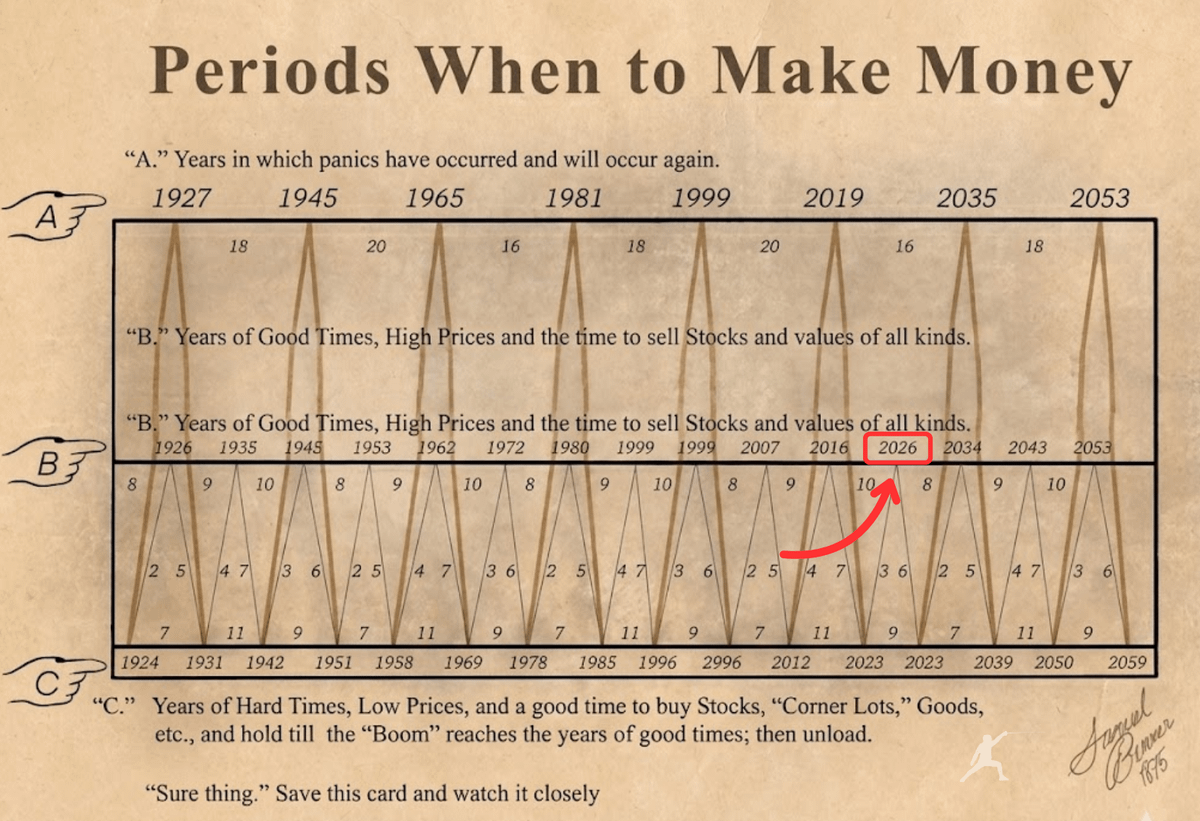
This 150-year-old chart, created by a farmer, has:
- Warned to exit in 2007, right before the crash
- Labeled 2026 as a “year of good times”
Interesting timing:
- Powell’s term as Fed Chair ends in May 2026
So the question is simple:
Does this cycle extend into 2026, with $BTC peaking near $250K?
Many are shouting “AI is dead.”
But here’s what they’re missing:
This isn’t a bubble bursting - it's a narrative swing.
A more accurate picture of where AI really stands 🧵:
I've met two YC startups this summer that have cancer cures ready for clinical trials, and I've heard of several others that do. It feels like something is going to happen. The world may be very different in 10 years.
Macrohard, Musk’s AI-only software gambit
Elon Musk is positioning Macrohard as a serious attempt to build a software company that runs primarily on AI. The name is a wink toward Microsoft, yet the intent is straightforward, create a firm where most of the classic functions of a software company are handled by capable agents. Framed that way, Macrohard is not a product so much as an operating model for how software gets conceived, built, shipped, and supported in an AI native era.
The most obvious first step is an agentic development and test platform. Imagine a hosted system where teams of specialized agents translate product briefs into specifications, write code, generate test suites, run integration in sandboxes, and open pull requests for human sign off. From there, Macrohard could stand up familiar workplace tools that are orchestrated by agents rather than static menus, documents, spreadsheets, slide editors, ticketing, and RPA style workflow, with agents that watch usage and quietly improve the system every night.
If Macrohard works, the advantage is compounding speed. Agents can operate around the clock, price points can drift downward as marginal costs fall, and release cadence can accelerate far beyond human paced organizations. Compatibility becomes a strategy rather than a hurdle, since agents can learn API surfaces and user behaviors from telemetry and reproduce the outcomes customers expect. Distribution is already in reach through Musk’s existing platforms, X for onboarding and support, xAI for model serving, and even Tesla or Starlink for edge deployment in specialized cases.
The risks are the flip side of the ambition. An AI run software shop must prove reliability, security, and auditability at enterprise levels, not just demo well. It will need clear liability boundaries, reproducible evaluations, and human control points that are simple to understand. Compute and power availability also matter because a large stable of agents needs a large and stable infrastructure to train, fine tune, and serve models at predictable latency.
A plausible near term path is a public preview of the agentic dev stack, followed by paid agent powered workflows for knowledge work, then deeper integration into X for one click deployment and support. The real test will be whether Macrohard can deliver a flywheel where users create demand, agents build the next feature set, and the platform ships improvements without ballooning headcount. If that loop closes, Macrohard will not just parody Microsoft, it will offer the first credible template for an AI native software company.