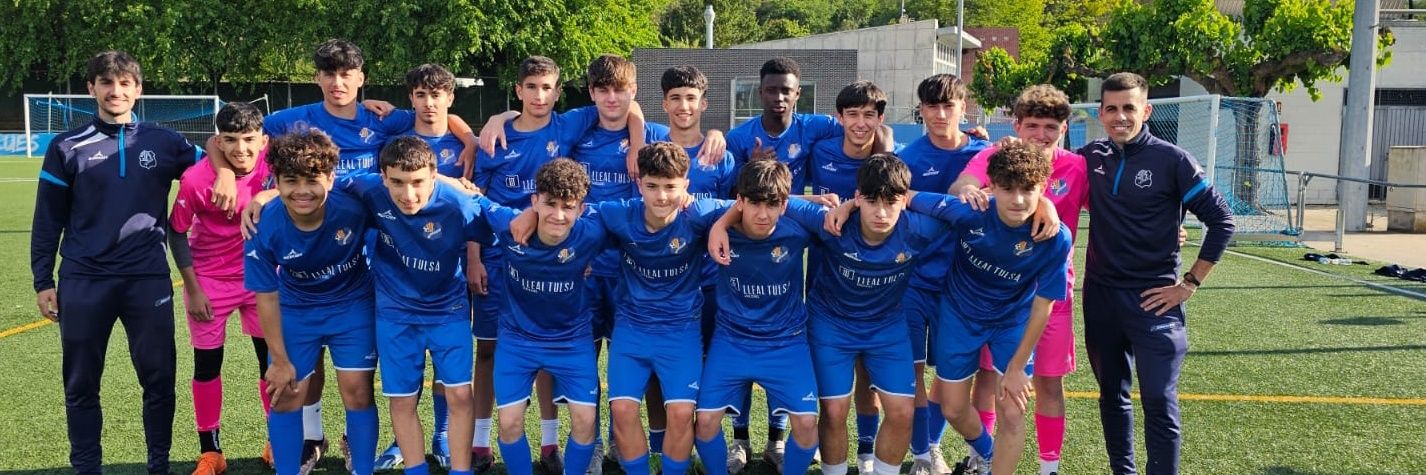
Importantísimo sobretodo en el futbol base. No hay que tener miedo a perder el balón, a equivocarse.. hay que tomar riesgos. Eso les va a hacer crecer mucho en todos los aspectos. Muchos niños viven con el miedo de perder el balón, y que sus padres y/o entrenadores les griten.
Para mí la clave está en saber detectar a quien hacerle caso y a quién no. El futbol es perceptivo, es imposible que un entrenador perciba lo mismo que el jugador en el campo. Si un jugador con capacidad de entender el juego te dice lo que está sintiendo, como entrenador toca escuchar.
Me ha encantado el torneo de Quim Junyent, elegido mejor jugador del Europeo sub-19. Es un interior con fuerte tren inferior, súper ágil para desequilibrar por dentro, coger altura o bajar a recibir, pausando o acelerando… Tremenda fase final. Ganazas de verlo en el Almería.
@KikuRimblas Sí, però també (no ho dic per tu) llegeixo com si no fer-ho així no volgués dir mossegar. Vol transicionar més que generar i dominar, però també hem vist mossegar amb petitons junts recuperant en 5 segons prop àrea rival.
Parece claro lo que busca Flick. A mi no me flipa todo presión, velocidad, desmarques y muchísimo ritmo, pero entiendo que hay que aceptar que es deseo de un entrenador que nos ha dado y da mucho. No es mi fútbol favorito pero competiremos y seremos divertidos.
Habrá que saber por qué Quim nunca ha llegado a debutar con el primer equipo del Barcelona y por qué sale libre.
Aun así, me parece que el Almería ha realizado uno de los mejores fichajes de LaLiga Hypermotion hasta el momento.
Jugador muy a seguir la próxima temporada.
Rodrigo De Paul, jugador de Argentina explicó esto...
pero muy de Menotti eso de Scaloni.
"Scaloni me enseñó un montón de cosas. Pero lo más importante que nos dijo, es que no somos jugadores de fútbol, sino que somos personas que juegan al fútbol..."
https://t.co/3AjL3CnxJj
El mejor ejemplo de los contextos. Cambian carreras porque, simple y llanamente, lo son todo. El Getafe no logró optimizar a un Álvaro que el Elche de Sarabia sí entendió. Y la sensación es que el Bournemouth lo multiplicará porque, más allá de cifras, es un 9 interesantísimo.
@Jordiq2@sirocco_10 Bueno clar però és molt relatiu això, ja que si rep una ajuda defensiva si necessitaria suport (ja sigui del lateral o un altre jugador). Però si estic d'acord en alliberar espai a carril exterior, per a generar situacions clares de 1c1.
Alemania necesita perfil en carril exterior a pierna hábil. Paraguay prioriza defender carriles interiores, el espacio está fuera. Pero tanto Wirtz como Sane reciben y van hacia dentro, no tienen desborde por fuera. El tener profundidad por fuera, favoreceria al juego interior.
🔎RUMBO AL MUNDIAL | ROMPER LA PRESIÓN: El arte de castigar el salto
En un fútbol de bloques altos asfixiantes, salir jugando no es "pasar por pasar"
De cara al Mundial, una clave para levantar la Copa será provocar el salto del rival para destrozar el espacio que abandonan📋👇
Let's talk about Uruguay, Marcelo Bielsa, his playing style and modern football.
Marcelo Bielsa has played essentially with the 4-3-3 as a starting formation. His attacking football is based on constant mobility and large distances between players. In possession, his full-backs push high, the wingers move inside, and both attacking midfielders join the front line. This creates three players on each side constantly rotating and exchanging positions.
Bielsa looks to progress mainly through the wide areas, using third-man combinations, runs in behind, and constant movement to disorganize the opposition. Another characteristic of his teams, something we see less often in modern football, is the use of natural-footed wingers. That fits perfectly with his desire to attack down the flanks. For example, a winger making a run in behind on his natural side is naturally better positioned to deliver crosses.
It is common to see Bielsa's teams attacking in something close to a 2-1-7, with the two centre-backs and one defensive midfielder behind the ball while the other seven players pin the opposition's back line. Very few teams in modern football attack with such an extreme structure. That brings us to the second issue: the distances between players. The passing distances between the centre-backs and defensive midfielder and the rest of the team are enormous.
In many ways, Bielsa is willing to sacrifice defensive transition by committing so many players to the last line. It is incredibly difficult for any defence to deal with seven attacking players occupying the final line, but Uruguay struggled badly in attack throughout the tournament. Most of their chances came from crosses.
For Bielsa's teams, crosses are not the ideal solution. When you attack with seven players on the last line, an intercepted cross or a clearance leaves huge spaces to defend. Uruguay often had only three players protecting defensive transition, and counter-pressing after a cross is much more difficult than after losing possession through wide combinations. At the same time, having so many players in the box explains why Uruguay remained dangerous from crosses. It is a trade-off, but one that leaves the team poorly balanced. Saudi Arabia didn't have enough threat in offensive transition to exploit those spaces, but Cape Verde and Spain did.
What we saw very little of was progression through the inside channels. There are several reasons for that. First, Bielsa's positional structure naturally favours wide progression. Trying to attack centrally while committing so many players forward carries enormous risks in defensive transition. Second, De Arrascaeta's injury was a huge blow. He is the player capable of receiving between the lines and creating in the final third. The third issue was the roles Bielsa gave to Bentancur and Fede Valverde. Both were used as attacking midfielders on the last line, which does not suit either player. It was frustrating to see Valverde almost pinned as a right winger in the opening game, while Bentancur often played far too high.
Ironically, Bielsa himself had already found a better balance in previous months, using Bentancur as the #6, Valverde as the #8, and De Arrascaeta as the #10. Bentancur needs to organize play from deeper areas, while Valverde is at his best as a box-to-box midfielder arriving from deep. Of course, if you want to attack with seven players and leave only three behind the ball, you need a specialist defensive midfielder like Ugarte to deal with transitions. But sacrificing the best qualities of both Valverde and Bentancur, while also missing De Arrascaeta, proved too much for Uruguay.
Defensively, I actually thought Uruguay performed quite well. Bielsa uses a man-oriented pressing system that is slightly more conservative than the pure man-to-man approach of Gasperini, for example. Rather than marking everyone immediately, Bielsa initially leaves one opposition player free while keeping an extra defender behind the press to protect the back line. If the opponent progresses by finding that free player, Uruguay then jumps aggressively and the spare defender steps out, effectively turning the structure into full man-to-man marking. Overall, this is something Bielsa's teams usually execute very well, and I don't think Uruguay suffered much from it. Their rest defence, however, was a different story.
Overall, I believe Uruguay would probably have progressed with a fit De Arrascaeta and with different roles for Valverde and Bentancur. In the end, individual mistakes also played a part, and those are simply part of football. I also don't think intensity was the problem. If anything, Uruguay were almost too intense against Spain. What they lacked was attacking clarity and enough solutions to consistently create chances.
Marcelo Bielsa has influenced coaches all over the world, myself included. It hurts to see him in this situation. It may be time for him to move on. Modern football has changed enormously. Bielsa is exceptionally methodical, demanding and stubborn, and those qualities are becoming increasingly difficult to sustain. Part of his frustration comes from feeling that football has become more of an industry, full of people chasing money rather than loving the game as obsessively as he does. I don't blame him. Anyway, his methods are becoming harder to apply, especially at club level. The intensity he demands, the constant mobility, the huge distances between players, the modern football calendar, and the profile of today's players make his model increasingly difficult to sustain over a full season.
I hope he steps away from football for a while, reflects, and eventually returns to rebuild a smaller football nation. A coaching career as influential as Marcelo Bielsa's deserves a better ending than this.
Crec que sovint es mata Bielsa per com tracta els periodistes i no tant per si futbolísticament és top o no (que per mi ho és). Altre debat és si en competicions curtes el seu mètode té l'impacte desitjat o necessita el dia a dia i temps.
@migdelcamp Crec que la proposta de Alemanya es de les que més m'agraden (sino la que més), però ahir vaig veure l'equip força imprecís, sobretot Pavlović i també (com ja comentes en un altre tuit) vàren trobar a faltar l'esquerra de Schlotterbeck.
🗣️"Tenemos al nuevo Messi".
@BorjaJimenSaez le dio a Yan Diomandé la oportunidad de debutar con el primer equipo del Leganés. Desde entonces, su crecimiento ha sido imparable hasta convertirse en una promesa del fútbol mundial y en el líder de Costa de Marfil en el mundial.
Funes el año pasado entrenaba en Tercera. Y este curso lo inició en Segunda Federación. Para que veamos el talento que hay abajo, que de hecho hay mucho que nunca llega, que no tiene la oportunidad, pero que lo hay. Solo hay que apostar por él como ha hecho el Málaga.