@samuelcolvin@Cloudflare@dok2001@KentonVarda WebSocket upgrades were never part of Worker sharding (https://t.co/s6eZiJiohB). They still reuse warm isolates, but only on the server that received them, so at very low traffic most start cold. It improves as traffic grows and more servers warm up.
@andriiimy@ritakozlov@Cloudflare With the new scheduler ( https://t.co/eoHmtWkYko ) the DO location hints should work as region configuration.
Hyperdrive is coming soon through the currently experimental interceptOutboundTcp API on Containers.
😴 rest easy - Durable Objects can now wait until they hibernate to apply code updates, giving long-running agent turns time to finish even if you're shipping PRs by the second.
https://t.co/sjIlhw7W4f
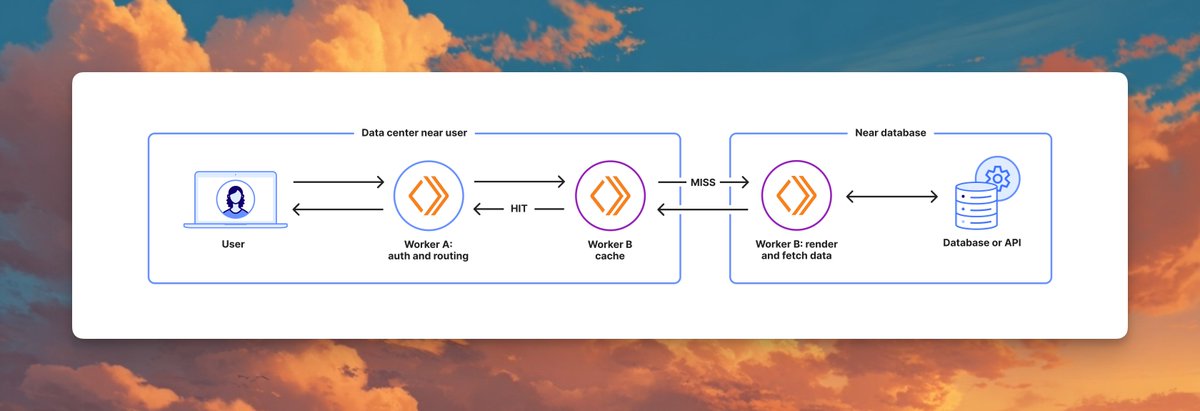
Workers Cache — Your Cloudflare Worker now has its own tiered cache in front of it:
https://t.co/6rAJN8e71s
Workers Cache is a programmable tiered cache between Workers — even between code running in the same Worker
we’ve seen pretty much every approach to caching over the years from our customers, and Workers Cache is the direct result of everything we’ve learned
it takes all the workarounds and clever hacks we’ve seen to make sites and APIs fast, and simplifies them down to writing JavaScript and returning Cache-Control headers
you can use for so much — for us this is like shipping 12 different things on the same day
first up — you can use it to place your app near your database, cache its responses, and run code in front close to users:
We recently undertook an effort to improve reliability of Rust Workers, which involved implementing panic=unwind and abort recovery in wasm-bindgen using WebAssembly Exception Handling. Excited to be able to share this work!
https://t.co/urPwwPY2Vm