@patio11@allTheYud AI models are just not AGI pilled.
If they don't know some new AI milestone has been reached, they will assign a vanishingly low probability to it happening in the medium term future. The only ever seem to be surprised in one direction.
@RexKwonDo_@NicCicutti@owenjonesjourno Well in my opinion a reasonable public policy goal (to trade off against others) is to make sure no pensioners are poor. Whether they have to pay rent/mortgage clearly impacts how much needs to be spent to achieve that goal.
@Dannythefink I appreciate you responding. And thank you for the clarification. It’s hard to read it as anything other than a mean spirited aside, so I am pleased to learn it wasn’t you as even though I disagree with your politics I always thought you came across as fair minded.
@Sidneysussex1@NicCicutti@owenjonesjourno I do not accept that the supposed “ringfenced” nature of NIC or the projected NIF surplus has any relevance for the public policy decisions about the appropriate future level of state pensions. The technicalities you’re relying on to say otherwise are flimsy and easily overcome.
@Sidneysussex1@NicCicutti@owenjonesjourno But NI contributions do not just go to the NIF. And to the extent they do, they just fund current payments (and a working reserve). You seem to be trying to draw sweeping public policy conclusions from things that are just technical details of the arrangements.
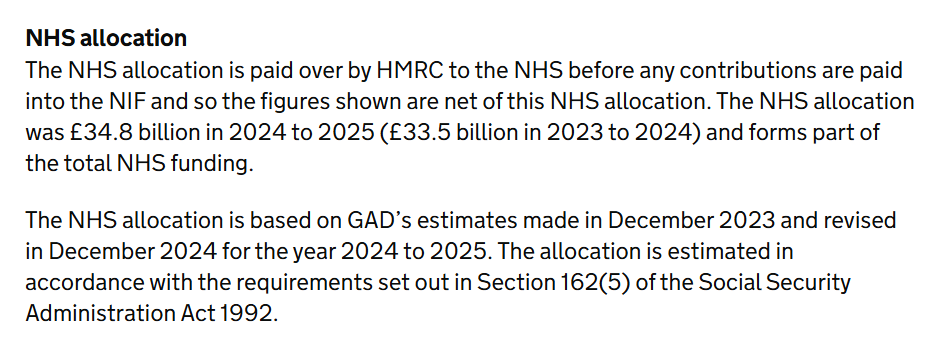
@Sidneysussex1@NicCicutti@owenjonesjourno The amount that goes to the NHS is variable and fungible with general fund monies. Therefore NI contributions do not just fund pensions. Nor are future payments funded. It’s all just current spending (save for a working reserve).
@Sidneysussex1@NicCicutti@owenjonesjourno You make a technically correct point that NIF can only be used for pensions, BUT not all NI contributions are paid into the NI Fund. NI contributions are used to finance current NHS expenditure, along with general fund monies, therefore they are fungible.
@Sidneysussex1@NicCicutti@owenjonesjourno You are misinterpreting the evidence.
The carried forward balance on the NI Fund is a working reserve/contingency. It's above the minimum, but that does not change what it is. It is not guaranteed funding for future pensions.
@Sidneysussex1@NicCicutti@owenjonesjourno Yes there is a retained balance. It's not strictly the case that every penny in is paid out. But that balance is just a contingency of around one sixth of annual payments, to cover any short term volatility in receipts. It is not retained contributions to finance future pensions.
@Sidneysussex1@NicCicutti@owenjonesjourno But the "surplus" you are referring to has already been spent, and continues to be spent to finance current spending in the year it is received.
@Sidneysussex1@NicCicutti@owenjonesjourno Thank you for the advice to trust myself. My advice to you is to make your claim explicit.
My claims are:
- National Insurance contributions finance current year spending (not future pensions),
- Are fungible (via NHS) with the general fund, and
- Are not paid by pensioners
@Sidneysussex1@NicCicutti@owenjonesjourno What is your claim here? That NI Funds are kept completely separate from general fund spending? Clearly they are fungible via the NHS. That NI Funds are earmarked for future pensions? Clearly they are not.
@Sidneysussex1@NicCicutti@owenjonesjourno But NI is NOT a hypothecated tax. National Insurance contributions fund general current year Government spending. National Insurance contributions are not retained for future year pension payments. You may not like that reality, but arguing technicalities does not change it.
@Sidneysussex1@NicCicutti@owenjonesjourno The amounts paid in each year are not ringfenced for future pensions. They finance current year spending. And when you get to be a pensioner you no longer pay them. So pensioners pay a lower tax rate than others.
@Sidneysussex1@NicCicutti@owenjonesjourno National Insurance is a tax paid into the Treasury to finance CURRENT spending. If you made NI contributions in 1994 it financed government spending in 1994. Your friend receiving £198 per week is receiving it from the tax paid by 2026 taxpayers.