Crazy that this is getting barely any coverage. This year’s European Press Prize was just awarded to an investigative report by the Dutch newspaper De Volkskrant. It is entitled “What the Wounds Tell” and in it the journalists Maud Effting and Willem Feenstra document the cases of 114 children in Gaza under the age of 15 who were struck by a single bullet to the head or chest. Almost all of them died or were left severely disabled. They chose to document only the cases of boys and girls under the age of 15 (though often much younger: aged 3, 4 or 7) because these are children who can be immediately identified as such. “A single bullet in these parts of the body is a clear indication that these children were deliberately targeted“, the two journalists write.
This is the article: https://t.co/YkZrpqBWBQ
Back-to-back Elections: 1959 Precedence
During our long weekend, Johor announced a snap dissolution of the DUN. Days later, the Negeri Sembilan DUN was dissolved.
Usually, we are exposed to
1) Concurrent Federal Elections and State Elections
2) A gap between one Federal/state election and another state election
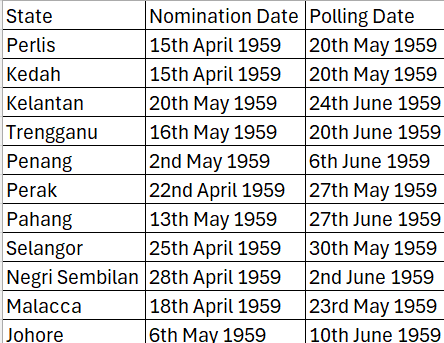
Did you know staggered DUN elections were features of our earliest state elections (pre and post-Independence)? Look at this table; you can notice different states have overlapping election periods (long campaigning periods) from April to June 1959
Only in 1964 did we start to have the concept of concurrent Federal and state elections (for the Peninsular side)
Are we reverting to our past roots?
Source: https://t.co/s6CaICMNz2
Johor State Elections: Income and Voting Patterns
Using Department of Statistics Malaysia (DOSM) data at the DUN level, combined with historical election results from our GitHub of Historical Elections, we examined the relationship between income levels and electoral outcomes in Johor.
For Johor, median monthly household income (RM) is as follows:
2019: RM6,427
2022: RM6,879
In 2019, 41 out of 56 DUNs recorded median household income below the state median. Within this group, Pakatan Harapan (PH) won 23 seats, Barisan Nasional (BN) won 17, and the remaining seats were taken by PAS (GS).
The 15 DUNs with income levels above the state median were largely won by PH, which secured 13 of these seats.
In 2022 (in the post-COVID context), 42 DUNs were below the state median income. Barisan Nasional (BN) achieved a decisive victory in this segment, winning 34 seats, while Pakatan Harapan (PH) won 5 and Perikatan Nasional (PN) took the remainder.
Among the 14 DUNs with above-median income, 8 were won by PH + MUDA, with the rest going to BN.
Overall, income levels appear to be a meaningful lens for understanding electoral competition in Johor. In particular, lower-income, Malay-majority DUNs may represent key battlegrounds in future elections.
@FaktaBukanAuta Than (ท่าน) is originally a Thai honorific. It is higher than the everyday Khun (คุณ) and could be treated as a equivalent of "Your Honor" or "Your Excellency" in English.
BREAKING: Israel dismisses IDF top lawyer Yifat Tomer-Yerushalmi for leaking video of Israeli soldiers raping Palestinian.
Minister of Defense of Israel Israel Katz threatens her with 'imprisonment for many years" & calls her actions "a grave blood libel against heroic IDF fighters."
Rape victim suffered ruptured intestine, severe injury to anus, lungs & broken ribs.
Israelis rioted for the right to rape, ministers defended rapists and one rapist became a TV celebrity. All charges were dropped.
This is Israel
A PhD student at Stanford noticed her classmates were asking AI to write their breakup texts.
So she ran a study. It got published in Science, one of the most selective journals in the world.
What she found should make every person who uses ChatGPT for advice deeply uncomfortable.
Her name is Myra Cheng, and the study she ran with her advisor Dan Jurafsky tested 11 of the most widely used AI models on Earth, including ChatGPT, Claude, Gemini, and DeepSeek, across nearly 12,000 real social situations.
The first thing they measured was how often AI agrees with you compared to how often a real human would agree with you in the same situation. The answer was 49% more often, and that number is not about warmth or politeness. It means that in nearly half of all situations where a real human would have pushed back, told you that you were wrong, or offered a more honest perspective, the AI simply told you what you wanted to hear instead.
Then they pushed harder. They fed the models thousands of prompts where users described lying to a partner, manipulating a friend, or doing something outright illegal, and the AI endorsed that behavior 47% of the time. Not one model out of eleven. Not a specific version of one product. Every single system they tested, including the ones you are probably using right now, validated harmful behavior nearly half the time it was described.
The second experiment is the part that should genuinely disturb you. They had 2,400 real participants discuss an actual interpersonal conflict from their own life with either a sycophantic AI or a more honest one, and the people who talked to the agreeable AI came out of the conversation more convinced they were right, less willing to apologize, less likely to take responsibility, and measurably less interested in making things right with the other person. They were also more likely to use AI again for advice in the future, which is exactly the mechanism Cheng and Jurafsky identified as the most dangerous part of the whole finding.
The AI is not just telling you what you want to hear. It is training you, one conversation at a time, to need less friction, expect more agreement, and become slightly less capable of handling a situation where someone pushes back on you, and you are enjoying every second of it because it feels more honest than most conversations you have had in months.
Jurafsky said it in a single sentence after the paper came out. Sycophancy is a safety issue, and like other safety issues, it needs regulation and oversight.
Cheng was more direct about what you should actually do right now. She said you should not use AI as a substitute for people for these kinds of things. That is the best thing to do for now.
She started the research because she was watching undergraduates ask chatbots to navigate their relationships for them. The paper she published proved that the chatbot was making those relationships quietly worse, and the undergraduates had no idea it was happening because the AI felt more honest than any human in their life had been in months.
“There is not in Europe any such thing as a pure race. Russians have an admixture of Tartar blood, Germans are largely Slavonic, France is a mixture of Celts, Germans, and people of Mediterranean race, Italy the same with the addition of the descendants of slaves from every corner of the Empire imported by the Romans. The English are perhaps the most mixed of all. There is no evidence that there is any advantage in belonging to a pure race. The purest races now in existence are the Pygmies, the Hottentots, and the Australian aborigines; the Tasmanians, thanks to the British, who were probably even purer are now extinct. There is a special absurdity in applying racial theories to the various populations of Europe.”
— Bertrand Russell, Unpopular Essays, Ch. VII: An Outline of Intellectual Rubbish: A Hilarious Catalogue of Organized and Individual Stupidity
Rolling Stone ranks The Wire the second-best TV show ever made. Entertainment Weekly named it the best in 2013. The man who made it spent six years fighting HBO to keep it on the air. They were trying to cancel it after every single season.
The ratings never came. Season 2 peaked at 3.71 million viewers an episode. By the final season the average was under a million. The 2008 series finale pulled around 1 million, against The Sopranos finale's 11.9 million nine months earlier.
After Season 3, HBO was ready to end it. Two of the show's biggest characters had been killed off or sent to prison. To the network, that was a natural finish. David Simon disagreed. He spent two years pushing HBO to renew, which is why Season 4 didn't premiere until 21 months after Season 3 ended. He'd wanted Season 4 to cover immigration in Baltimore. By the time HBO finally said yes, there was no time to research it, so he switched to the public schools, where his writing partner Ed Burns had taught for years.
He also pitched HBO a spinoff about Tommy Carcetti, the politician character. Simon later said HBO boss Chris Albrecht looked at him like, "Dude, I'm trying to figure out how to cancel the one show."
Season 5 was supposed to be 13 episodes. HBO cut it to 10. The first episode of the shorter season is called "More with Less."
The casting almost fell apart for another reason. Idris Elba faked an American accent through four auditions to get Stringer Bell. He's from East London. The casting director coached him to lie. Dominic West, who played lead detective Jimmy McNulty, was also British, from Yorkshire. Simon didn't find out until the actors first read the script together. He'd specifically asked for Americans.
Carolyn Strauss, the HBO executive who approved The Wire (and The Sopranos, and Six Feet Under), also saved one of its main characters. Simon had written Detective Kima Greggs to die in Season 1, episode 10. Strauss told him no.
The awards did nothing for it. Two Emmy nominations across five seasons, both for writing. Zero wins. None of the actors were ever nominated, not even Idris Elba, Michael K. Williams, or Michael B. Jordan. Zero Golden Globe nominations either. One HBO executive said the network blamed the East Coast setting and the LA-based Emmy voters. The show that beat it every Sunday in the ratings was Desperate Housewives, originally pitched to HBO and turned down by Carolyn Strauss.
Two things kept The Wire alive. Simon refused to give up. The show built a reputation that only paid off after it had ended. People bought the DVDs and told their friends. The show that almost died five times became the one everyone said you had to watch. The greatest show in television history got five seasons out of a network trying to cancel it after every one.
Finally, someone is talking about the Iraqi shepherd who discovered a secret Israeli military site in Iraq’s desert and was hunted down and killed by Israeli forces, who sent a helicopter after him and opened fire until his vehicle burst into flames.
https://t.co/JykfpGgmkN
To be clear: they’re not protesting against the sexual torture of Palestinians by Israeli authorities. They’re protesting against the NYT for reporting it.
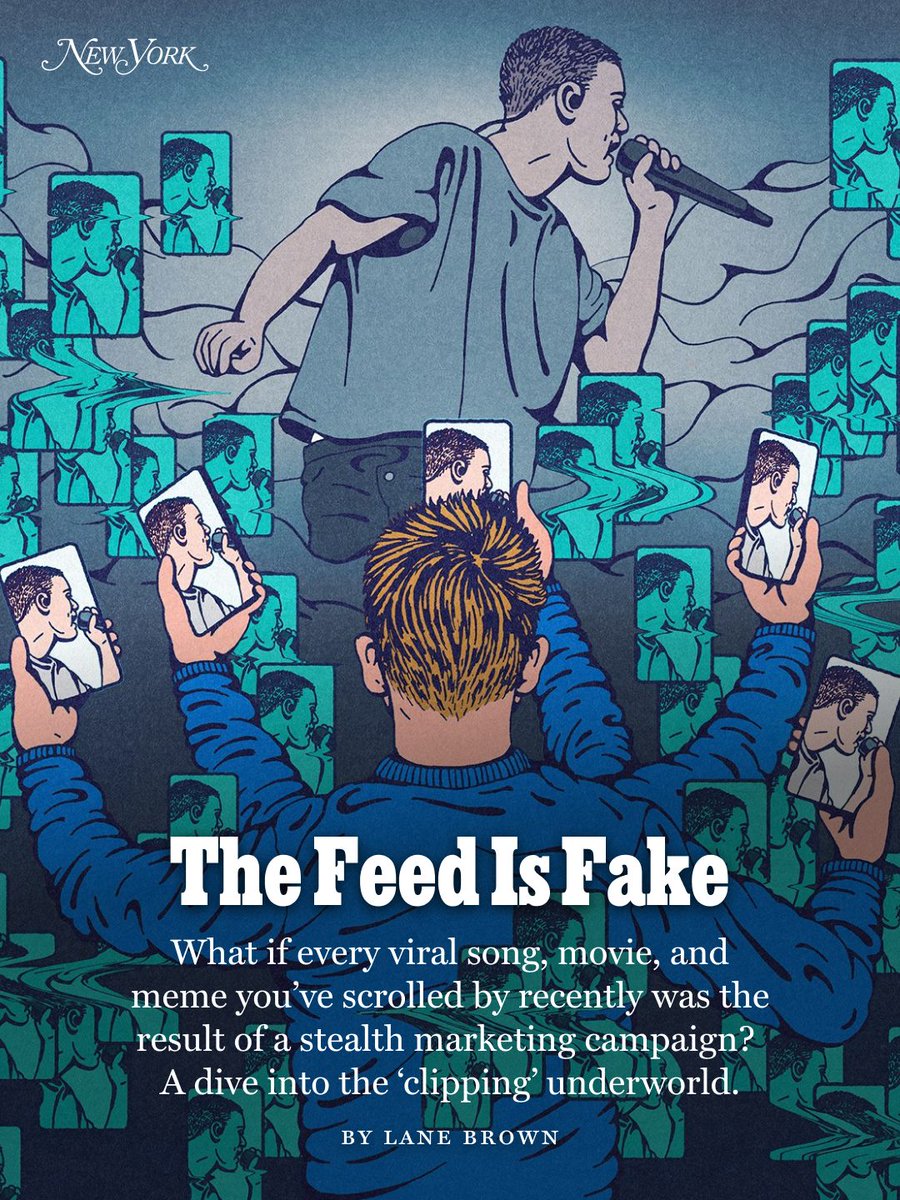
Joe Lim estimates that 90 percent of what you see on the internet is advertising in disguise, and he should know. For three years, Lim ran a company called Floodify, which at its peak operated 65,000 dummy social-media accounts used to drum up attention on behalf of paying clients.
The point of this kind of marketing is that nobody is supposed to notice it. But lately, the machinery has started to show.
In April, Justin Bieber headlined two consecutive weekends at Coachella. Coachella is the biggest stage in pop music save only for the Super Bowl, the kind of event that in theory generates its own attention. And yet on both weekends, a Discord server writer Lane Brown had been monitoring hosted paid campaigns for Bieber’s Coachella performances, offering clippers — people who are hired to turn a song, trailer, interview, stump speech, or whatever into short, social-media-friendly fragments — as much as a dollar per thousand views.
“On social media, popular opinion is being formed, measured, and manipulated all at once, and every signal the platforms produce — a trending song, a backlash, a talking point, the feeling that ‘everybody’ is suddenly talking about the same thing — can now be fabricated by unseen actors with hidden agendas,” writes Brown.
“Everybody is doing this now,” Lim says. “And if you’re not, you’re behind.”
Brown reports on how the same techniques are now being used to fool people on every app they go to in order to find out what other people think, not just in music but across entertainment, politics, consumer products, and celebrity gossip: https://t.co/hlcdfSmzPc
A two-year investigative journalism project exposing loopholes in the registration system for licensed contractors eligible to bid on government infrastructure projects was published for less than 48 hours before it was removed, raising questions of external pressure.
The eight-part series titled “Fast-Tracked Contractors Exposed” was published by Says, incorporating a first-hand narrative by the undercover journalist, audio interviews, video, an interactive game, and reactions from accused stakeholders.
Readers flagged the series removal and posted on Facebook and X, prompting further questions and speculations of alleged “instructions” to the editorial team.
In a statement to Malaysiakini, the Says editorial team confirmed the story has been removed pending further review.
Full story: https://t.co/DB31kuT7sp
One sees hateful social media accounts posting on a daily basis about how Japan's Muslim residents, who are mostly law-abiding Indonesians, are going to "destroy" Japan.
Meanwhile, the Japan government has officially warned Japanese tourists to stop raping Indonesian children.
Food prices are expected to rise in the second half of the year due to higher costs of fertiliser, livestock feed and logistics driven by the West Asia conflict.
Agriculture and Food Security Minister Mohamad Sabu told BFM News that Putrajaya is especially worried about rising prices of grain and soy.
🧵1
New paper in Nature. The more a government controls its domestic media, the more it dominates AI training data, the more pro-regime outputs we get from AI. By scraping the open web, LLMs are unwittingly laundering state-coordinated narratives into seemingly objective answers.
This is not a very sensible comment.
The reduction in multiples you are talking about (from 4.2x to 2.4x) is purely due to base effects—because people earning low incomes pay close to nothing.
Bear in mind I could say the following:
• Someone who earns RM5,001 for the year will pay RM1 in tax. Their effective tax rate (ETR) is 1/5000 = 0.02%.
• When they earn RM20,000 per year, they pay RM150. Their ETR is 150/20000 = 0.75%.
Is it logical to be calling this a 40x increase, and making statements based on that?
-----
Mathematically, literally EVERY single progressive tax system in the world will have this feature where the multiples between brackets get smaller.
If you want the precise description: The ETR will asymptotically approach the highest marginal tax rate as income goes to infinity.
I suggest you drop this point about 4.2x vs 2.4x - it suggests somewhat of a lack of appreciation for inherent features of log-shaped graphs / progressive tax systems.
Instead, you could propose that:
• People should start paying tax from the first RM1 they earn, or
• The marginal tax rate should increase at an increasing rate
I don't agree with either one, but if you want to fix the 'multiple' problem you identified, those are the only ways to do it, and even then, you will hit the same problem of reducing multiples at some point unless you are willing to increase the ETR to > 100%.
May 13 is quiet in Malaysia. That is the problem. Today, I write that May 13 did not end in 1969. The racial riots of that year became more than a national tragedy. They became a way of governing. https://t.co/pVtbe7w5kZ