...the generation of similar proteogenomic resources in disease-relevant contexts like the brain, liver, etc. that will continue to push this field forward, similar to what is being done for transcriptomics. (3/3)
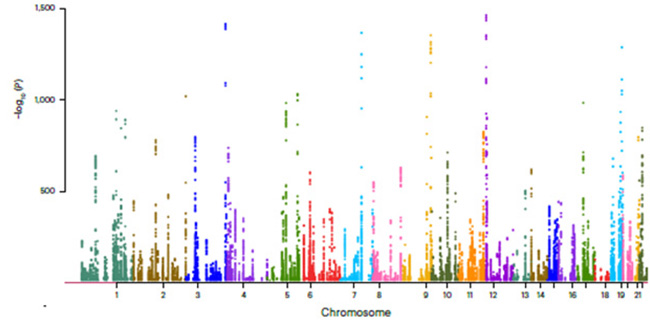
I'm very excited to see this work published in @ScienceTM . Proteogenomic studies have grown very rapidly in plasma, with almost every other context being completely ignored along the way. We find that even within closely related contexts (plasma and CSF), (1/3)
@DanWestern2 new @ScienceTM paper (https://t.co/ky3tgJEBUc) demonstrates that CSF proteogenomics captures disease‑relevant pathways missed in plasma, uncovering 400+ protein–trait associations across AD, PD, MS, and psychiatric disorders. Less accessible ≠ less important.
...massive amounts of pQTL signal is distinct between the two. This has really important implications for studying neurological disease due to the filtering effect of the blood-brain barrier. As the pQTL field continues to expand, we hope this article will incentivize... (2/3)
Integrating GWAS and protein quantitative trait loci, scientists link 38 proteins to Alzheimer’s, 24 of them new. @WUSTL @NatureGenet@ccrugom https://t.co/nvrr83i00c
I'd like to share our new lab publication @ccrugom on an atlas of CSF and brain metabolite quantitative trait loci. Special thanks to the mentorship of Carlos, and the instrumental contributions from both @chengran2020 and @DanWestern2. https://t.co/CrkaHuktLn
Thank you to mentorship from @ccrugom, our wonderful lab members, and collaborators including @wysscoray, @jineto_ARL, @AceAlzheimer, and many others who contributed to this work! Congrats to fellow PhD student @CiyangWang on her metabolite QTL work also in @NatureGenet 13/13
Thrilled to announce that our new @ccrugom lab manuscript detailing the proteogenomic landscape of human cerebrospinal fluid is now live at @NatureGenet. Many thanks to @WUADRC and @WashUNeurology for supporting this work. 1/13 https://t.co/PQdarW2Crs
We have made summary statistics for each protein available through the GWAS catalog (FTP server, GCST90421033-GCST90428040) and our lab website (https://t.co/cZXpxFg6oY, also has PWAS weight files) for other researchers to use and build on our work. 12/13
Great work by @DrShen_Yy and many others to characterize the early protein changes in autosomal dominant AD. So glad I could play a part in a wonderful publication!
Excited to share the latest paper from the lab, published today @CellCellPress "CSF proteomics identifies early changes in autosomal dominant Alzheimer’s disease". We identified proteins that capture disease changes 15-20 years before clinical symptoms https://t.co/3vw8chCuSa