@phtevenstrong Historically, how have junior tokens been worth the additional risk? What % are fully wiped out when something goes wrong (junior and senior effectively have same losses) vs partial wipeouts where there’s been different outcomes for junior and senior tokens?
@oldhawksol@solsticefi@hylo_so@onrefinance@humafinance@Loopscale Seems like USX has a lot of liquidity around $1, but is vulnerable when it gets near the edge of the concentrated capital
ONyc is a worry with a 90 redemption period in particular, platforms with long redemption periods are quite susceptible to depeps
Our mission at Quiet Alpha is to create a universal risk score for all of DeFi
Moments like this illustrate the need for a more clear, robust and understandable way to navigate risk in DeFi
TradFi has Moody's, S&P, and Fitch credit ratings
DeFi will have QA Risk Scores
Our three main lessons from the biggest crypto liquidation event in history
1/ Leveraged trading is riskier than you think
Most leveraged traders will acknowledge the inherent risks in trading high volatility assets, particularly when trading at aggressive leverage multiples
However, this event exposed just how thin and fragile perps markets can be. In particular, an issue in one trading venue (Binance) can have consequences across the entire market
Leveraged traders during this event with only "modest" leverage (e.g., 2-3x) would have had their entire position wiped in one candle in the majority of alts. Many traders had their entire portfolios wiped
It also acutely affected delta neutral traders, which as part of Auto-Deleveraging also saw some of their positions liquidated. This was exacerbated with funding rates going as low as -400% after
Leveraged traders need to reconsider how they can appropriate position their trades to account for these scenarios, across stop losses, collateral rebalancing and leverage ratios
2/ You cannot ignore oracle design when assessing risk
This event clearly illustrated how essential oracle pricing is for the functioning of markets
In particular, oracles using the market price of stablecoins add another element of risk. In turbulent market conditions, traders may execute large market sell orders of fully collateralized stablecoins. This can cause a temporary depeg, even when the underlying stablecoin is robust
Platforms that use oracles that price stablecoins on NAV offer a lower risk profile here, as temporary dips in the market price will not have any impact
3/ The importance of dry powder
Having a reserve of stablecoins in your portfolio can position yourself to make profits during these events
Savvy traders could have made significant profits from buying the flash crash.
Furthermore, as traders sell other assets to recapitalize their accounts, this presents arbitrage opportunities
For example, we executed a 1000%+ APY opportunity by taking advantage of a depeg in a number of Solana LSTs
These opportunities typically only present themselves during periods of market stress - underlying the importance of having a reserve of capital to take advantage of them
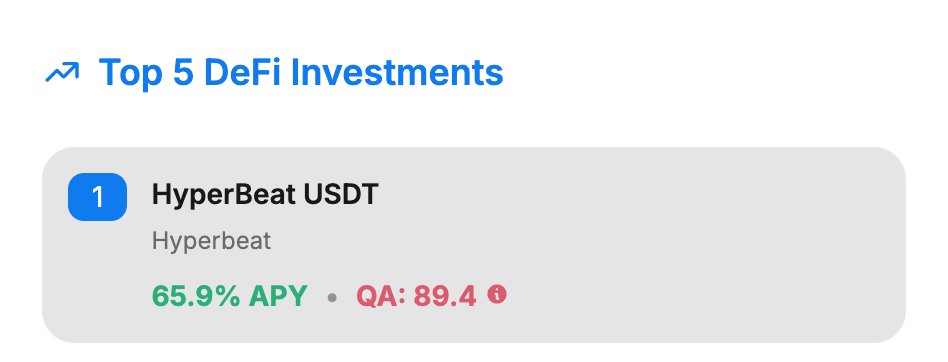
.@hyperbeat USDT pool is the highest yielding opportunity we have analysed with a 65.9% APY
The pool dynamically predominately allocates across a number of Hyperliquid basis trades, including PUMP & XPL
It also has one of the highest risk profiles, with a QA Risk Score of 89.4 (indicating very high risk)
Incredible fixed rates on @ExponentFinance right now with eUSX (24% fixed) and hylosol+ (23%).
That's over 100% APY on the hylosol+ position if you're looping with @Loopscale
1000% APR arbritage opportunity from depegged LSTs on Solana
With the liquidations of October 10-11th we spotted an opportunity to profit from the depeg of JupSOL
The trade is still profitable now
A guide on how you can copy this trade🧵