UChicago announced today that it had partnered with AI company Anthropic to give students, faculty, and staff access to Claude Enterprise services on a rolling basis starting in July. All University community members will have access by fall quarter. Story to come.
Claude Code for Academics
"A gentle introduction in how to use Claude Code for Academics."
presentation slides and github repo from Alessandro Spina
link in reply
Every time I discuss the economic and social disruptions caused by the worldwide decline in fertility, I hear the same response: artificial intelligence (AI) and robots will make this issue irrelevant.
I find the answer deeply paradoxical because, despite being an economist, I am compelled to point out that the argument suffers from the mistake of “economism”: thinking that all social interactions in life are solely about productivity.
Most of the problems caused by declining fertility are largely unrelated to productivity: the depopulation of rural areas, the collapse of public services, and inverted family structures in which one child supports four grandparents. Reducing all of this to purely economic terms is an extremely narrow view of society and life. A robot cannot visit your grandmother in a nursing home in a depopulated town in Korea.
But there is an even more fundamental question: how do you know that societies will permit the deployment of artificial intelligence on a large enough scale? If we have learned anything from economic history, it is that societies repeatedly create barriers to wealth and hinder the adoption of new technologies.
The Roman Empire had a working steam device, the aeolipile, and never developed it beyond a toy. The Ming dynasty burned Zheng He’s fleet and turned inward. Spain expelled its Jewish and Moorish populations at the height of its imperial power, gutting its merchant and artisan classes. The Ottoman Empire resisted the printing press for nearly three centuries after Gutenberg. Tokugawa Japan had firearms in the 1500s but chose to abandon them. The Qing restricted all foreign trade to a single port in Canton for over a century. Argentina was one of the ten richest countries in the world in 1910 and spent a century in relative decline through self-inflicted policy choices. The Soviet Union had world-class mathematicians and physicists but could not produce a decent pair of shoes because the institutional framework would not allow it. India’s License Raj strangled industrial development for four decades after independence. Closer to our own time, much of Europe spent decades resisting genetically modified crops despite the technology being available. Right now, the EU is drafting some of the strictest AI regulations in the world.
And these problems will hit hardest where people least expect them. The conversation about aging and AI tends to focus on rich countries like the U.S. or Japan, but the most acute disruptions will come in emerging economies. Latin America and the Middle East have experienced some of the deepest and fastest declines in fertility on the planet. Colombia’s TFR is 1.06, Jamaica��s 1.20, Turkey’s 1.48, and Mexico’s 1.60. These countries are getting old before they get rich. On top of that, they face a double blow: not only are fewer children being born, but their most skilled and ambitious young workers are leaving. The doctors, engineers, and entrepreneurs who might drive AI adoption are moving to the US, Canada, or Europe.
And let’s be honest: these are not exactly countries known for getting out of the way of innovation. The political economies of Latin America and the Middle East are riddled with extractive institutions, captured regulators, powerful incumbents who block competition, and states that struggle to deliver basic public services, let alone manage an AI transition. If Argentina could not reform its economy in a hundred years of trying (perhaps it is doing it now, but the jury is still out on whether this reform will be sustainable), if Mexico cannot keep its own engineers from leaving, if Egypt cannot fix its educational system, I am not sure why we should expect them to seamlessly deploy the most disruptive technology in human history. The countries that most need technological dynamism to offset demographic decline are precisely the ones least equipped to make it happen.
There is nothing inevitable about adopting new technologies. It requires political will, institutional flexibility, and social acceptance. Aging, fiscally strained democracies dominated by elderly voters are not obviously the best candidates for any of those three.
So when someone tells me “don’t worry, AI will fix it,” I hear an argument that assumes the best possible technological outcome, assumes societies will actually adopt it, assumes it will be deployed fast enough, and assumes the only thing that matters is productivity. That is four enormous assumptions stacked on top of each other. And I am sorry, but since I teach global economic history for a living, I have learned that optimistic assumptions are rarely validated by the crooked timber of humanity.
AI journal articles are a bigger risk to the career evaluation process than they are to the research process.
AI can produce articles comparable to those in many decent journals, but most of these articles are not that good—neither the AI ones nor those in journals.
In the post, @causalinf uses Claude to write a shift-share paper. Regrettably, the publication success of shift-share papers far exceeds their real-world accuracy or reliability.
There is a whole class of methods like this, which are good for careers because they reliably produce good t-statistics and nice stories for editors and referees—e.g. distance IVs, poorly identified structural models, diff-in-diff with few time periods, etc.
[hans_unpopular_opinion.gif]
It's not universally true, but for the most part, the class of papers that AI can rapidly reproduce were not adding all that much social value in the first place.
Flip through recent editions of the top econ journals and find the articles that you think are really correct and important. Very very few of those are in the category of "AI could have written this." Instead, they are good original ideas, creative (and often difficult) data collection, original solutions to real problems.
Maybe someday AI will produce these as well, but right now it's not even close. AI articles are mainly exposing the fact that a whole lot of econ research is formulaic and not that informative about the world.
Original work that says something new and important about the world will continue to stand out, at least for the time being. Maybe the AI slopcopalypse will force more researchers to do work with lasting value.
Hay una generación a la que se le dijo que yendo a la universidad le iría mejor. Sin embargo, no se preparó el mercado laboral para acogerles. Porque la universidad se movió por lógicas de rentabilidad y no de utilidad. Esto se ve cuando se habla con alumnos y profesores.
I learned from a great Spanish economist many years ago that so many hate economists because they play in policy discussions the same role as the kid who told you in second grade that Santa Claus does not exist (well, since this was in Spain, the “Reyes Magos”).
You know it is true, but you hate him even more precisely because you know he is right. People listen to Jon Stewart (populist left) or Oren Cass (populist right) because they want to escape reality. Stewart and Cass are the discontents of adulthood, sellers of fantasies, partly out of intellectual immaturity, partly out of venal interests.
That said, we are not without blame in the profession. We often forget, for instance, that voters care about many issues beyond output growth. During the Brexit campaign, economists who argued for “remain” (which I defended) blissfully ignored issues of democracy, self-government, and regional balance within the UK, which were crucial to many voters. I see similar blindness in many other discussions in Europe right now, in particular in Spain. For instance, I have often voted for policies that did not maximize output growth but that I thought were important for other reasons.
At the end of the day, one should listen to experts to understand the trade-offs involved in different policy decisions, but being an expert does not provide deeper insight into how to adjudicate among competing claims. That ability comes from “prudence,” and “prudence” is not what gets you published in Econometrica.
As a profession, we would do well to remind ourselves that yes, Stewart and Cass are ignoramuses, but that we often lack “prudence” as well.
@Jongonzlz La cuestión es: siempre se puede construir más, pero ¿vamos a dejar que los centros de las ciudades sean solo para turistas? Hay cuestiones de elección social que van más allá de mecanismos de oferta y demanda.
@Jongonzlz La vivienda es un bien muy inelástico, no funciona como el arroz o los cupcakes de tu ejemplo.
El aumento de oferta es necesario, sin duda. Pero plantear esto como una dicotomía no tiene sentido. Ambas cosas tienen cabida.
Happy to announce that the Research Agenda for #socialcapital in #economicdevelopment published by @Elgar_Economics is finally out. An insightful collection of chapters that will guide future research on this relevant topic. Thank you @semihakcomak for this exciting journey!
Some social scientists are convinced that there is only way way to think about causation. And their choice of methods is dictated by this view. But philosophers argue that there are various concepts of causation.
For information on the handbook: https://t.co/Y52pRAnFes
Economic development is less the result of good local policies than a reflection of national institutional strength.
As @dape595, Balaguer, @jpeiropalomino & @Emili_T_A show regional quality matters—but within the frame set of good national #institutions
https://t.co/IUcsLGRDot
NEW PAPER: Politics Versus Economics: The Case of Spanish Regional Financing
By Daniel Aparicio-Pérez, Maria Teresa Balaguer-Coll, Arne Risa Hole & Emili Tortosa-Ausina
https://t.co/h2FGhYRj16
@SAGECQPolitics@PolStudiesAssoc@uniyorkpolitics#ECRs
Submit your paper to the next #INFER Annual Conference in in Rome (September 10th-12th) using the EasyChair platform 👇
https://t.co/R89LdTa6qu
🗓️Deadline for submissions: March 15th, 2025
Deadline for registration: June 15th, 2025
Sapienza, Università di Roma, @SapienzaRoma
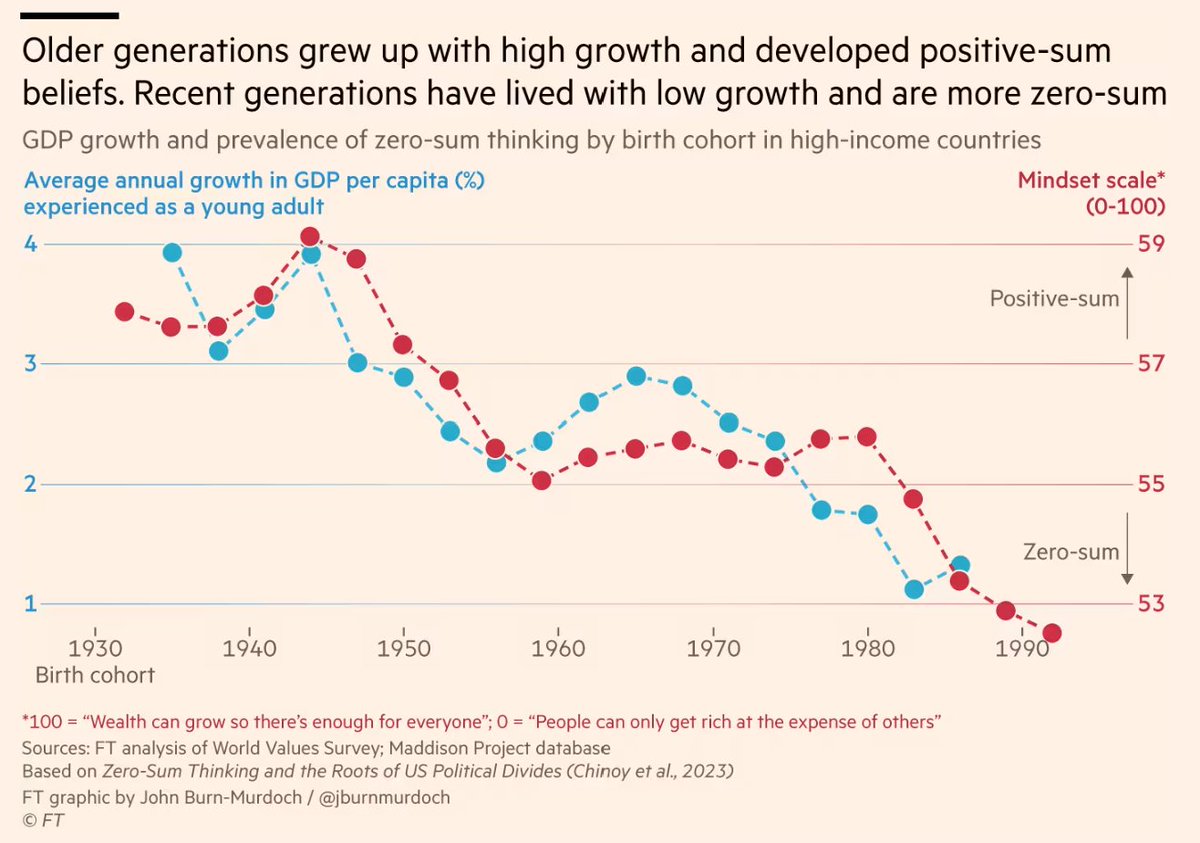
The most underappreciated benefit of economic growth is that without it, the economy becomes a zero-sum game. The only way of improving your standard of living is at the expense of someone else. Predictably, recent generations, who have seen slower growth, are more prone to zero-sum thinking.
What sparked humanity's leap from stagnation to prosperity? What lies at the core of inequality among nations? Insights from Unified Growth Theory, from @GalorOded https://t.co/wj29TlxvuV
Gracias a @GrupoInteco por la organización de XXI edición de su workshop en @UJIuniversitat permitiendo el reencuentro de colegas que investigamos en temas de integración económica y conocer a personas que seguimos y leemos como @AmSantacreu. ¡Fantástica Keynote speaker!