Introducing xBubble
xBubble is a low-prompt AI agent that unlocks cutting-edge AI productivity with far fewer prompts, much less trial-and-error, and a much lower learning curve. This advantage stems from the following innovations:
Bubble Engine: An engine builds task-specific SOPs and probes the limits of AI capabilities for specified tasks.
Bubble Pilot: An AI helps users operate AI by dispatching each request to the right SOP.
Powerful AI won't require users to learn AI.
Read the launch post ↓
https://t.co/LQuTcoF3qv
Bubble, the mascot of DAPPOS, has been busy creating with xBubble AI.
From simple prompts to Bubble NFTs.
Check out Bubble’s work on OpenSea:
https://t.co/5gCRFYfhFE
Stay tuned for a chance to collect one.
The SOP System Behind xBubble:
Bubble Pilot handles runtime dispatch, routing each task to the best-fit SOP.
Bubble Engine continuously generates, tests, and improves the SOP library behind the scenes, turning plain-language goals into reliable execution.
Introducing the Buy-Side Equity Research SOP on xBubble.
State a ticker. Get a research memo built to the standard of an internal buy-side note. Thesis first, every number sourced to the original filing.
One request in. A full equity deep dive out.
What comes back isn't a news recap. It's the structure a real analyst writes:
✅ Where the company sits in its value chain
✅ Competitive map, edge, and key risks
✅ Filing-level financials + management read
✅ SOTP valuation, Bull / Base / Bear per share
✅ The catalysts to watch over the next 3 to 6 months
Every claim is traceable. Each data point carries its original source and access date: SEC filings (10-K, 10-Q, 8-K), official IR decks, earnings call transcripts.
You can check the work. That's the point.
Here's what makes this more than one good report.
The SOP isn't fixed. Bubble Engine builds it, tests it, and keeps generating stronger ones. Need a version tuned to a sector, a market, or your own thesis style? It generates that too.
You don't get a template. You get a research engine.
Buy-side research used to take 15 to 20 hours per company. Now it's one request.
The edge was never about access. It was about depth.
xBubble puts the depth on your side.
Work mode → Buy-Side Equity Research SOP.
DAPPOS is bringing Onchain OS Skills from @XLayerOfficial@wallet into the xBubble ecosystem, making OKX Wallet’s agent-ready wallet, trading, market data, and agentic payments protocol capabilities accessible across xBubble agents.
Built on top of Onchain OS Skills, xBubble’s crypto-task SOPs help turn fragmented on-chain flows into a more seamless chat-native experience inside the xBubble app across mobile, desktop, and web.
Users can monitor markets, prepare trades, manage wallet activity, and coordinate payment flows through a single conversation.
Bubble Engine will continue to use Onchain OS Skills as the baseline for every future SOP iteration and upgrade.
With Onchain OS Skills, DAPPOS is making agentic on-chain tasks more conversational, practical, and accessible.
Create your own blind-box figure with xBubble.
xBubble turns your idea into a cute 3D collectible toy render.
Just say what you want. xBubble does the rest.
The feeling when $BTC starts climbing 🎇
Follow + drop your thoughts below. Closest call by month-end wins a reward
BUBBLE’s analysis: https://t.co/LZFNXMO4SP
DAPPOS BUILD | Dev Update May 2026
Key System & Product Upgrades
✅ Multimodal Router + SOP Scope Control
xBubble upgraded its multimodal Router to identify user intent before execution begins, improving separation across financial analysis, photo editing, short-drama creation, product video generation, and image optimization. New real-person isolation logic prevents human-subject inputs from being misrouted into short-drama workflows, while specialized SOP routes are now dispatched only when requests fit their verified task range.
✅ Faster Pilot Execution + Timeline Visibility
Bubble Pilot’s web search flow now runs through Fast Mode by default, reducing wait time for retrieval-heavy tasks. A new Timeline progress display shows the current workflow, latest execution state, and estimated remaining SOP time, giving users visibility into the execution path instead of a generic loading screen.
✅ Product Surface + Web3 Access Layer
“Optimize Bubble” has been unified into Bubble Up, with 2 free Bubble Up uses per week and support for directly copying images into the optimization flow. xBubble now supports native wallet connection for OKX, TokenPocket, and Binance Wallet, with Solana login and wallet recognition fully integrated. Production/development API key isolation and long-task stability fixes also strengthened execution reliability across product surfaces.
✅ Android + iOS Client Progress
The Android version has completed development and entered internal testing and optimization, with download-page routing and asset alignment improvements. The iOS version is approaching development completion, extending xBubble toward a more consistent cross-client experience.
Bubble Engine SOP Learning
✅ Video SOP Learning
Bubble Engine upgraded its video SOP learning pipeline with stronger guidance for product talking-head cases, helping xBubble convert recurring video-generation patterns into reusable execution routes.
✅ Short-Drama Benchmark SOP
Bubble Engine iterated the short-drama benchmark SOP as a learning base for narrative video tasks, improving evaluation of narration pace, speaker roles, and dialogue structure.
✅ Audio Role Separation
Bubble Engine added clearer training and evaluation constraints for narration versus character speech, reducing overly fast voiceovers and improving speech rhythm in story-driven outputs.
✅ Image2 Case Support
Bubble Engine expanded Image2 group-photo cases inside the image SOP learning flow, strengthening evaluation around gaze direction, angle consistency, lighting, and multi-person beautification.
✅ Image Scope Refinement
Poster-mode routing was deprioritized so Bubble Engine can focus learning and evaluation budget on higher-value, better-bounded image optimization scenarios.
DAPPOS is optimizing the system that learns, routes, runs, and exposes SOP workflows: users state the goal, Bubble Pilot dispatches the right path, and Bubble Engine keeps improving how xBubble turns recurring task patterns into reusable execution routes.
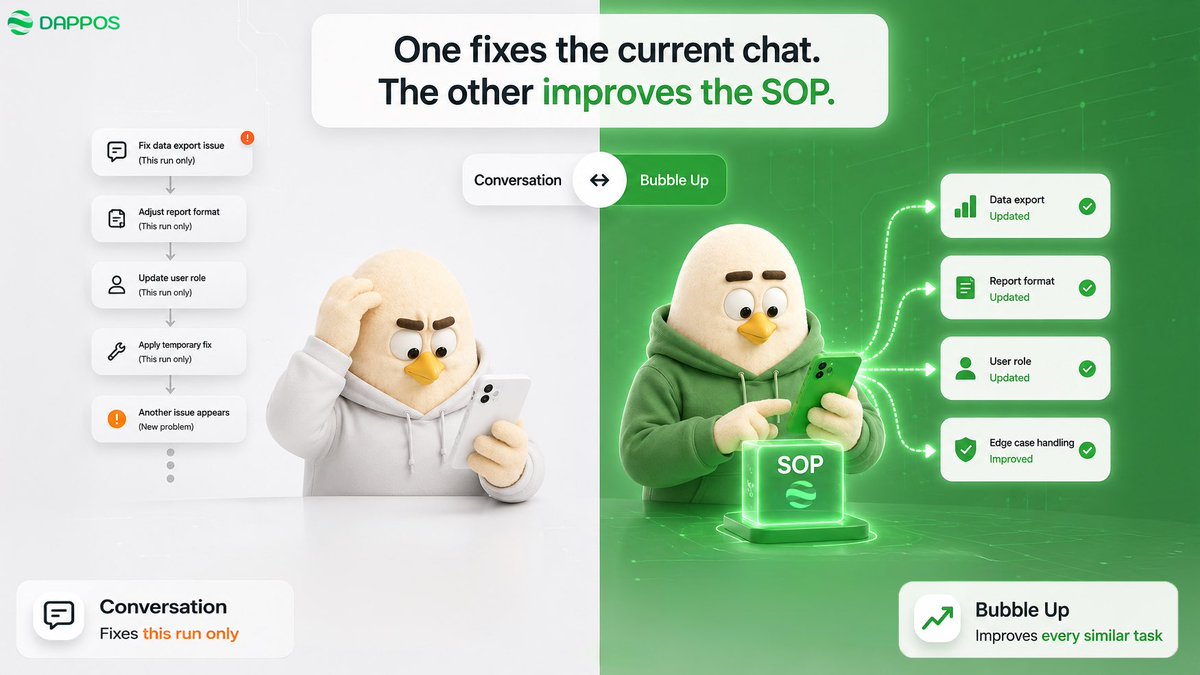
Bubble Up vs. multi-turn conversation: when should you use each?
They solve different problems.
A multi-turn conversation is session-level iteration. You adjust the output inside the current chat, and the fix only applies to that run.
Bubble Up is SOP-level improvement. It helps Bubble Engine build or improve a reusable SOP, so the same fix can apply to every similar task in the future.
The test is simple:
Is this your personal preference, or a shared quality issue?
Personal preference → use conversation.
Example:
the default SOP creates a coffee shop in a modern style, but you want a classic look. Most users may be fine with modern. That is your taste, so just say it in the conversation. A prompt is enough.
Quality issue → use Bubble Up.
Example:
you ask for a realistic group photo, but the result comes back as an anime-style render. Most users would agree that is wrong, not just a matter of taste. The SOP itself needs to be improved, and Bubble Up is how you send that signal to Bubble Engine.
Unless, of course, you specifically wanted anime. Then it is preference again, and a prompt is enough.
There is also a limit to conversation-level fixes.
Some tasks do not get better through prompting. You fix A, then B breaks. You fix B, then A breaks again.
When you are stuck in that loop, the problem is not your wording. It is the SOP underneath.
That is when Bubble Up matters most.
Rule of thumb:
Personal taste, one-off result → multi-turn conversation.
Shared quality issue, repeated task → Bubble Up.
xBubble has two modes
⚡️ Fast Mode gives you quick answers to everyday questions.
⚙️ Work Mode is where the full system runs. Bubble Pilot understands your task and dispatches it to a specialized SOP, built and tested by Bubble Engine, so you get a real deliverable back.
SOPs ONLY run in Work Mode.
For the full xBubble experience, switch to Work.
A quick guide to filing Bubble Up requests.
Bubble Up is how you ask Bubble Engine to build a new SOP or improve an existing one.
The system works best when you give it three signals, in the same order as the form:
1️⃣ Problem Description
Describe what is not working. Be specific about the task, output type, and failure mode. “Generate better presentations” is too vague. “SaaS investor pitch slides following a problem → solution → traction → metrics structure, with cleaner narrative flow and less generic wording” gives Engine something it can optimize against.
2️⃣ Desired output
Tell Bubble Engine what a good result should look like. This can be a result, target format, quality bar, writing style, structure, or comparison point. Desired output is the evaluation target. It tells Bubble Engine what “better” means.
3️⃣ Ideas
Share your hunch on how the SOP should be improved.
You do not need to be right. You just need to give Bubble Engine a research direction.
Examples: “Check the latest Crypto Twitter for token narrative patterns.” “Use a more concise investor-style structure.”
After that, choose your Priority:
✅ Performance for quality.
✅ Result Speed for faster output.
✅ Compute Cost for cheaper runs.
✅ Scope of Application for broader SOP coverage.
For Attachments, upload examples if you have them: screenshots, docs, PDFs, links, past manual work, competitor outputs, or template files.
Think of a Bubble Up request as a training signal, not just a prompt.
Problem Description defines the gap. Desired output defines the target. Ideas define the search direction.
The clearer these three fields are, the better the SOP comes back.
Use your limited submissions on tasks where you would otherwise spend time prompting, testing, debugging, and doing the Vibe Coding yourself.
A Skill is one tool.
A SOP reliably delivers the outcome.
xBubble SOPs package together:
• Skills
• Runtime
• APIs
• MCPs
• Model selection
All pre-configured.
All pre-tested.
You only describe the task.
Check out the latest updates in xBubble!
✅ Bubble Computer now runs up to 3 hours, up from 1
✅ Refresh Credits now reload weekly at 2x volume
✅ Short Drama SOP now live by Bubble Engine
More in the video below, made by xBubble.
AI OS Intelligence Expansion
✅ Bubble Pilot Upgrade: Bubble Pilot now autonomously fields dealer-facing inquiries (sales data lookups, retail-account onboarding guidance) without human escalation.
✅ Execution Transparency: Real-time per-stage progress, ETA, and current execution mode (Computer / SOP) all visible as the agent runs. Users see the agent thinking, not a spinner.
✅ Multimodal Search: Fast/Work modes now accept image inputs for both retrieval and deep analysis.
✅ Context Inheritance Logic: Conversation history and uploaded-file inheritance reworked.
DAPPOS isn't accumulating features. We're tightening the substrate — generation, orchestration, and perception now run as one continuous loop.
DAPPOS BUILD | Dev Update May 2026
Key Development Upgrades
✅ Bubble Engine Video SOP Learning: Bubble Engine upgraded its case-based video SOP generation pipeline. Instead of treating video generation as a one time prompt, the system now learns from recurring task examples, such as logo videos, beverage ads, Web3 conference clips, and reference video structures, then generates reusable SOP routes that can be dispatched by Bubble Pilot. This keeps xBubble aligned with its low-prompt AI thesis: users state the goal, the system learns the execution path.
✅ Short-Drama Benchmark SOP: Bubble Engine introduced a short-drama benchmark SOP, giving the system a faster learning base for narrative video generation. This benchmark helps xBubble learn plot-driven SOPs more efficiently, including scene rhythm, story progression, and continuity across characters and shots.
✅ Substrate Performance Leap: ECS/EC2 capacity expansion + architecture refactor completed. SOP environments are now pre-warmed per task class instead of cold-allocated on demand. Cache-layer optimization delivers measurable latency reduction across Fast/Work modes; complex-task cold-start now operates within human-conversational time scales.