I mentioned yesterday that in addition to the proof that NervGen $NGEN NVG-291 peptide significantly heals SCI paralysis that is also has in animal studies healed MS and Stroke and that logically in my opinion Alzheimer's too. The Nervegen CEO 2 back, Paul, told me that he thought Alzheimer's would be the #1 source fo revenue for NVG-291. I assumed he was basing it on logic too.
Someone on Seeking Alpha did AI research if there were ever any studies on NVG-292 for Alzheimer's. They found some, so I then asked Claude if it could verify that and give me links to verify the sources. Very positive answer, yes. Here is the very lengthy chat,
Question: NervGen Direct Alzheimer's Mouse Studies (presume with NVG-291)? It has worked for $SCI in humans, stroke in animals, $MS in animals, blast induced hearing loss in animals. Now I hear there are Alzheimer's studies. Please tell me about this with links so I can verify the info on Alzheimer's and ALS if there are studies on it too.
Answer: Here's what I found on NervGen's ($NGEN) work in Alzheimer's and ALS, separate from the $SCI/stroke/$MS/hearing-loss work you already know about. Alzheimer's disease Preclinical mouse studies: In August 2021, NervGen partnered with Dr. Ksenia Kastanenka of Massachusetts General Hospital to study the effects of NVG-291 in validated animal models of Alzheimer's disease, with Kastanenka's methodology for studying neurodegeneration intended to provide insight into the potential for PTPσ inhibition in Alzheimer's disease. A near-identical collaboration was separately announced with Dr. Ksenia Kastanenka's lab under the "NervGen Pharma" banner around the same time partnering with Dr. Ksenia Kastanenka to study the effects of NVG-291 in validated animal models of Alzheimer's disease, in a laboratory that uses in vivo animal models of disease, optogenetics, multiphoton microscopy, calcium imaging, and voltage-sensitive dye imaging. biospace https://t.co/q9nPSWPFGI
Human trial component: Separately (and earlier that year), NervGen announced it would add an Alzheimer's disease patient cohort to its Phase 1 clinical trial program for NVG-291, with the stated goal to study the safety and pharmacokinetic profile of NVG-291 in both elderly and Alzheimer's disease patients, including biomarker and cognitive tests to identify early signals of efficacy. marketscreener https://t.co/4dlOLxvE4R Current status: A pharma-intelligence database (AdisInsight) lists NVG-291's highest development phase for Alzheimer's disease as Phase I as of its June 2025 update — consistent with the patient-cohort addition above. I did not find a published mouse-study readout (positive or negative) from the Kastanenka collaboration. NervGen's full-year-2025 report (March 2026) says the company expects to expand NVG-291 into complementary clinical indications, as informed by established preclinical efficacy, with prioritization expected to be announced by mid-2026 — Alzheimer's isn't named explicitly in that line, so whether it's among the prioritized indications should become clear when that announcement lands. springer https://t.co/acuPcja3vJ
ALS This is the one place where the picture is less positive than the other indications you listed — and it's on a different molecule, not NVG-291: In mid-2024, NervGen advanced a second, newer candidate, NVG-300, a novel biologic molecule targeting ischemic stroke, ALS, and spinal cord injury, discovered in 2022. patsnap By Q4 2024, the company's own earnings summary states preclinical validation in ALS for NVG-300 is paused, with focus remaining on stroke and $SCI. So as things stand, ALS is not an active program for NervGen — it was dropped before yielding published results, likely a resourcing call given NervGen's cash position was tight through 2024–2025 (they were burning ~$17M/year against cash in the teens of millions before a 2026 Nasdaq listing).
Links to verify NervGen Pharma and Massachusetts General Hospital Collaborate on Preclinical Studies in Alzheimer's Disease Aug 2021 release announcing the Kastanenka/MGH mouse-model study of NVG-291 in Alzheimer's disease. https://t.co/KCAn46i2TH Releasing the Handbrake on Endogenous Repair – An Alternative Approach to Treating Alzheimer's Disease? Interview with NervGen's then-CEO Paul Brennan on NVG-291's rationale for Alzheimer's. https://t.co/dUWYtrrFUw NervGen Adds Alzheimer's Disease Patient Cohort to Phase 1 Trial Jan 2021 announcement adding an $AD patient cohort to the Phase 1 safety/$PK trial. https://t.co/YD1ZTsLnTn NVG-291 Drug Profile — AdisInsight Pharma database listing NVG-291's development phase by indication, including Phase I Alzheimer's disease and Research-stage ALS. https://t.co/a578PGT9cQ NervGen Advances NVG-300 to Preclinical Proof-of-Concept Stage July 2024 announcement of NVG-300 targeting ischemic stroke, ALS, and $SCI. https://t.co/BYNy5vzG7w NervGen Pharma ($NGEN) Q1 2025 earnings summary Confirms NVG-300's ALS preclinical validation was discontinued; stroke/$SCI work continues. https://t.co/h69flMUhEx
Question: Someone said an AI said the following, can you confirm this. It has your info but more "1. Direct Alzheimer's Mouse Studies (Proprietary/Contract Research) NervGen commissioned specific studies using NVG-291-R (the rodent analog of its human drug NVG-291) in genetically engineered mice that develop Alzheimer's-like pathology (amyloid plaques and memory loss): • Sylics Collaboration: NervGen partnered with the neuroscience contract research organization Sylics to test NVG-291-R in validated Alzheimer's mouse models. According to company disclosures, treated mice showed statistically significant improvements in spatial learning and memory compared to placebo-treated mice. • Massachusetts General Hospital (MGH): NervGen also collaborated with Dr. Ksenia Kastanenka at MGH to examine how blocking the PTPσ receptor affects neural circuits, plaque-related damage, and cellular repair in Alzheimer's mouse models.
Peer-Reviewed Animal Studies in Related Brain Models Much of the publicly published, peer-reviewed animal evidence supporting NVG-291 for Alzheimer's comes from rodent models of severe ischemic stroke, multiple sclerosis, and spinal cord injury, which share key biological mechanisms with Alzheimer's: • Memory recovery in brain-damaged mice: In a peer-reviewed Cell Reports study led by the University of Cincinnati and Case Western Reserve University, mice with severe ischemic stroke were treated with NVG-291-R starting up to 7 days after injury. Treated mice showed significant recovery in spatial learning and memory (measured via maze tests) compared to untreated mice.
• Physical brain repair: Tissue analysis from these animal experiments demonstrated that NVG-291-R stimulated axonal sprouting (neurons growing new connections around damaged tissue) and increased the migration of newborn neurons from neural stem cells to injured brain regions. • Reduced neuroinflammation: Across multiple rodent models, blocking PTPσ shifted microglia (the brain's immune cells) from a destructive, inflammatory state into a protective, repair-focused state."
Answer: Good news: most of that holds up, with sourcing — but there's an important piece of context it leaves out. Here's the breakdown. Confirmed as accurate Sylics collaboration — real. In June 2021, NervGen entered a research agreement with Sylics Contract Research, a contract research organization specializing in testing novel therapies in neurosciences, to study the effects of NVG-291 in mouse models of Alzheimer's disease, explicitly as a step toward a planned Phase 1b trial in Alzheimer's disease. However, I could not find any NervGen disclosure of the actual Sylics results (the "statistically significant improvements in spatial learning and memory" line). That may exist in an investor deck or conference poster I didn't turn up, but it isn't in any public press release or filing I could locate — treat that specific figure as unverified rather than confirmed. newsfilecorp
MGH/Kastanenka collaboration — confirmed, matches what I found in your previous question: NervGen partnered with Dr. Ksenia Kastanenka of Massachusetts General Hospital to study the effects of NVG-291 in validated animal models of Alzheimer's disease. biospace Cell Reports stroke study — confirmed, accurately described. Researchers from the University of Cincinnati and Case Western Reserve University published a preclinical study in Cell Reports on July 26, 2022, reporting significant improvement in motor function, sensory function, spatial learning and memory in a severe ischemic stroke model. NVG-291-R allowed nervous system repair and significant functional recovery, and the drug repaired the nervous system even when given seven days after the stroke.
On mechanism: Jerry Silver, co-author, said the study showed the drug repaired damage through at least two avenues: creating new neuronal connections and enhancing migration of newly-formed neurons to the injury site — matching the "axonal sprouting" and "neuroblast migration" claims. The microglia-polarization claim is also consistent with NervGen's own general platform language elsewhere (anti-inflammatory polarization of microglia is one of the repair mechanisms the company attributes to NVG-291-R across its SCI/stroke/PNI models). Study: Novel drug promotes nervous system repair in animal models of stroke
So: the Alzheimer's mouse-study collaborations (Sylics, MGH) did happen and the stroke Cell Reports paper is real and well-described — but there's no sign the Alzheimer's clinical program ever got past the planning stage, and it's absent from NervGen's own communications for the last three-plus years. I'd read "Alzheimer's studies" claims with that gap in mind rather than as evidence of current active work.
Yesterday I put out post and video on "Full Measure did a complete report on $NGEN NervGen NVG-291 and the drug approval process." that shows this drug significantly heals SCI paralysis. Below I put the link which seems to turn into the full post here. There is more good news. "Finally NervGen $NGEN gets a helping hand from FDA NervGen Receives FDA Breakthrough Therapy Designation" https://t.co/9S5NAfTYJ4 happened last week, between the time show was shot and released. So, what Denis wanted has happened. There is more good news. A study showed that 72% of the drugs that get this, are eventually approved, which is about 7 times better than all drugs that go to the FDA. https://t.co/bCraAJq6T4 FDA Breakthrough Therapy Designation — Market Approval Rate 72%, 13% still under review, 15% Fail, bodes well for $NGEN NervGen NVG-291. Plus, Faster Approvals.
On that 72% it is correct but the press story was confusing in that the 72% was for a shorter period cut off 3 years before the end so there was time to find out if the drug was approved, so the total number of drugs was a lower #, but the approved # was accurate. Wanted you all to know this good news.
And I asked people to spread this far and wide to get pressure for the drug to market faster, and many did, Thanks!
Also right now NervGen does not have enough money to provide Right to Try NVG-291. But if a rich benefactor were to fund them $100 million I guess, then could. They have to sell at cost in that program. This would be a game changer, not only for SCI community because animal test show NV-291 also heals MS and Stroke and it is expected that it will heal Alzheimer's too. So with it in Right to Use -- Yes — in the United States, a doctor can legally prescribe an FDA‑approved drug for an unapproved (off‑label) use, provided it is medically appropriate and supported by sound clinical judgment and evidence 📷Food and Drug Administration (.gov).
That means the patients get it at the price the FDA wants, and doctors/med schools etc. get access to do small trials on MS, Alzheimer's, etc. If a non-profit asked for donations to do a test, I would contribute. I think it will work on Alzheimer's, over 50% is my guess partial or complete healing of it. In months in a non-FDA test we could know it works for Alzheimer's or not. That even surpasses the human benefit of SCI being on the market. Just knowing that NVG-291 heals ALZ would be incredible worldwide benefit, it would change the world economy positively and give real hope to billions. We all would know that almost for sure before the time Alzheimer's would seriously harm us, we would have a treatment for it. If you know a person that could fund this, please pass this on to them. Thanks all.
Here is original post:
Darp101 on X: "Great news, Full Measure did a complete report on $NGEN NervGen NVG-291 and the drug approval process. She has won 5 Emmys. Listening to the segment right now, quite good. Just finished. Excellent, even better than expected, it goes past the drug to the problem the current" / X
@pureblood617@PVA1946@DeptVetAffairs PVA I know your org, and have contributed. The DOD did pay for study that showed NVG-291 heals blast damaged hearing in animals, effectively. Same idea, nerves regrew. The DOD and VA can bypass the FDA and use it. You are in a great position at PVSA to make it happen. Thanks!
I can not edit prior comment but this one is most accurate. Breakthrough Therapy Designation (what we got): Net typical effect: Drugs can reach the market 1.5–2.5 years earlier than they would under a traditional endpoint requirement, with the exact savings depending on how long the confirmatory endpoint would have taken.
Accelerated Approval does not itself shorten the review clock; the speed comes from approving on the surrogate evidence. Drugs can reach the market 1.5–3+ years earlier
What about both on same drug? Combined ~2.5–3.5+ years faster to market Largest among standard expedited combinations
So alone both are about equal, but they can be combined and that combo is the fastest currently available. I shorted the details in this, but that is bottom-line. So about as good of news as we can get, but now we want both. Cheers
On Rich's point below: Grok says:
Breakthrough Therapy Designation: Net typical effect: Drugs can reach the market 1.5–3+ years earlier than they would under a traditional endpoint requirement, with the exact savings depending on how long the confirmatory endpoint would have taken. Accelerated Approval does not itself shorten the review clock; the speed comes from approving on the surrogate evidence. Post-approval confirmatory period: Median time from Accelerated Approval to conversion to traditional approval has historically been ~3 years (recent cohorts often ~2–3 years).
What about both on same drug? Combined
~2.5–3.5+ years to market
Largest among standard expedited combinations
So alone both are about equal, but they can be combined and that combo is the fastest currently available. I shorted the details in this, but that is bottom-line. So about as good of news as we can get, but now we want both. Cheers
Hi Rich, Grok says:
Breakthrough Therapy Designation: Net typical effect: Drugs can reach the market 1.5–3+ years earlier than they would under a traditional endpoint requirement, with the exact savings depending on how long the confirmatory endpoint would have taken.
Accelerated Approval does not itself shorten the review clock; the speed comes from approving on the surrogate evidence.
Post-approval confirmatory period: Median time from Accelerated Approval to conversion to traditional approval has historically been ~3 years (recent cohorts often ~2–3 years).
What about both on same drug? Combined
~2.5–3.5+ years to market
Largest among standard expedited combinations
So alone both are about equal, but they can be combined and that combo is the fastest currently available. I shorted the details in this, but that is bottom-line. So about as good of news as we can get, but now we want both. Cheers
Good news John, it actually got Accelerated Approval last week, between the time show shot and released. Great news but that mean still could be 2 years, just faster. Also, it means about 72% chance the drug is approved, way way better than drugs without it. I would like to see an executive order type approval then a revamping of FDA rules so this type of drug would already be on the market in the future.
Thanks Robert for the great work you have done. Sharyl Atkisson just put out a report on a drug (NVG-291 NervGen) that that is proven to heal SCO paralysis to a great degree. She used Denis Prager as an example of the need to speed up safe drug approvals https://t.co/UjNPitKwOu People are literally getting out of wheel chairs and walking in FDA drug trial, yet over a year after this was no onlt last week did it finally get Accelerated Aproval status, but even with that it could be many years more before people can get this drug that is obviously effective and safe. Please speed this up and any drug like it that is safe and the side effects of using it are less than 1% as bad as the side effects of not using it (lifetime SCI paralysis. Below I will copy in my thank you to Sharyl for this report. I think if you watch this video, you will make it happen. I am a fan of yours.
Thank you Sharyl!!! Great report on NVG-291. I hope RFK watches this video. Great news it did get Accelerated Approval between you doing this and then releasing it, think it was Friday. The process needs to be changed. I was clear it worked and was extra safe over a year ago and should have been put on the market then. BTW if there is a rich person out there that needs this, you can make it happen. Fund NervGen
$NGEN
about $50 million very low dilution or just gift them it, and they can make it available (my guess) for Compassionate Care status now. Even with Accelerated Approval it is slow. Side effects were about about the same as placebo. No patient has complained, they loved the drug in the trial. What the FDA misses is what is the side effect of not having the drug? Lifetime paralysis! What drug would get approved if it had lifetime paralysis as a 100% likely side effect? NONE. But by not approving they are bringing about that intolerable side effect without realizing it. They need to put way more weight on the side effect of not having a drug that is known to work.
Thank you Sharyl!!! Great report on NVG-291. I hope RFK watches this video. Great news it did get Accelerated Approval between you doing this and then releasing it, think it was Friday. The process needs to be changed. I was clear it worked and was extra safe over a year ago and should have been put on the market then. BTW if there is a rich person out there that needs this, you can make it happen. Fund NervGen $NGEN about $50 million very low dilution or just gift them it, and they can make it available (my guess) for Compassionate Care status now.
Even with Accelerated Approval it is slow. Side effects were about about the same as placebo. No patient has complained, they loved the drug in the trial.
What the FDA misses is what is the side effect of not having the drug? Lifetime paralysis! What drug would get approved if it had lifetime paralysis as a 100% likely side effect? NONE. But by not approving they are bringing about that intolerable side effect without realizing it. They need to put way more weight on the side effect of not having a drug that is known to work.
Great news, Full Measure did a complete report on $NGEN NervGen NVG-291 and the drug approval process. She has won 5 Emmys. Listening to the segment right now, quite good. Just finished. Excellent, even better than expected, it goes past the drug to the problem the current system that is harmfully causing more suffering than preventing it. So true, not NervGen's fault. NVG-291 should have easily been on the market over a year ago. It was clear it worked and it was extra safe. Brad may see this, thank you for doing this! We have talked in past. THIS is the video have really wanting. We have some great ones, but this is the long form very professional 60 Minutes style have been really wanting. Superb! Will now watch again.
Now we do have accelerated approval, great news. And this report maybe was a trigger for that. We can do even better; the FDA can get this approved in months. Maybe RFK will watch this video.
Do spread this far and wide, a public clamor for it could make it happen. Cheers https://t.co/UjNPitKwOu
@HFI_Research I have been thinking that a long time HFIR, but never said anything. They are truly amazing, as a contra. Keep posting their covers so I know what will not happen.
It was the only stock I bot on Friday. Mostly for patients and also for investors it has been frustrating for me to see this take so long. I would have approved it over a year ago, obviously very safe and effective back then, if I had no stock in it.
BUT now finally what have wanted to see has happened. And again, I have peppered RFK here on X and on FDA site to accelerate NVG-291 and have asked others to do the same, especially anyone that knew RFK. Thanks to all that helped, maybe someone did get thru. With this designation chances are very high it approved and it goes thru process a lot faster for sure. So even though it i up 50% think it is the best investment it has ever been now, and patients have a likely solution sooner. Cheers
The Mining Report did new interview with Mark https://t.co/xjXU0bqQmM Today Cerrado $CRDOF is about the only gold miner that is up, mkt loves the deal and the results. Josh is investor that does these for free and asks hard questions. BTW I do love the deal and the Q. Mark is talking $500 million a year cashflow when all mines are up. Q AISC is impressively low.
In last week NGEN has gone from 1.20s to 1.90s. my best performer out of 50+ stocks in midst of worst post election crash by factor of 2 to one in last 50 years. It likely did go down for 1 hour somewhere in that 1 week super rally it just had, but are we talking about the same stock? It is up about 50% in about a week?
FDA Breakthrough Therapy Designation — Market Approval Rate 72%, 13% still under review, 15% Fail, bodes well for $NGEN NervGen NVG-291. Plus, Faster Approvals
NervGen's NVG-291 peptide just got Breakthrough status for their SCI paralysis healing drug. https://t.co/9S5NAfTYJ4 Here is a CBS TV report on it, showing fantastic benefit, https://t.co/hWWdIjgdaU
About 72% of drugs granted the FDA’s Breakthrough Therapy designation between 2013 and 2022 ultimately received market approval BioSpace+1 Nearly Three Quarters of FDA Breakthrough Designated Drugs Win Approval: Report - BioSpace https://t.co/sCRh9txddp
Latest data
A 2025 Jefferies report, based on FDA data and analysis from Friends of Cancer Research and Biomedtracker, found that 223 of 599 breakthrough therapy–designated drugs from 2013–2022 were approved, 13% were still pending decisions, and the remainder failed during development BioSpace+1. This equates to roughly 72% approval rate for the period studied.
Why the Approval Rate Is High
Breakthrough Therapy Designation is reserved for drugs that:
Treat serious or life‑threatening conditions.
Show preliminary clinical evidence of substantial improvement over existing therapies.
Because the FDA only grants BTD when early data already looks strong, the pool of candidates is pre‑selected for promise, which naturally raises the approval rate. Analysts quoted in the results note that this may reflect both:
FDA’s ability to identify strong candidates early, and
Potential confirmation bias, where designated drugs receive more attention and support 2
This is encouraging for those that need the drug and for the company's future sales.
Drugs with Breakthrough Therapy Designation typically reach approval months to years faster than similar drugs without it, mainly because the designation accelerates development and often leads to Priority Review, which shortens FDA’s review goal to 6 months instead of 10.
What Breakthrough Therapy Designation actually speeds
Breakthrough Therapy designation is designed to expedite development, not just review. FDA states that BTD provides:
All Fast Track features (more frequent communication, rolling review) 1
Intensive guidance beginning as early as Phase 1 1
Senior‑manager involvement to resolve issues quickly 1
1 Source
This means clinical trial design, endpoint selection, and evidence generation are optimized early, reducing the time it takes to assemble an approvable application.
How this compares to drugs without BTD
Drugs without Breakthrough Therapy designation proceed through standard development timelines, with fewer FDA interactions and no special guidance. They may still receive Priority Review, but they do not benefit from the accelerated development-phase collaboration that BTD confers.
The only explicit review‑time difference: Priority Review
FDA’s Priority Review program—often granted to BTD drugs—sets a 6‑month review goal, compared with the 10‑month standard review goal
Food and Drug Administration (.gov)+1
.
BTD drugs frequently qualify for Priority Review, because the same evidence that supports BTD (substantial improvement over existing therapy) often meets Priority Review criteria.
Non‑BTD drugs may or may not receive Priority Review, depending on their evidence.
Thus, the review‑phase acceleration is clear and quantifiable:
6 months (Priority Review) vs. 10 months (standard review).
Why BTD drugs often reach approval faster overall
Even though FDA does not publish a single “average approval time” for BTD drugs, several mechanisms shorten the total timeline:
Earlier, more efficient trial designs reduce development time.
Rolling review allows FDA to evaluate sections of the application as they are completed 1 .
Priority Review eligibility shortens the final review clock.
Senior‑level FDA involvement helps resolve scientific and regulatory issues quickly
AI fought me (Grok) but finally it answered my question is this is the worst 2-week midterm election reaction? After 8 asks this. BTW this is not about politics, this crash in stocks, oil, gold, copper, silver is so severe wante dto know how it compared. Not sure what this means but is it by 2 to 1 the worst reaction for all 4 combined, most years were positive so an extreme outlier.
Approximate ~2-week post-midterm returnsYear Election Date S&P 500 Oil (WTI/USO proxy)
Gold. Silver
2022 Nov 8 (published +5.7% in first week)
2018 Nov 6 (published −2.5%)
2014 Nov 4 (published −0.6%)
2010 Nov 2 (published +4.9%)
And so forth we are down about 9.5% avg on all 4 prices in 2026 , so only one other year in 50 years was half as bad rest most positive or even. This time is different for whatever reasons
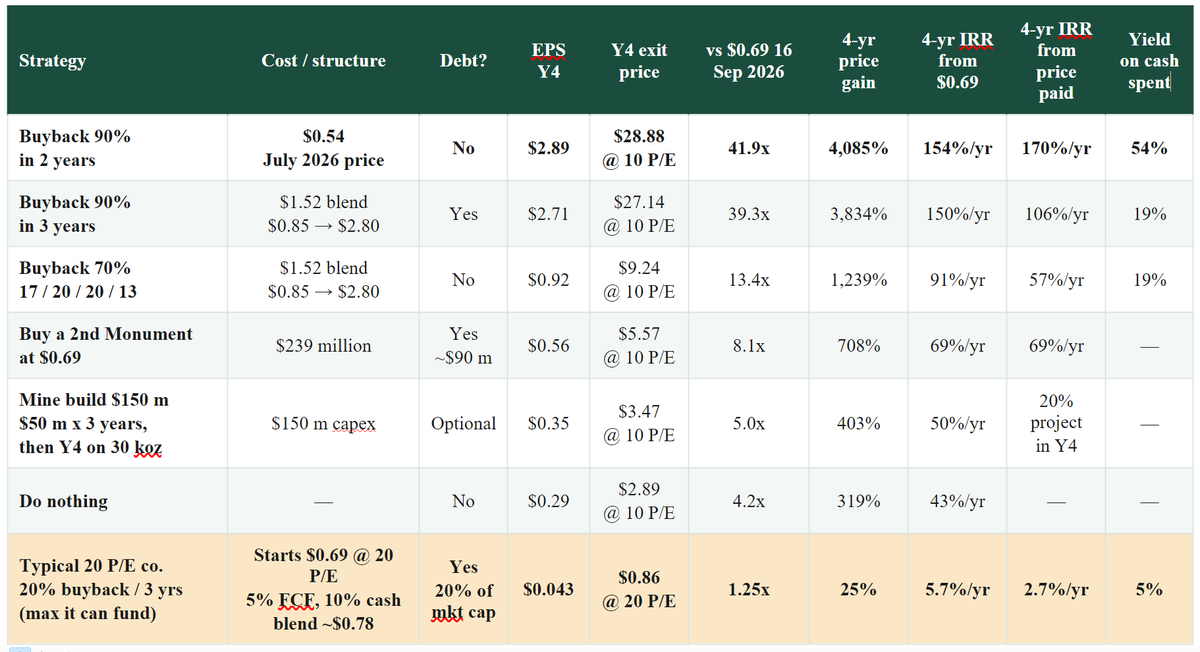
An investment fund has taken a position in $MMTMF Monument Mining and is advocating in a Seeking Alpha article that Monuments do agressive stock buybacks, they say-- "In regards to Monument trading at one times earnings, a wise management or board would be buying back shares aggressively in order to increase the value for remaining shareholders. Unfortunately, many managers still focus on the gross dollar amount of net income and shareholder equity and think their job is to increase those two figures. That is not the optimal way to look at it. The optimal way to look at it is to recognize that the manager's job is to increase intrinsic value per share. If one is focused on increasing shareholder equity, a stock repurchase makes no sense. After all, a repurchase reduces shareholder equity, the metric they are focused on increasing. When managers are focused on increasing per share value, they recognize that buying back stock below intrinsic value is massively accretive to remaining shareholders." Monument Mining: An Absurdly Low Valuation And Substantial Value For Shareholders | Seeking Alpha https://t.co/33WrGRfyRI
This lines up with my article here on X and shareholder resolution to bring about buybacks here: Darp101 on X: "Monument Mining Buyback Proposal: $MMY.V $MMTMF A comparison of investing cash into Monument's own shares versus building a new mine in Australia or buying another producer. This is the bottom-line chart. The complete report is attached. A path to a 40-bagger is feasible." / X