🤯BREAKING: Researchers just mathematically proved that AI layoffs will collapse the economy: and every CEO already knows it.
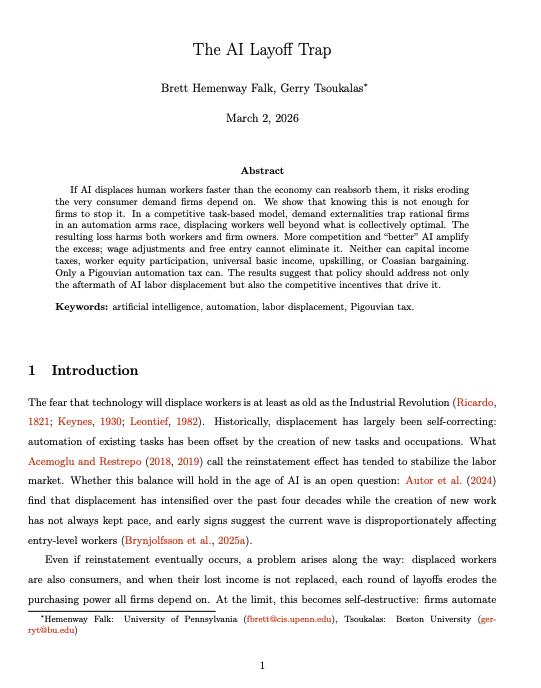
The AI Layoff Trap. A game theory paper from UPenn + Boston University is glaringly important!
100K+ tech layoffs in 2025. 80% of US workers exposed. And no market force can stop it.
��� Every company fires workers to cut costs
→ Every fired worker stops buying products
→ Revenue collapses across every sector
→ The companies that fired everyone go bankrupt
It's a Prisoner's Dilemma with math behind it. Automate and you survive short-term. Don't automate and your competitor kills you. But everyone automating destroys the demand that makes all companies viable.
UBI (universal basic income) won't fix it.
Profit taxes won't fix it.
The researchers found only one solution: a Pigouvian automation tax "robot tax"
The AI trap on the economy is here!
Best GitHub Repos to Learn AI From Scratch in 2026:
1. Andrej Karpathy – Neural Networks: Zero to Hero
https://t.co/JncqiOajt0
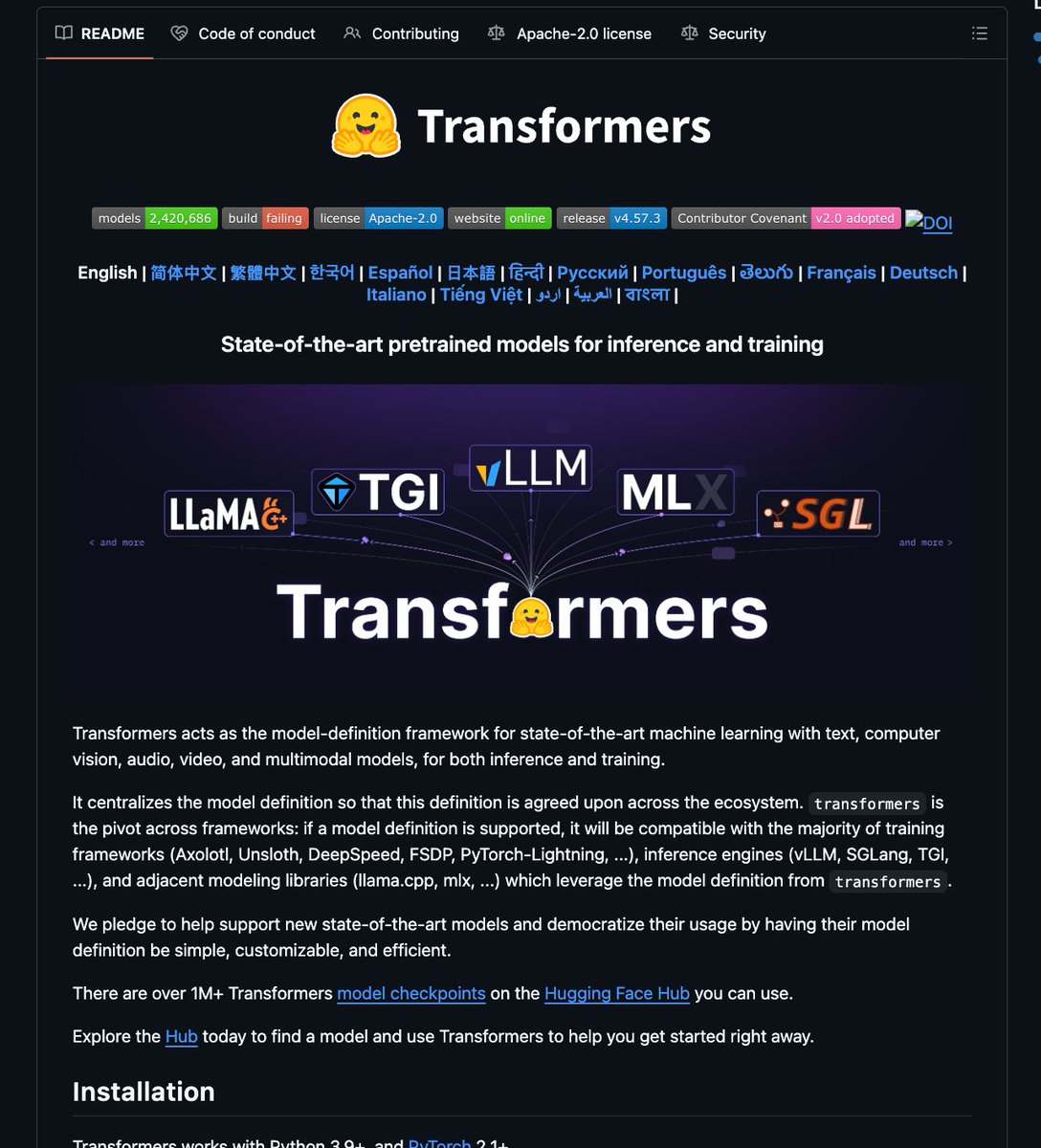
2. Hugging Face Transformers
https://t.co/BxWihIjLVS
3. FastAI/fastb
https://t.co/jIXKI5RJEx
4. Made-With-ML
https://t.co/X1onmkUV3A
5. ML System Design
https://t.co/w0sfzvTNCN
6. Awesome Generative AI guide(
https://t.co/nnDwR5VSja
7. Dive into Deep Learning
https://t.co/O9dlGrK3G9
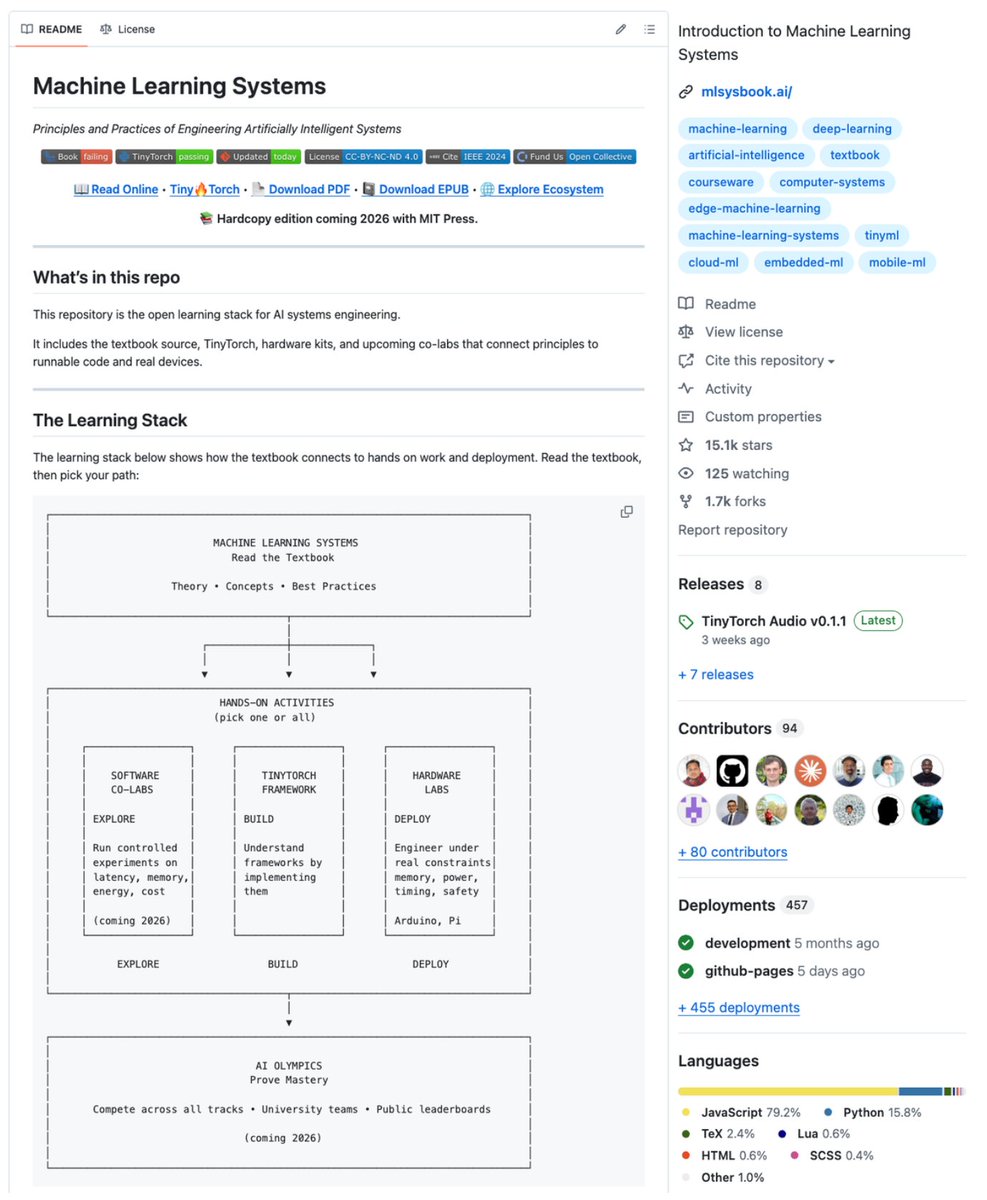
Harvard just open-sourced an entire ML Systems curriculum.
The complete learning stack for AI engineering:
- A textbook
- TinyTorch (build ML frameworks from scratch)
- Hardware kits for Arduino and Raspberry Pi
- Notebooks connecting theory to runnable code
100% open-source.
Training massive LLMs used to be painfully slow, but not anymore!
DeepSpeed is an open-source deep learning optimization library that makes it easy to train and fine-tune models that would otherwise be too large, too slow, or too expensive.
It powers many state-of-the-art LLMs and brings the kind of system-level optimizations needed for massive training runs.
ZeRO (Zero Redundancy Optimizer) is the core of DeepSpeed. It partitions optimizer states, gradients, and parameters across GPUs which removes memory duplication and lets you train models far beyond single GPU limits.
Here’s why DeepSpeed matters:
• ZeRO-powered memory optimization for training trillion-parameter scale models
• Up to 10x faster training through kernel optimizations and parallelism techniques
• 3D parallelism combining data, tensor, and pipeline parallel training
• Inference optimizations that reduce latency and memory use for serving large LLMs
• Works with PyTorch and slots directly into existing training loops
DeepSpeed handles the engineering complexity behind distributed training so you can run larger models, bigger batches, and faster iterations without restructuring your codebase.
It is 100% Open Source
Link to the Github Repo in the comments!
The 5 Levels of AI Agents
Lets explore the 5 levels of AI Agents, from simple to complex. Always start with level 1 and add complexity as needed.
Level 1: Agent with tools and instructions. When people say agents are just LLM + tool calls in a loop, this is what they mean (this also tells you their level of understanding).
Instructions "teach" the Agent how to achieve its task and tools let Agents interact with external environments to push or pull data. Here's an Agent that helps developers build Agents using Agno (so clean 🤩)
Level 2: Agent with knowledge and storage. Rarely does a model have all the information it needs to achieve its task and we obviously can't jam everything in the context, so we give the Agent knowledge that it searches at runtime (i.e Agentic RAG or Dynamic few-shot).
Knowledge search needs to be hybrid (full-text and semantic). Hybrid search + reranking is the best out-of-the-box Agentic Search strategy you can use.
Storage saves the Agent's state in a database. LLM calls are "stateless" and storage makes Agents "stateful" by storing messages in a database and adding them to the current call as needed.
If you're using chatgpt, storage is what lets us continue the chat after closing the tab and each chat thread that you see on the left navbar is a "session" in storage.
Storage also saves the session state (very useful) but that's for another day. Here's how knowledge & storage look like in code:
Level 3: Agent with memory and reasoning. Memory let's an Agent remember details about a user and personalize its responses across sessions. This is a fairly new concept that everyone is still exploring. The part of memory im the most excited about is "self-learning", more on this soon.
Reasoning is a key feature that every agent builder should know when and how to use. The biggest problem with Agents is that the success rate of an agent decreases with the number steps the agent needs to take. Eg: if success rate of 1 step is 90%, average success rate of an agent that needs to take 5 steps (across 1000s of runs) is ~60%. This is no good.
Reasoning architectures not only improve cognitive reasoning (understanding of data and instructions) but also improves the success rate of each step. By taking a hit on cost and latency, we can improve the overall performance. Here's how you can add memory and reasoning to an Agno agent:
Level 4: Multi Agent Teams. Agents work best when they have a narrow scope (i.e. specialized to a domain) and a reasonably small set of tools (<10 ish). By putting agents together in a team, we can increase the overall capabilities and solve broader, more complex problems.
Remember to add reasoning, otherwise the Team leader struggles to work on complex tasks. Note: my current (2025) belief is that autonomous multi-agent teams don't work. They work <1/2 the time and thats no good.
As models get better and capabilities improve, this is the level im most excited about, but at the moment autonomous multi-agent systems remain an area of research and experimentation only.
Agno comes with an industry leading multi-agent architecture that supports 3 modes of execution: coordinate, route and collaborate with the ability to automatically manage agentic memory and context. Here's an example:
Level 5: Agentic Systems. APIs (i.e. servers) that take in a request, asynchronously and reliable complete the task and stream back the result. These are hard, very hard - when the request comes in we need to save the state in a database and trigger an async job (background task in FastAPI) and stream the results back as they're ready. Websockets can work here, but they are not an each tech to work with.
Agentic systems is where the $ is and what everyone is trying to build. We've put out the Agent API, Agent UI and detailed documentation on how to build them. I hope to write more on this to help AI engineers build better systems.
Thank you for reading, I should probably turn this into a blog post. If you liked reading this, please let me know and consider starring Agno: https://t.co/SxiAqHQGsx
If you're interested in building Agents, you can read more on our docs: https://t.co/WUTRv7IuFr
Final parting words: AI Engineering is Software Engineering. Keep it simple and things become a lot easier.
Thanks,
Ashpreet
Introducing Agentic Object Detection!
Given a text prompt like “unripe strawberries” or “Kellogg’s branded cereal” and an image, we use an agentic workflow to reason at length and detect the specified objects. No need to label any training data. Watch the video for details.
Here is why you need to understand 𝗔𝗴𝗲𝗻𝘁𝗶𝗰 𝗥𝗔𝗚 as an AI Engineer.
Simple naive RAG systems are rarely used in real world applications. To provide correct actions to solve the user intent, we are always adding some agency to the RAG system - it is usually just a bit of it.
It is important to 𝗻𝗼𝘁 𝗴𝗲𝘁 𝗹𝗼𝘀𝘁 𝗶𝗻 𝘁𝗵𝗲 𝗯𝘂𝘇𝘇 𝗮𝗻𝗱 𝘁𝗲𝗿𝗺𝗶𝗻𝗼𝗹𝗼𝗴𝘆 and understand that there is 𝗻𝗼 𝘀𝗶𝗻𝗴𝗹𝗲 𝗯𝗹𝘂𝗲𝗽𝗿𝗶𝗻𝘁 to add this agency to your RAG system and you should adapt to your use case. My advice is to think in systems and engineering flows.
Let’s explore some of the moving pieces in Agentic RAG:
𝟭. Analysis of the user query: we pass the original user query to a LLM based Agent for analysis. This is where:
➡️ The original query can be rewritten, sometimes multiple times to create either a single or multiple queries to be passed down the pipeline.
➡️ The agent decides if additional data sources are required to answer the query.
𝟮. If additional data is required, the Retrieval step is triggered. In Agentic RAG case, we could have a single or multiple agents responsible for figuring out what data sources should be tapped into, few examples:
➡️ Real time user data. This is a pretty cool concept as we might have some real time information like current location available for the user.
➡️ Internal documents that a user might be interested in.
➡️ Data available on the web.
➡️ …
𝟯. If there is no need for additional data, we try to compose the answer (or multiple answers or a set of actions) straight via an LLM.
𝟰. The answer gets analyzed, summarized and evaluated for correctness and relevance:
➡️ If the Agent decides that the answer is good enough, it gets returned to the user.
➡️ If the Agent decides that the answer needs improvement, we try to rewrite the user query and repeat the generation loop.
✅ Remember the Reflection pattern from my last Newsletter article? This is exactly that. 👆
The real power of Agentic RAG lies in its ability to perform additional routing pre and post generation, handle multiple distinct data sources for retrieval if it is needed and recover from failures while generating correct answers.
What are your thoughts on Agentic RAG? Let me know in the comments! 👇
#RAG #LLM #AI
The India AI Mission is a major step toward building AI capabilities, ensuring digital inclusion, and driving economic growth.
Here’s how India is shaping the future of AI.🧵
I started my first AI influencer in September.
September: $159
October: $693
November: $2,421
December: $3,890
January: ??
Here's a one-minute guide on how to do (even if you have no idea)
Open Thread ↓↓
Like everyone, I've been a bit distracted exploring @deepseek_ai R1 and experimenting with it locally.
I've spoken to a few people recently who don't know how to run local LLMs - this thread will cover a few different tools to get up and running easily.
Save time and boost efficiency! 🚀 Lazy Predict lets you train and evaluate multiple ML models simultaneously—no tedious coding needed. Perfect for quick insights and model selection. Check it out: https://t.co/qMXDAN5plm #MachineLearning#LazyPredict