We give traders what every professional deserves: a fair path to scale.
No shortcuts: just verified risk-adjusted performance and the opportunity to earn.
Every record has a worst drawdown. Investors expect it.
What they're bothered about, is what happens next.
An orderly recovery, with steady risk (no revenge sizing), tells them the process held under stress. A frantic bounce back on doubled risk tells them the opposite, even if the curve ends up in the same place.
When someone is deciding whether to back you, the only real sample they have of how you behave under pressure is the last time the market went against you.
So the questions get specific:
- Were you expecting to lose money in that environment, or did the loss surprise you?
- Did your position sizing change while you were underwater?
- Did the trade frequency spike?
- Did some part of the strategy quietly become a different strategy?
None of that can be reconstructed afterwards. It is either in the record or it is not, which is exactly why the recovery carries more weight than the depth.
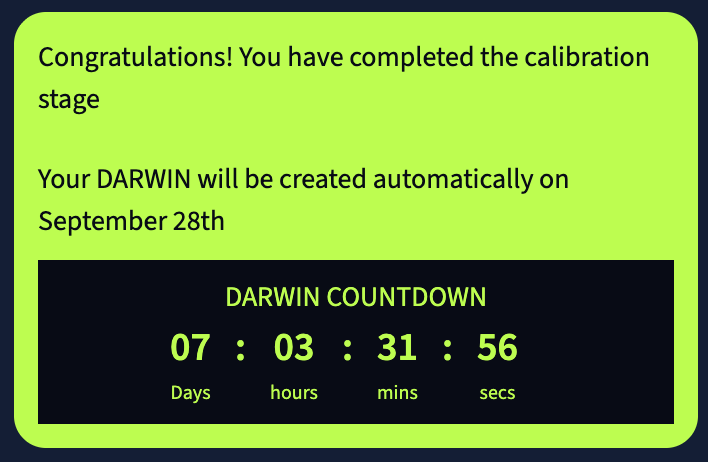
Calibration phase is done @DarwinexZero
Expecting to launch my Darwin with a bang, running about +3% for September atm on the signal account.
Let's see what the Darwin itself will have in store next week.
Steady growth as a trader won't always look or feel like it.
Steady growth includes periods of highs and lows and can happen over a long-period of time.
But "steady" growth is the one type of growth that can't be taken away from you easily.
Focus on the long-term.
If someone is selling a trading course, mentorship or education based on their ability as a trader, I think asking for a verified track record is completely reasonable.
A track record does not automatically make someone a great teacher and it does not guarantee future performance. But it answers one very important question: Can this person actually do what they are teaching me to do?
If you ask for proof and they immediately become defensive, attack you for asking or constantly find ways to avoid providing any evidence, I would consider that a serious red flag.
Maybe they have a legitimate reason. Listen to it and decide whether you are satisfied with the explanation.
But never feel guilty for asking.
There is a major conflict of interest in the trading education industry: someone can potentially make far more money selling the dream of trading than actually trading. Verified performance removes a lot of that uncertainty.
I’m writing this because one of my biggest regrets in my trading journey is that I didn’t start learning ONLY from verified traders earlier. It could have saved me a lot of pain, wasted time and losses. Be very careful who you learn from in this space. There are simply too many conflicts of interest.
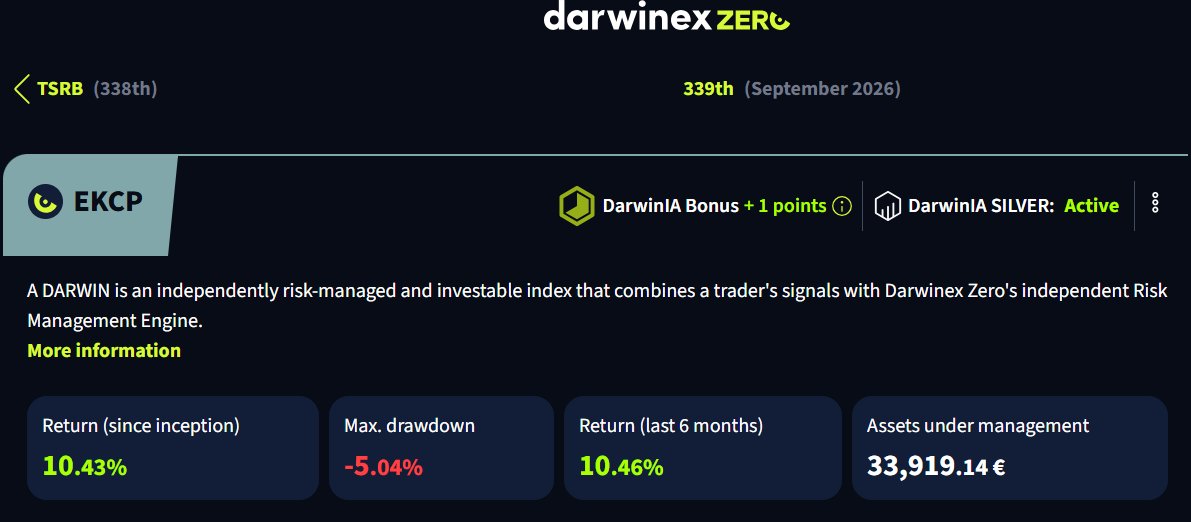
A DARWIN is the "wrapper" that allows your trading to become an asset that an investor can trade.
Your strategy is rebuilt on standardised risk, so what an investor buys is the edge + Darwinex risk management.
Investors hunting for diversification are not really buying your average return; they are buying how your strategy behaves in the stretch where everything else they own moves together.
The uncorrelated month is the USP.
Which is why a hard period you came through cleanly can be worth more than years of calm ones.
2nd accounts with @DarwinexZero , halfway to Darwinia Gold! Lets see if we can continue in this pace, even though its supposed to only be a bot trading on it, we have had some good opportunities in the markets recently that i wanted to capitalize on with this account aswell.
Duration Ratio measures the time you spend in winning positions relative to losing ones.
A trader who runs winners and cuts losers shows one profile. A trader hoping losers come back shows another.
VaR estimates the loss a strategy should expect on a bad day, at a stated confidence level.
Its real use is comparison. A slow trend book and a fast intraday book look nothing alike until you read both through the same VaR.
Risk-adjusted, on one axis. That is the view an investor works from.
A serious investor is always going to look past just the equity curve of your account. They want to understand your sizing.
They want to know when you pressed into a position and when you held back. Is your risk able to be modelled moving forward or does it look more like mood swings and behavioural swings?
The curve is only an indication of what happened but taking a look at sizing and value at risk tells them whether something is going to happen again, which is the question they want answered.