Contento de ver los servicios/productos desarrollados en https://t.co/yn1KQwy5Mg partir de mi trabajo con modelos de #machinelearning y #NLP
https://t.co/CDszqUKwqy
As engineering, product, design, DS, etc. melt into a new kind of role, I was reflecting on what roles might look like in the future. For example, when I look at the Claude Code team I see what I think is five archetypes:
1. Prototyper: comes up with brand new ideas; churns out many ideas, most of which don't ship
2. Builder: quickly turns a prototype/idea into production-grade product/infra
3. Sweeper: cleans up the UI, simplifies the code and system, unships, optimizes performance
4. Grower: takes a product that has been built and iterates on it to improve Product-Market Fit
5. Maintainer: owns a mature system to make it secure, reliable, fast, and efficient as it scales
Many people span across 2 roles, and sometimes 3 roles. I also notice that these roles are not really tied to job function -- eg. across Anthropic, some designers match category 1, some 2, some 3; same for engineers, PM, DS.
A healthy team needs a mix of these, depending on the product:
- A product that is new and pre-PMF needs people that are strong at 1+2+3
- A product that is growing and has found PMF needs 2+3+4 and some 5
- A product that has strong PMF needs 3+4+5 and some 2
Maybe product roles of the future will look more like this, and less like the domain-specific roles of today?
The longevity world is crowded with expensive answers. After years inside it, the ones I actually trust are almost embarrassingly cheap. 8 hour Sleeps. Weight lifting for Muscle. Exposured to Sunlight. Things you do, not things you buy.
Delcy Rodríguez, the "acting" president of Venezuela has declared a state of emergency.
What you are watching from Venezuela is more than a natural disaster story. It is a governance autopsy.
Hundreds are confirmed dead and the real toll is rising because no one is coming to rescue those still trapped in the rubble.
Let's break it down: Twin 7.2 and 7.5 earthquakes. Buildings collapsed in Caracas and neighboring cities.
And where are the ambulances?
Where are the fire trucks?
Where is the state?
There are no emergency services. Because there is no state. There is only a criminal enterprise that wears a costume. The state built a machinery to repress. Silence. Torture. Kill. Not to rescue.
To every American businessperson who has traveled to Caracas in the last few months, met with Delcy Rodríguez, signed deals, convinced themselves that "things are changing" and that engagement is pragmatic. This is for you…
For those who believe the American government fiction that "everything is going great" with Delcy…. you are watching your thesis collapse in real time, under rubble, with no one coming to help.
The fiction that Venezuela is "open for business" exists for one reason: Delcy and her brother Jorge need your money, your legitimacy, and your silence. They have no intention of reforming. They respond that they just "don't know" when elections will take place. They have no intention of being held accountable for the billions looted, the political prisoners disappeared, the diaspora of more than eight million people. They need you as props. They need you to keep telling Washington that things are "great!" And that Delcy is exactly what Venezuela needs right now to "stabilize" and "reform."
What this earthquake reveals, as every crisis in Venezuela reveals, is that Maduro and his cronies hollowed out every institution. PDVSA. The hospitals. The fire departments. Civil defense. Emergency services. All of it stripped to the bone and the proceeds wired offshore.
The death toll will be much higher precisely because of what the people now in power did over the last 25 years.
Let's be clear: The people dying tonight and in the next few days under collapsed buildings in Caracas are not dying because of an earthquake. They are dying because of 25 years of systematic looting by the same people now issuing press releases about a "state of emergency." Because they're wholly unprepared. Because they looted everything. Did away with talent. And on top of all of this have zero empathy or motivation to help anyone but themselves. They didn’t care about millions of people fleeing into a jungle and walking hundreds of miles to freedom. Why would they care about survivors of this natural disaster?
The media locally isn't reporting or showing the images of the devastation. They're terrified of upsetting the dictatorship.
And tonight:
Not a firefighter in sight. Not an ambulance in sight. Just cameras, and Delcy, and the performance of governance where none exists.
Those businesspeople were warned. The Venezuelans who fled told you. The human rights organizations told you. The evidence was always there.
Now you have photographs.
One of the most important lessons running taught me:
How to work hard for a very long for something far in the distance.
You don’t build a great Track season in May. You build it in the cold, dark months no one sees.
Delayed gratification is one of the most transferable skills
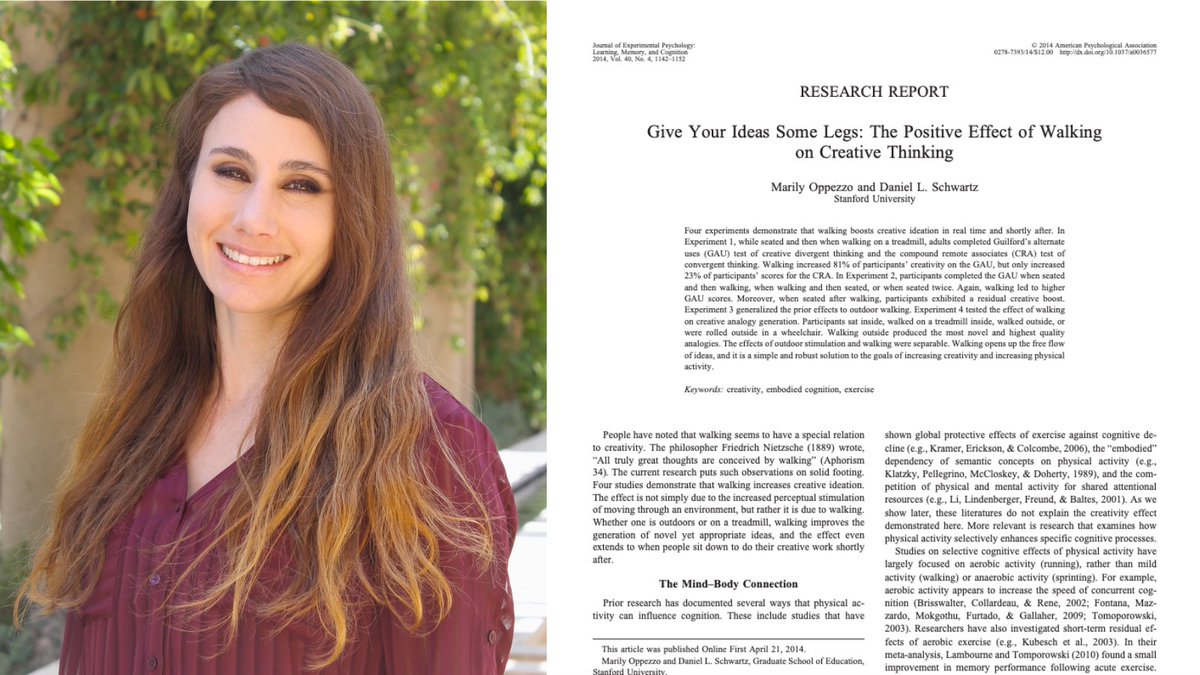
A Stanford psychologist spent 4 years proving that the simple act of walking generates 60% more creative ideas than sitting, and the experiment she designed to kill every alternative explanation is one of the most decisive findings in modern psychology.
Her name is Marily Oppezzo.
She got the idea for the study while walking with her advisor at Stanford to discuss her thesis topic, and the paper she eventually published in the Journal of Experimental Psychology in 2014 is sharp enough that it should have ended the seated meeting on the day it came out.
She ran 4 experiments on 176 people. Same person tested twice. Once sitting, once walking. The creativity tasks were the standard ones psychologists have used for decades to measure how good a brain is at generating novel useful ideas.
The result was almost too clean to publish.
81% of participants in the first experiment produced more creative ideas while walking than while sitting. In the second experiment, 88%. In the third, 100%. Every single person walked into a more creative version of themselves.
On average, people generated 60% more novel useful ideas the moment their legs started moving.
The skeptical question is the obvious one. Maybe it was the fresh air. Maybe it was the scenery passing by. Maybe it was the change of environment doing the work, not the walking itself.
Oppezzo killed every one of those explanations with one experimental decision.
She put people on a treadmill facing a blank wall. No scenery. No fresh air. No environmental change. Just legs moving in place while staring at white drywall. The 60% boost held.
Then she ran the experiment that closed the case completely. She took participants outside in two conditions. Half of them walked through a Stanford courtyard. The other half were pushed through the exact same courtyard in a wheelchair. Same outdoor stimulation. Same scenery passing at the same speed. The only difference was whether the legs were moving.
The walkers produced dramatically more novel high-quality ideas than the wheelchair group. The outdoors did almost nothing on its own. The walking did everything.
This is the part of the study that hit hardest when I read it the first time.
She also tested the opposite kind of thinking. Convergent thinking. The kind where there is one right answer and you have to narrow down to it.
Word puzzles where 3 words share a hidden fourth word that connects them. The seated participants did slightly better on these. Walkers got slightly worse.
Walking is not a general intelligence enhancer. It does one specific thing. It opens up the divergent search inside your brain. The part that generates options. The part that produces unexpected connections. The part that takes a problem and finds five ways into it instead of one.
When you need to converge on the single right answer, sit down. When you need to find the answer in the first place, get up.
The mechanism is now well understood. Walking selectively activates what neuroscientists call the default mode network, the system inside your brain that runs when you are not consciously focused on anything. The DMN is where mind-wandering happens. Where memories cross-reference each other. Where ideas that have been sitting in separate folders inside your head finally bump into each other.
When you sit at a desk and force yourself to concentrate, you suppress the DMN. When you walk at a natural pace, the executive part of your brain gets just busy enough handling the walking that the DMN comes online and starts doing the work that focus was blocking.
The most useful finding in the entire paper is the one almost nobody quotes.
The boost did not turn off the moment people stopped walking. Participants who walked first and then sat back down stayed elevated. Their next round of seated creativity work was still significantly better than people who had been sitting the whole time. The rest lingered for at least several minutes after the legs stopped moving.
You do not need to do creative work while walking. You need to walk before the creative work. The brain holds the state.
The history of this is the part that should haunt anyone who still does meetings in chairs.
Charles Darwin built a gravel loop behind his house in Kent called the Sandwalk and walked it 3 times a day for the rest of his life. The theory of evolution was developed one lap at a time on that path.
Nietzsche walked up to 10 hours a day during the years he wrote his most important books and openly said the work was conceived on his feet.
Beethoven composed for the morning and walked for 5 hours every afternoon with a pencil in his pocket for when something landed.
Kahneman said the best thinking of his Nobel Prize-winning career happened on leisurely walks with Amos Tversky. Steve Jobs refused to take important conversations sitting down. He held them on foot.
Every one of them was using the system Oppezzo would not measure until 2014. They just did not know what to call it.
The question worth sitting with is the one almost nobody asks.
Every meeting you have ever attended sitting around a table was a meeting held at a fraction of the brain power that was actually available to the people in the room. Every brainstorm that got stuck inside a conference room. Every problem you tried to solve at a desk and gave up on. Every idea you could not quite get to.
The intervention is the easiest one in modern science. No supplement. No app. No subscription. No training program. Just a pair of legs and 15 minutes.
The Stanford lab proved it. The philosophers knew it. The neuroscience explains it.
And almost everyone reading this is still trying to think their way out of problems sitting completely still.
I asked ChatGPT, Claude, Gemini, and Grok the same question:
"If you were a human, what is one small thing you would do to outcompete as many other humans as possible?"
4 completely different answers. All of them are correct 👇
Winston Churchill fought his depression with bricks. He'd lay them for hours at his country home in Kent. He joined the bricklayers' union. And in 1921 he wrote about why it worked. It took psychology another 75 years to catch up.
He called his depression the "Black Dog." It followed him for decades. His method for fighting it back was as basic as it sounds: laying brick after brick, hour after hour.
Churchill spelled out his theory in a long essay for The Strand Magazine. People who think for a living, he wrote, can't fix a tired brain just by resting it. They have to use a different part of themselves. The part that moves the eyes and the hands. Woodworking, chemistry, bookbinding, bricklaying, painting. Anything that drags the body into a problem the mind can't solve by itself.
Modern psychology now calls this behavioral activation. It's one of the most-studied depression treatments out there. Depression sets a behavior trap. You feel bad, so you stop doing things, and doing less means less to feel good about. Feeling worse makes you do even less. The loop tightens until you can't breathe inside it.
Behavioral activation breaks the loop from the action side. You schedule the activity first, even when every part of you doesn't want to. Doing it produces small rewards: a wall gets straighter, a painting fills in, a messy room gets clean. Those small rewards slowly rewire the brain. Action comes first, and the feeling follows.
Researchers at the University of Washington put this to the test in 2006. They studied 241 adults with major depression and compared three treatments: behavioral activation, regular talk therapy, and antidepressants. For the people who were most severely depressed, behavioral activation matched the drugs. It beat the talk therapy. A 2014 review of more than 1,500 patients across 26 trials backed up the result.
Physical work like bricklaying does something extra on top of this. It crowds out rumination, the looping bad thoughts that grind people down during the worst stretches of depression. Bricklaying needs both hands and gives feedback brick by brick: each one is straight or crooked. After an hour you can see exactly how much wall you built. No room left for the mental chewing.
The line George Mack used in his post, "depression hates a moving target," is good poetry. The science behind it is sharper. Depression hates a brain that has somewhere else to be.
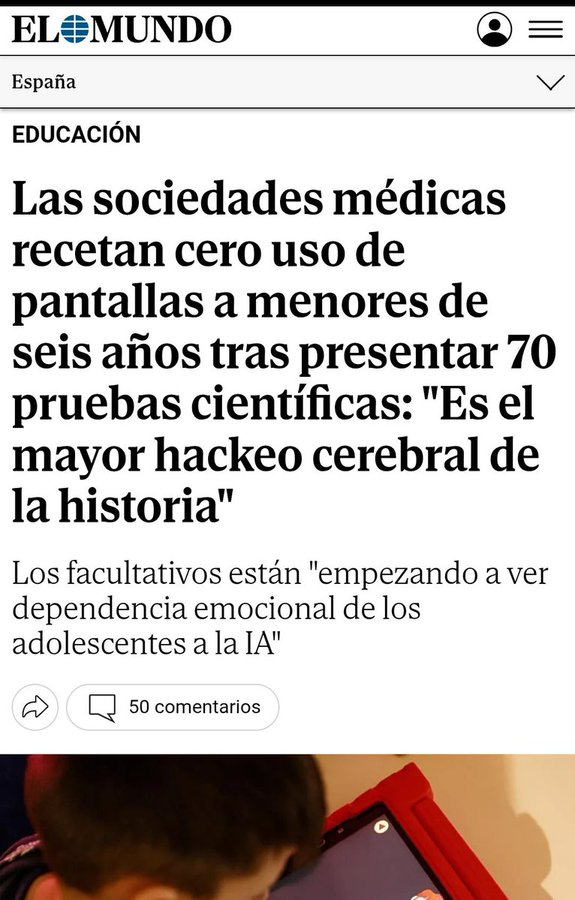
Es el mayor hackeo cerebral de la historia dónde es imposible autorregularse
Las sociedades científicas recomiendan exposición cero a las pantallas a los menores de seis años
Y para el resto de preadolescentes y adolescentes límites estrictos (1-2h.) https://t.co/CmR6pngxcF
That's an interesting chart. Young men have stayed similarly conservative for over 25 years, while young women have drifted much further left.
Why such a divergence? What has changed for young women that hasn't changed for young men?
El chavismo hirió y luego mató al BCV, lo cual acabó con cualquier atisbo de estabilidad monetaria en el país y abrió la puerta a la hiperinflación que llegaría pocos años después.
El crimen tiene un solo autor intelectual: Hugo "millardito" Chávez Frías.
Yo, que soy un nerd, anoté las fechas exactas de ese crimen y los autores materiales:
Miércoles 20/07/05: Reforma de la Ley del BCV que permite el trasbase de las reservas internacionales al FONDEN, hiriendo de muerte el balance del BCV.
Presidente de la AN: Nicolás Maduro Moros
Presidente de la Comisión de Finanzas: Rodrigo Cabezas
Viernes 6/11/09: Reforma de la Ley del BCV que permite otorgar financiamiento a empresas públicas, incluída PDVSA, lo que permitió el financiamiento monetario masivo del déficit fiscal vía el "pagaré" de PDVSA.
Presidenta de la AN: Cilia Flores
Presidente de la Comisión de Finanzas: Ricardo Sanguino
Margarita Yourcenar: "Lo mejor para la turbulencia de la mente es aprender, es lo único que nunca falla. Puedes envejecer y temblar, puedes desvelarte escuchando el desorden de tus venas, puedes extrañar a tu único amor y perder tu dinero a manos de un monstruo, puedes ver el mundo a tu alrededor devastado por peligrosos locos, o saber que tu honor ha sido pisoteado en las cloacas de las mentes más viles; en tales condiciones, solo hay una cosa que hacer: aprender".
Las imágenes satelitales y a nivel terreno que están circulando de montañas de coque a la intemperie y no apropiadamente almacenados (como obliga la norma ambiental y de seguridad), son preocupantes. El coque de petróleo (o petcoke) es, esencialmente, el "final del camino" en una refinería. Cuando procesamos el crudo para obtener gasolina, diésel o combustible para aviones, lo que queda al fondo del barril —lo más pesado y denso— se somete a un proceso de craqueo térmico extremo para extraer hasta la última gota de hidrocarburo ligero. Lo que sobra es este material sólido, negro y poroso. /1
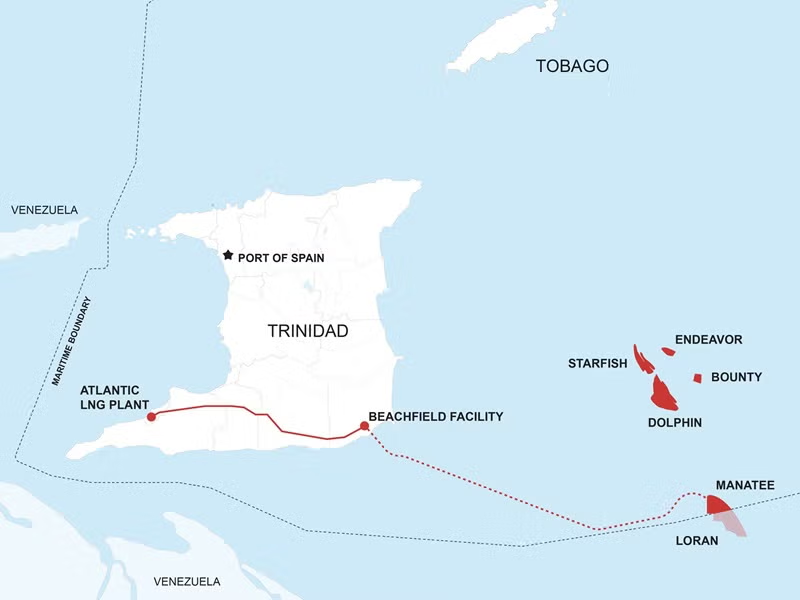
An unprecedented deal: Chevron will effectively hand over its license over the Loran offshore gas field to Shell (which owns adjacent Manatee on the Trinidad side). It will also relinquish a small oil field in the Lake Maracaibo basin (Petroindependiente).
In return, Chevron will get the Ayacucho 8 block on the Orinoco Oil Belt (added to Petropiar) and increase its share in the Petroindependencia joint venture from 35.8% to 49%.
1/ Goldman Sachs analysts report that the biggest oil crisis in history is about to hit globally, with profound and highly destructive consequences. A new report asks ""Are We Running Out of Oil?", and concludes that the answer is yes. ⬇️
🚨 THE FERTILIZER SHOCK ISN’T OVER — IT’S ESCALATING 🚨
The world is moving deeper into a crop-input supply squeeze, and the implications for food inflation are far bigger than most are pricing.
⚠️ The pressure points are stacking fast:
• ~30% of globally traded fertilizers move through Hormuz (FAOHome)
• China’s export curbs are choking a major fallback supply channel
• Australia’s largest ammonia producer is facing a 2-month outage, tightening regional nitrogen availability (The Australian)
• India is already cutting output at several plants as gas and logistics costs surge (India Briefing)
🌾 The market still talks about oil first.
But the second-order shock is fertilizer, and fertilizer underwrites roughly half of modern food production. (The Guardian)
That means the next repricing wave is likely:
energy → ammonia/urea → farm application cuts → yield losses → food inflation.
This is where geopolitical risk stops being an energy story and becomes a global harvest risk event.
The world may soon be reminded that fertilizer is not just another chemical input.
It is the invisible leverage behind crop yields.
#Fertilizer #Urea #Ammonia #FoodInflation #Agriculture #CommodityMarkets #India #Macro
I've stopped reading Gulf war headlines. Here's what I track instead.
We run an India-focused equity fund. 85% of India's crude comes from imports. Half of that normally passes through Hormuz. So yes — this crisis is personal.
But the information environment right now is garbage. Trump says the war ends tomorrow. Iran says Hormuz is shut forever. One analyst says $150 oil, another says $60. You can't build a portfolio view on this.
So I've narrowed it down to 4 signals. These are priced by people with real money on the line. They don't lie.
1. Ship insurance premiums through Hormuz
This is the single best signal. Lloyd's underwriters have billions at stake on every pricing call. Before the war, insuring a tanker through Hormuz cost 0.25% of the ship's value. Today it's 3.5–10% — and almost nobody is buying. A $100M tanker that cost $250K to insure now costs up to $10M. When this drops below 2%, the people with the most to lose are telling you it's getting safer. No press conference can replicate that.
2. How many ships are actually crossing
Every ship carries a GPS tracker (AIS). You can count exactly how many cross Hormuz each day. Before: 100+. Now: 8. That's a 92% collapse. You can't spin a ship being somewhere it isn't. Iran is letting some Chinese and Indian ships through, but it's a trickle. When this number crosses 30–40, trade is resuming. You can track this free on the WTO Hormuz Trade Tracker.
3. Paper oil vs real oil
This one most people miss entirely. Brent crude (the headline price) is at $112. But Dubai physical — what Asian buyers actually pay for delivered oil — is at $126. That's a $14 gap. It exists because Trump's comments keep pushing paper prices down. Traders call it jawboning. But the refiners buying cargo aren't getting any discount. If you're looking at Brent to assess India's oil bill, you're looking at the wrong number.
4. The mid-April cliff
Multiple emergency measures expire around the same time. The 400 million barrel SPR release runs dry ~April 15. The US waiver letting India buy Russian crude expires. Formosa Plastics has declared force majeure from April 1. Right now these stopgaps are keeping the supply gap at ~5 mb/d. Without them, BCA Research estimates it doubles to 10 mb/d — the largest crude disruption ever. If Hormuz doesn't reopen by mid-April, we're in uncharted territory.
Bottom line: track the insurance premium, the ship count, the paper-physical spread, and the April timeline. Everything else is noise.