DataExos is a cloud, AI, and data consultancy & outsourcing partner.
...harnessing data/innovation to improve efficiency, productivity, experiences, & insights
Trusted Infrastructure for Superintelligence
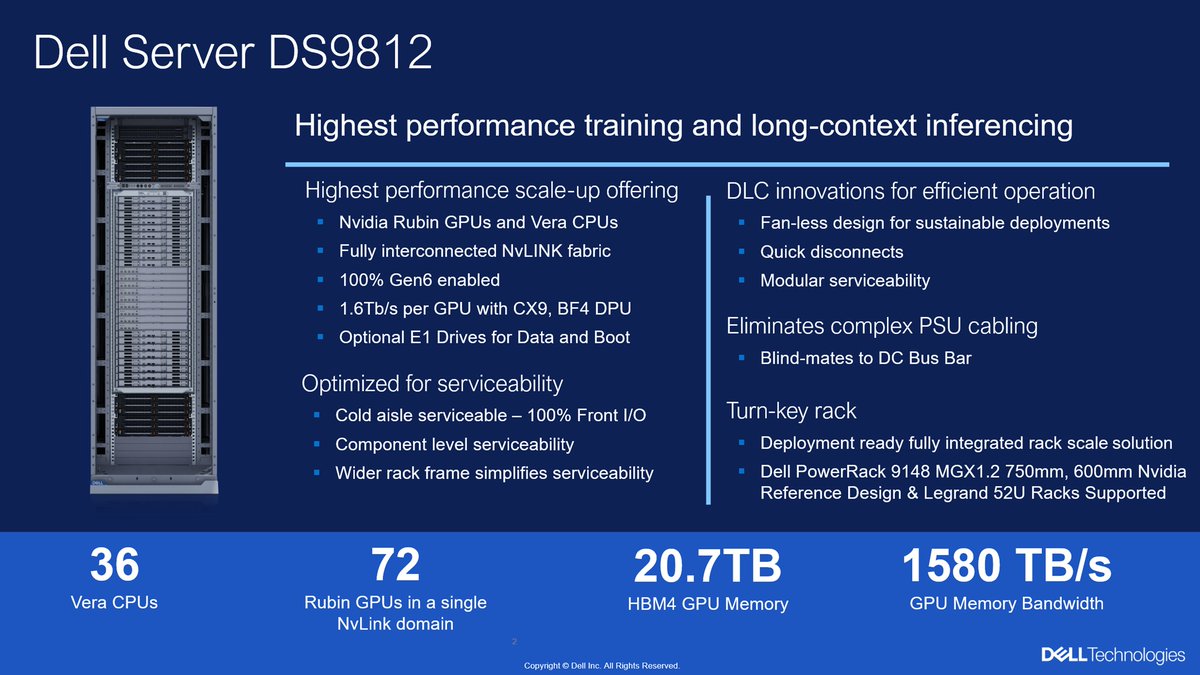
Proud of the @Dell team. The first Vera Rubin NVL72 rack-scale system, fully integrated and shipping in volume. 🚀
Thank you @JensenHuang@nvidia. The pace of this partnership is unlike anything I've seen in 40+ years.
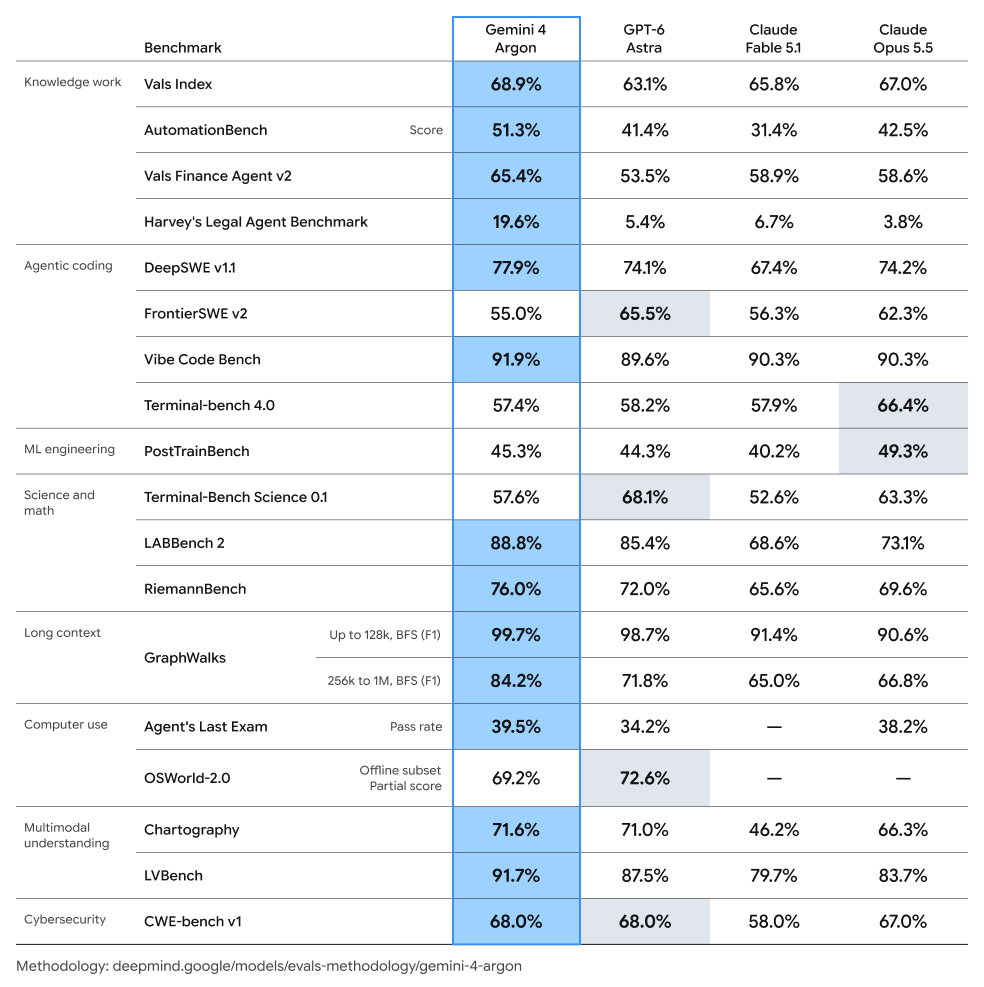
Introducing Gemini 4 Argon – our new frontier model.
It’s built for complex workflows across coding, enterprise knowledge work, and cybersecurity defense – rolling out today to a set of trusted testers through our Fairwind Program.
The White House is testing a different approach to AI governance: voluntary industry commitments backed more by political and reputational pressure than by law.
President Donald Trump said he and major technology leaders signed what he called a “morally binding” AI agreement following a White House luncheon with executives from Nvidia, Meta, Google, Anthropic, OpenAI, Microsoft, Amazon, AMD, Tesla, and others. Speaker Mike Johnson described it as a voluntary statement of principles rather than a legally binding regulatory framework.
That distinction matters.
The administration has consistently emphasized rapid AI development, private-sector collaboration, and voluntary frameworks over mandatory preclearance or licensing requirements for frontier models.
The emerging model appears to be:
→ Industry self-regulation
→ Federal guidance and oversight
→ Stronger safety expectations
→ Continued emphasis on U.S. AI leadership
→ Potential creation of a small oversight committee
The challenge is whether voluntary commitments can keep pace with increasingly capable systems.
Recent debates around frontier-model safety have made one thing clear: AI governance is moving from an abstract policy discussion into an operational question of who is responsible when systems behave unexpectedly.
The real test will not be whether companies agree to principles in Washington.
It will be whether those principles translate into measurable controls, transparent incident response, enforceable internal governance, and consistent behavior when commercial pressure increases.
A voluntary agreement can establish direction.
Trust will depend on execution.
Read: https://t.co/7CgIawkVNP
---
#ArtificialIntelligence #AIGovernance #AISafety #TechnologyPolicy #EnterpriseAI #ResponsibleAI
Google is pushing enterprise AI agents beyond text and voice into real-time visual presence.
Gemini 3.8 Live with Live Avatar is now generally available in Gemini Enterprise, giving organizations the ability to deploy agents with synchronized, near-real-time avatar video alongside live voice interaction.
That opens the door to use cases such as:
→ Customer support agents
→ Sales assistants
→ Branded marketing experiences
→ Guided service interactions
→ Live conversational applications
But the avatar itself is not the important part.
The real value comes from what sits behind it:
enterprise data + workflows + permissions + escalation + governance.
A convincing digital representative is only useful if it can access the right information, act within approved boundaries, and hand off to a human when necessary.
That is why this release matters.
AI agents are increasingly becoming interfaces to the business itself — not just tools sitting beside employees.
And as those interfaces become more human-like, organizations will need to pay even closer attention to disclosure, identity, data access, and trust.
The future of customer-facing AI may be less about “chatting with a bot” and more about interacting with a real-time digital representative of the organization.
Read: https://t.co/eJrbbChxul
---
#ArtificialIntelligence #Gemini #AIAgents #EnterpriseAI #CustomerExperience #ConversationalAI
We’re building Copilot as a new OS for work that spans every model, every form factor, and every task. Today, we’re announcing our biggest update to Copilot to date, bringing four things together:
· Autopilot: proactive and long-running agent built for the enterprise
· Code: build apps with Copilot, hosted inside your company’s tenant
· Home: Chat + Cowork together
· Office: now fully embedded in Copilot (and Copilot embedded in Office, of course!)
Plus, you can invoke Copilot in Teams, and we’re introducing Today, a proactive experience that surfaces the most important information from across M365 without needing to ask for it.
The way we work is changing and so are our workflows. This update brings AI into that flow, from answering a question, to building an app, to getting work done on your behalf.
The U.S.–China AI rivalry may be getting a new layer: shared concern over keeping increasingly capable systems under human control.
During President Xi Jinping’s state visit to Washington, both leaders struck a warm public tone, but there were few visible breakthroughs on the major issues dividing the two countries, including trade, Taiwan, and artificial intelligence. Reuters likewise described the summit as heavy on symbolism and light on substantive breakthroughs.
One line stood out.
Xi said the two countries should work to ensure AI remains “under human control” and act as responsible major powers.
That matters because the U.S. and China are not just competing over who builds the most capable AI systems.
They are also becoming central to questions around:
→ AI safety and control
→ Advanced chips and compute
→ Model access and export restrictions
→ National security
→ Standards and governance
→ The broader geopolitical balance around frontier AI
The tension is obvious.
Both countries want technological advantage. At the same time, both have an interest in avoiding systems that become difficult to control or destabilize critical infrastructure, economies, or national security.
That does not mean strategic competition is going away.
But AI may become one of the areas where competition and coordination have to exist at the same time.
For the two most powerful AI ecosystems in the world, the question may increasingly be not only:
Who leads?
But also:
What rules are necessary when both sides are building systems neither side wants to lose control of?
Read: https://t.co/w47peelqKS
---
#ArtificialIntelligence #USChina #AIGovernance #Geopolitics #AISafety #TechnologyPolicy
Claude has discovered a previously unknown enzyme system hidden in the DNA of bacteriophages. Beside the enzyme’s gene sits a long array of repeating DNA—a structure that looks somewhat similar to CRISPR.
We don’t yet understand what this system does, but only a handful of known systems share its features, and all of them are able to cut, copy, and paste DNA. Historically, the discovery of such programmable systems has helped revolutionize medicine. CRISPR, for instance, is now the foundation of genetic medicines. But it will take much more work to learn what this system does, and whether it can be put to similar use.
Read more: https://t.co/RuEosScSMb
Can our TPUs survive and operate in space? Well, we're going to find out.
Project Suncatcher is hitching a ride aboard @SpaceX's Transporter-18 mission, testing a prototype satellite built in partnership with @planet
One small step for TPUs....
AI is starting to move from a tool attackers use to something closer to infrastructure attacks can run on.
Researchers at Cisco Talos identified a Windows malware tool called CLOSEDQUORUM that queries four different AI models — DeepSeek, Qwen, Mistral, and Gemini — to help decide what action to take on a compromised machine.
That is an important shift.
Earlier AI-enabled malware has mostly used models for things like:
→ Writing code
→ Generating phishing content
→ Automating parts of an attack
CLOSEDQUORUM goes further by using LLM responses as part of the control system itself.
It can query multiple providers, continue operating if one is unavailable, and reportedly has no built-in path for a human operator to issue commands once it is running.
Cisco Talos also introduced CAIRN, an open-source framework designed to identify the technical “fingerprints” left behind when malware integrates with AI services.
The broader implication is straightforward:
AI is beginning to appear inside the execution loop of cyberattacks, not just in the preparation phase.
That raises the stakes for defenders.
Security teams may increasingly need to detect not only malicious code and network behavior, but also the signs of agentic decision-making, model orchestration, and AI-assisted command-and-control.
This is still an emerging category, but it is one worth watching closely.
Read: https://t.co/4Rb25V8Z8Z
---
#ArtificialIntelligence #Cybersecurity #AIAgents #Malware #ThreatIntelligence #AISecurity
OpenAI’s nonprofit arm is putting $40 million behind AI-enabled cancer vaccine research at UNC Lineberger.
The goal is not simply to apply AI to existing cancer data.
It is to create better biological data that can help researchers design more precise personalized cancer vaccines.
UNC researchers will analyze de-identified tumor tissue and immune cells from multiple biobanks to improve AI methods for selecting tumor antigens — the targets used to train a patient’s immune system to recognize and attack cancer cells.
The work will also compare different vaccine formulations in clinical trials involving triple-negative breast cancer.
What stands out to us is the structure of the effort:
→ Generate richer clinical and biological data
→ Use that data to improve AI-based target selection
→ Test the results in real clinical settings
→ Make findings broadly available to researchers worldwide
That is an important reminder that the value of AI in healthcare is often constrained less by the model itself than by the quality, specificity, and accessibility of the data available to it.
Better models matter.
But in fields like oncology, better data may matter even more.
If this work succeeds, the impact could extend well beyond one institution — potentially improving how personalized cancer vaccines are designed across the broader research community.
Read: https://t.co/EVT6Dy0Fhb
---
#ArtificialIntelligence #HealthcareAI #CancerResearch #PrecisionMedicine #OpenAI #UNCLineberger
Introducing Claude Opus 5.5, the first model in our new Claude 5.5 family.
It performs at the level of Claude Fable 5.1 for most tasks, and costs 40% less to run than Opus 5.
Google is making multilingual AI workflows more native inside Gemini Notebook.
A new Output Language setting lets users choose the language Gemini uses for generated content — including chat responses, study guides, documentation, and supported Audio and Video Overviews.
Google lists support for more than 80 languages.
The practical value is straightforward:
A team can keep its source material, project context, and notebook structure in one place while generating outputs for different audiences without treating translation as a completely separate workflow.
That can be especially useful for:
→ Global documentation
→ Internal training
→ Multilingual knowledge bases
→ Regional communications
→ Cross-border collaboration
There is one important limitation: language support is not identical across every Gemini Notebook feature, so teams still need to validate the specific output type and target language they plan to use.
The broader shift is more interesting than the setting itself.
AI workspaces are becoming increasingly configurable around context, workflow, modality, and now language.
That moves them closer to being adaptable operating environments for global teams — rather than just general-purpose chat interfaces.
Read: https://t.co/CotszpjxTU
---
#ArtificialIntelligence #Gemini #GoogleAI #MultilingualAI #KnowledgeManagement #FutureOfWork
AI trust inside the enterprise may depend less on whether people trust AI — and more on whether they trust how their organization uses it.
A new InformationWeek piece makes an important distinction: CIOs cannot credibly promise that AI will never fail, behave unexpectedly, or create new risks. But they can demonstrate that deployments are governed, monitored, and accountable.
That means building confidence through evidence:
→ Documented risk assessments
→ Human oversight
→ Continuous monitoring
→ Transparent incident response
→ Clear ownership of AI decisions
→ Records of what was approved, modified, or rejected
One statistic stood out: 47% of surveyed senior AI decision-makers said their organizations had bypassed their own AI governance process for urgent deployments — despite 98% having formal governance policies.
That is the real trust problem.
A policy is not governance if it disappears under pressure.
And sometimes the strongest signal of responsible AI is not what an organization deploys, but what it deliberately chooses not to deploy. As one expert put it, “Trust is built on visible restraint.”
The takeaway for CIOs and AI leaders is straightforward:
Do not promise certainty. Demonstrate judgment.
Read: https://t.co/qAt6D8PrpP
---
#ArtificialIntelligence #AIGovernance #CIO #EnterpriseAI #ResponsibleAI #DigitalTransformation
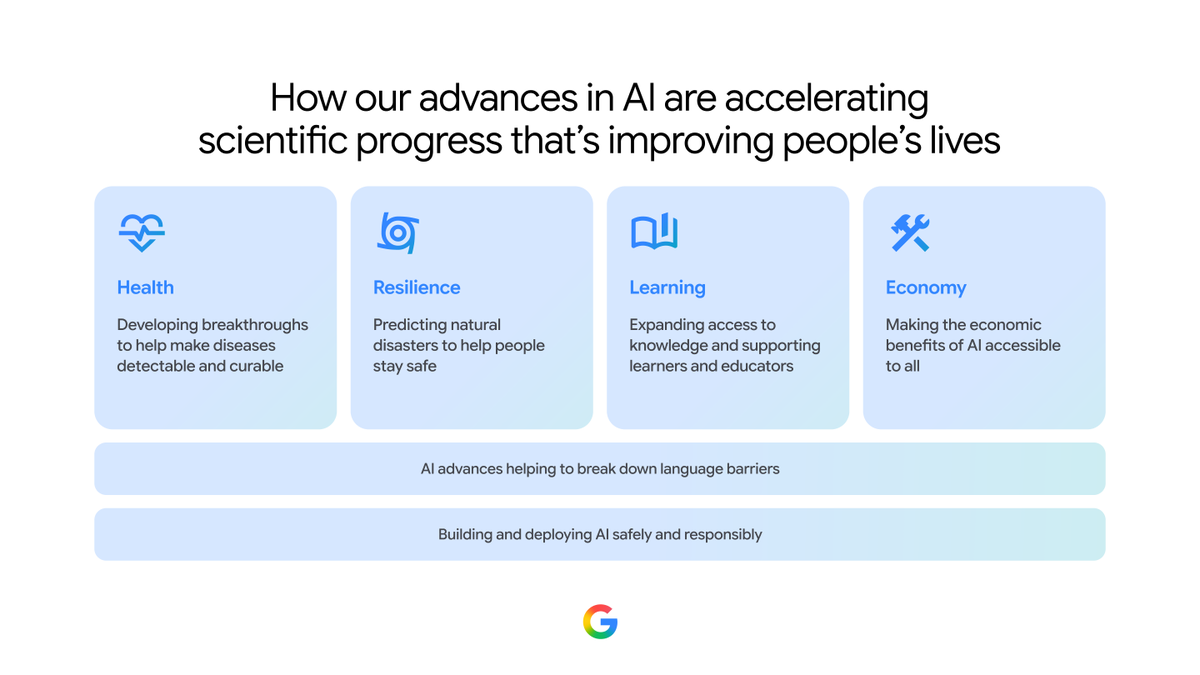
Today we have set out how we’re building AI to accelerate science and improve people’s lives. Just some examples in the last week or so:
- Mapped all 9B possible single letter genetic changes across the human genome with AlphaGenome Atlas and made it openly available to researchers.
- Billions of decisions depend on weather predictions so we introduced WeatherNext 3, our most accurate and capable global weather AI model to date.
- We published AI & Economy ATLAS, a comprehensive open-access look at how people are using AI globally.
- AI has enabled extraordinary advances in language translation. Today our services are available in nearly 300 languages, spoken by 7B people
We’re focusing our efforts on four key areas: health, natural disaster and weather resilience, learning, and economic opportunity. https://t.co/DDKcUTYj54
How can we reconstruct a memory that was never filmed?
Our team paired restored archival photos with pose control models to capture the mannerisms and micro-expressions of Burt and Ethelle.
This helped bring the day they first met to life for Love, Rendered, a new documentary in collaboration with @PrimordialSoup_ and @StorySyndicate_.
Watch the full film on YouTube → https://t.co/x4R6lBIl9j
AI may be approaching a point where it does not just assist mathematicians — it begins to outperform them at parts of the work they once considered uniquely human.
A new Scientific American feature captures the tension inside the mathematics community as frontier models solve, disprove, or contribute to problems that would previously have defined entire academic careers.
Terence Tao described the moment as a “crisis in our mathematical values and practices.” Others are asking an even deeper question:
What happens to a profession when the machine can produce the result, but the human still needs to understand why it matters?
That distinction may become increasingly important.
AI can accelerate discovery. But mathematics has never been only about arriving at an answer.
It is also about:
→ Understanding why something is true
→ Building intuition
→ Developing new methods
→ Teaching others
→ Finding meaning in the structure of the problem itself
Some mathematicians see AI as a powerful collaborator. Others worry it could hollow out the very process that makes mathematics worth doing.
And that may be why mathematics matters far beyond mathematics.
As one researcher put it, mathematicians may be “the canary in the coal mine for a lot of other professions.”
The broader question is becoming difficult to avoid:
Do we do things because we want the result — or because there is value in the human act of doing them?
Read: https://t.co/JbgTCDihMN
---
#ArtificialIntelligence #Mathematics #FutureOfWork #AIResearch #HumanIntelligence #Innovation
Meta’s new AI agent Muse is already the No. 2 app on the U.S. App Store.
That is notable — but the more interesting story is what consumers appear to be signaling.
Muse has reportedly surpassed 83,000 U.S. iOS downloads since launch. That is slower than the early trajectories of Threads, Meta AI, or ChatGPT, but it is still enough to push a brand-new agentic AI product near the top of the charts.
Why does that matter?
Because Meta is betting that the next phase of consumer AI will not be defined by chatbots that simply answer questions.
It will be defined by agents that act on our behalf.
That means:
→ Managing tasks
→ Coordinating plans
→ Connecting to accounts and services
→ Retaining context over time
→ Taking action with less constant prompting
The competitive field is also getting crowded quickly, with products like Muse, Instinct, Gemini Spark, and Claude Cowork all pushing toward more persistent, action-oriented AI.
But consumer agents face a challenge enterprise tools do not face in quite the same way:
Trust is part of the product.
The more useful an agent becomes, the more access it typically needs — to messages, accounts, location, payments, credentials, and personal context.
So the race may not be won by the agent that can do the most.
It may be won by the one people are most comfortable allowing to do the most for them.
Read: https://t.co/dsApFzUwin
---
#ArtificialIntelligence #AIAgents #Meta #ConsumerAI #AgenticAI #FutureOfAI
Google just brought Gemini closer to the operating system.
The company has launched a dedicated Gemini desktop app for Windows 10 and 11, following its Mac release earlier this year.
Users can launch Gemini with Alt + Space and access capabilities including:
→ Multiple Gemini model tiers
→ Extended thinking
→ Image and video generation
→ Gemini Notebook
→ Gmail and Google Docs connections
→ Agent capabilities for eligible subscribers
On the surface, this looks like another desktop app launch.
But the strategic direction is more interesting.
AI assistants are steadily moving from websites we visit to persistent interfaces embedded in the environments where we already work.
OpenAI, Anthropic, Microsoft, SpaceXAI, and now Google are increasingly competing for that desktop layer — where AI can eventually understand context, interact with applications, access approved data and execute work without requiring users to constantly switch between tools.
Read: https://t.co/RKwiGtFA9N
---
#ArtificialIntelligence #Gemini #GoogleAI #FutureOfWork #AIAgents #Productivity