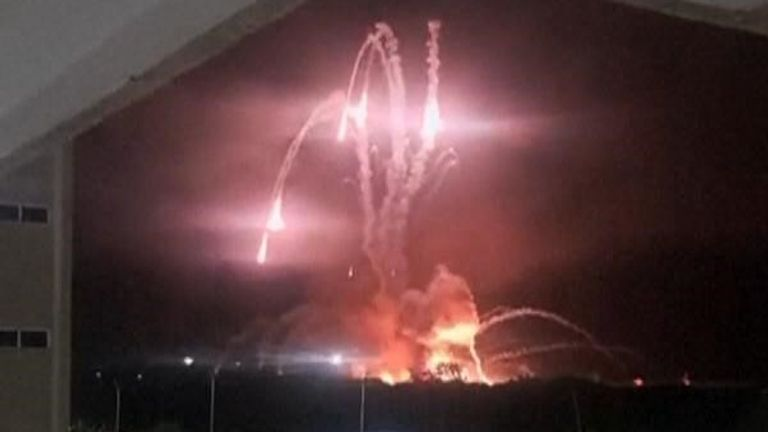
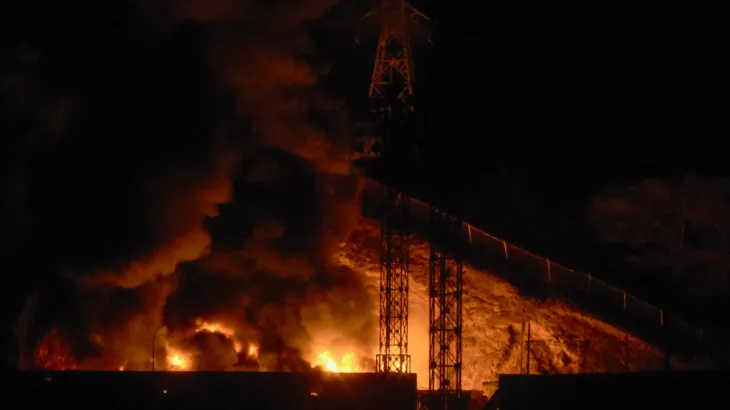
‼️ There is a possibility that Russia may be sending Shahed-type drones (Russian name: Geran) to Iran. Iran has already shown interest in Russia's modified versions, such as Geran-3 and Geran-5, which are essentially inexpensive cruise missiles with improved speed (up to 600 km/h) and anti-jamming capabilities.
The factory in the Alabuga Special Economic Zone currently produces more than 500 drones per month and is constantly expanding. Experts note that the scale of production in Alabuga allows Moscow to export updated and "battle-tested" versions of the drones back to Iran.
‼️ Destroying the Russian factory that makes Shahed/Geran drones would be the right strategic decision.
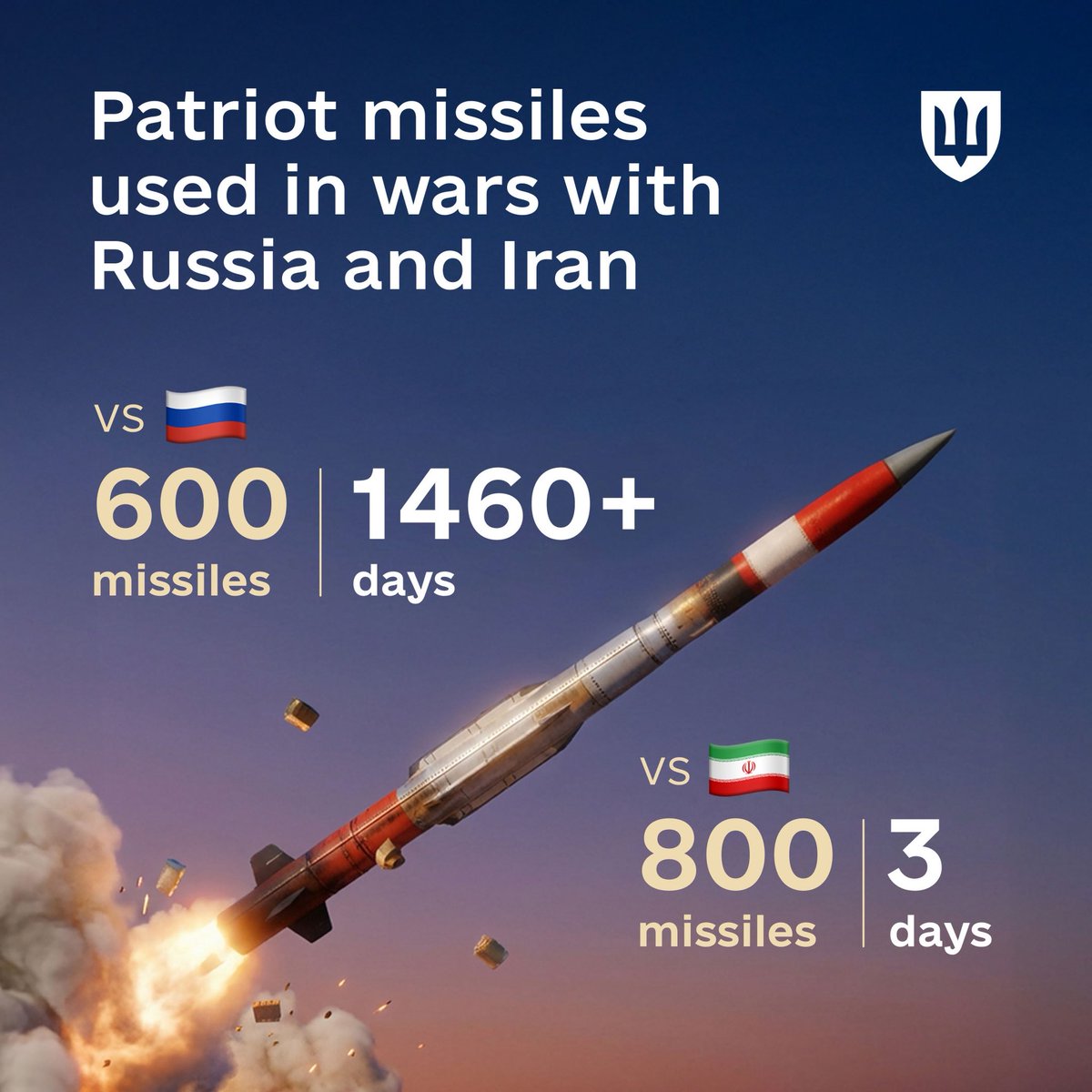
800 Patriot missiles were used for air defense in just 3 days in the Middle East. Ukraine received 600 in 4 years of full-scale war.
Russia, Iran and North Korea form a new Axis of Evil. Ukraine was the first to confront this Axis. We continue to fight, but we need support.
The free world must stop managing this threat — and start defeating it.
China’s Prosperity: Built by Households, Claimed by the State
Let this sink in.
The IMF puts China’s 2025 GDP per capita at $13,806 a year — roughly $1,150 a month.
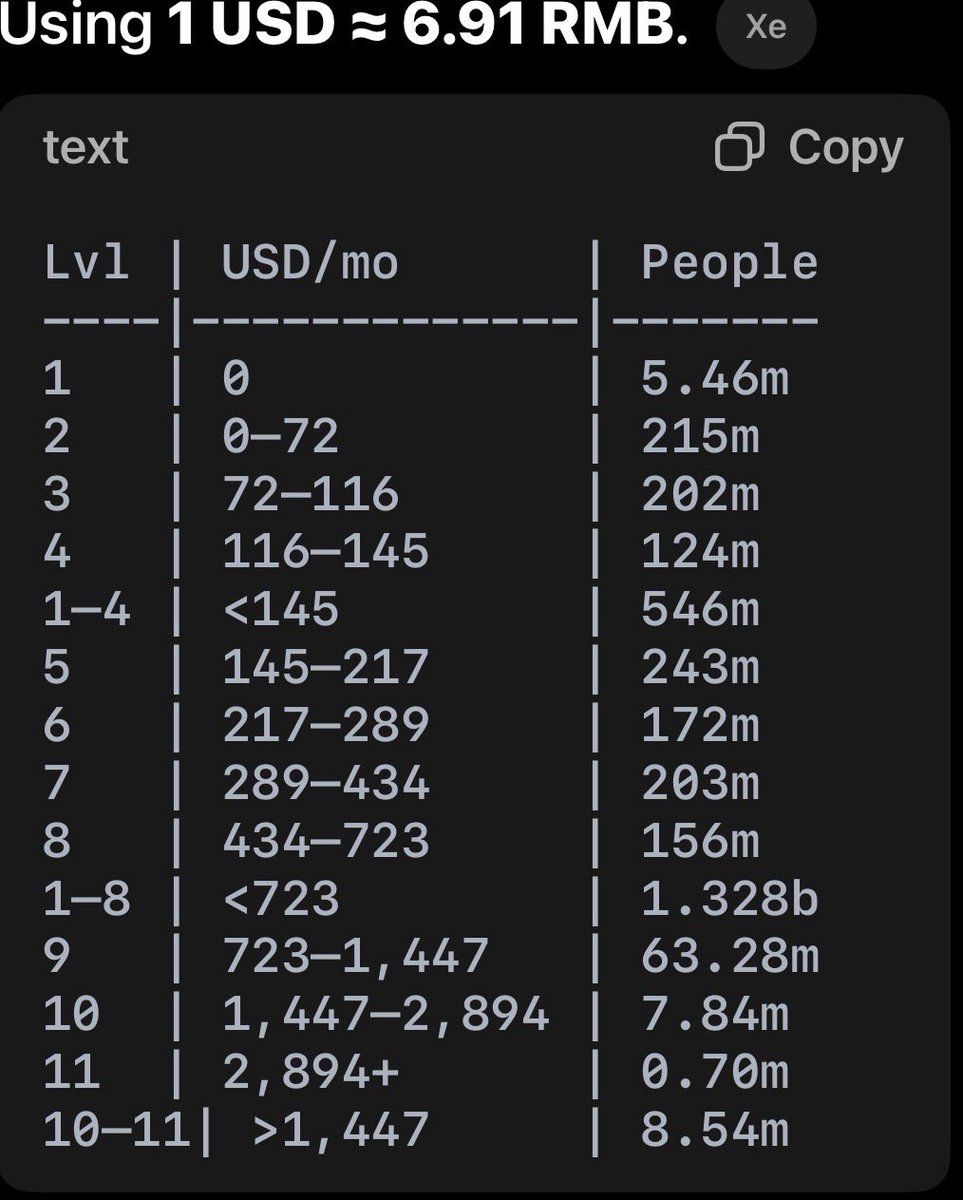
But using China International Capital Corp (CICC) income buckets below, only about ~2.5% of Chinese actually clear that level in monthly income — ~35 million out of ~1.4 billion. Most don’t live anywhere near the “average.”
So when outsiders swoon over the skyline, the mega-bridges, the high-speed rail to end of map, and the factory machine that exports “cheap and good” to the world, keep the base reality in frame:
•~547 million live on < $145/month.
•~1.33 billion earn < $724/month.
Official stats show Chinese workers averaged 48.6 hours a week in 2025 — basically seven hours a day, every day of the week.
That’s the point: China’s wealth was allocated by the state — into bureaucracy, infrastructure, capacity, and export power, not household income.
This isn’t prosperity for Chinese people. It’s industrial power—financed by households, enforced by silence.
At Netflix, scale drives everything.
Their logging system ingests 5 PB/day, averaging 10M+ events/sec across 40K+ microservices to serve 300M+ subscribers.
See how they did it with some key optimizations in fingerprinting, serialization, and queries.
Ukraine’s GUR just released its 2025 drone raid compilation, showing dozens of strikes on Russian air defenses, ships, and aircraft.
The first full year of Ukrainian long-range FPV strike drone ops has savaged the Russian rear area, especially in Crimea and on the Black Sea.
Stop using GPT for everything.
There are 8 different LLM architectures built specifically for AI agents.
Each one is optimized for different tasks.
Here's when to use each one:
𝗔𝗿𝗿𝗲𝘀𝘁 𝗪𝗮𝗿𝗿𝗮𝗻𝘁𝘀 𝗮𝘀 𝗖𝗮𝘀𝘂𝘀 𝗕𝗲𝗹𝗹𝗶
𝙃𝙤𝙬 𝙖 𝙡𝙖𝙬 𝙚𝙣𝙛𝙤𝙧𝙘𝙚𝙢𝙚𝙣𝙩 𝙧𝙖𝙩𝙞𝙤𝙣𝙖𝙡𝙚 𝙞𝙨 𝙗𝙚𝙞𝙣𝙜 𝙪𝙨𝙚𝙙 𝙩𝙤 𝙟𝙪𝙨𝙩𝙞𝙛𝙮 𝙖𝙞𝙧 𝙨𝙩𝙧𝙞𝙠𝙚𝙨 𝙤𝙣 𝙨𝙤𝙫𝙚𝙧𝙚𝙞𝙜𝙣 𝙢𝙞𝙡𝙞𝙩𝙖𝙧𝙮 𝙗𝙖𝙨𝙚𝙨, 𝙖𝙣𝙙 𝙬𝙝𝙮 𝘾𝙤𝙣𝙜𝙧𝙚𝙨𝙨 𝙬𝙖𝙨 𝙡𝙚𝙛𝙩 𝙬𝙞𝙩𝙝 𝙣𝙤𝙩𝙝𝙞𝙣𝙜 𝙗𝙪𝙩 𝙤𝙫𝙚𝙧𝙨𝙞𝙜𝙝𝙩 𝙖𝙛𝙩𝙚𝙧 𝙩𝙝𝙚 𝙛𝙖𝙘𝙩.
"Marine helicopters do not fly combat missions over a foreign capital blasting loudspeakers announcing that an imminent strike is merely the legal act of serving an arrest warrant. Missile, rocket, and cannon fire, and the suppression of military bases, are not law enforcement signaling mechanisms. They are instruments of war. Calling them anything else does not change their nature." -- OSINT Intuit™
------
The emerging State Department legal justification for tonight’s strikes appears to be that US forces attacked Venezuelan military facilities in order to protect DEA personnel executing arrest warrants for Nicolás Maduro and his wife.
According to public statements by Mike Lee, citing a direct call with Marco Rubio, the kinetic action was framed as defensive. The argument is that the president may use inherent Article II authority to employ military force to protect US personnel from an actual or imminent threat while executing federal law enforcement actions such as serving arrest warrants.
With the operation now concluded, Maduro reportedly in US custody and no further kinetic action anticipated, the president’s swift execution presents Congress with a fait accompli. The action is complete. Congressional recourse is limited to investigation and oversight rather than prevention or authorization.
If this rationale stands, it implies that:
• US military force may be used preemptively to secure arrests abroad
• Host nation military resistance is treated as criminal obstruction rather than national defense
• Sovereignty becomes conditional on US prosecutorial interests
At minimum, this justification raises serious questions about proportionality, necessity, and the long-term consequences of redefining arrest protection as a basis for interstate military action. It mirrors the stretched legal theories historically used to justify summary executions of accused drug traffickers by reclassifying them as “narco-terrorists.” This is not a defensible legal framework. It is legal argumentation designed to provide post hoc cover for a completed operation, not a doctrine capable of withstanding sustained scrutiny by Congress, courts, or serious strategic analysts.
By contrast, prior uses of Article II authority to employ force abroad were justified on grounds of repelling armed attacks, degrading imminent threats, or protecting US forces already engaged in hostilities. They were not predicated on the execution of domestic arrest warrants or the facilitation of law enforcement actions inside a foreign capital. That distinction matters. Once military force is justified not by armed conflict but by prosecutorial objectives, the threshold for interstate violence shifts from necessity to convenience, and the constitutional guardrails meant to separate war from policing begin to erode. In that moment, the military ceases to function as a defender of national security and sovereignty and becomes an extension of the administration’s legal reach.
The more plausible explanation for this theory is not legal rigor but operational fear. A war-based justification would have required broader congressional notification, staff briefings, and advance coordination. That expands the circle of knowledge and increases leak risk. In an operation where the objective is physical custody of a head of state, even limited disclosure could result in flight, diplomatic sanctuary, or third-country protection.
Framing the action as a narrow, executive-controlled defensive measure reduced advance notice and preserved surprise. The justification also mirrors the logic previously used to deploy military forces into US cities such as Chicago, where the stated purpose was to protect federal officers during the execution of their legal duties. In both cases, military force is framed not as a response to armed conflict, but as a protective extension of law enforcement authority. The difference is scale, not theory.
Seen this way, the legal theory did not shape the operation. The operation shaped the legal theory. Congress was not sidelined because it was irrelevant, but because it was viewed as a liability at the staff level. That choice may have improved operational security, but it did so at the cost of legal durability and institutional norms.
This was not an absence of precedent. A Panama-style framework existed and could have been invoked, including arguments based on hostile acts or the unlawful seizure of US assets. Using it would have required admitting the action for what it was. An act of war. That admission appears to have been deliberately avoided.
#OSINT #Venezuela #Maduro
Beschwerden von Soldaten zeigen schlimmste Gräueltaten innerhalb Russlands Armee
Der Milit��rexperte Franz-Stefan Gady verweist auf X auf einen Artikel der "New York Times", wonach aus mehr als 6.000 vertraulichen Beschwerden hervorgeht, dass Kommandeure unbequeme Soldaten schlagen, foltern und "auslöschen". Sie werden demnach auf todsichere Missionen geschickt oder direkt getötet und die Leichen dann in Gruben, geheimen Gräbern oder unter Panzerabwehrminen versteckt.
"Schwer verwundete und kranke Männer werden mit gebrochenen Gliedmaßen, schweren Kopfverletzungen, Krebs im Stadium 4, Schizophrenie, Schlaganfallkomplikationen an die Front in der Ukraine zurückgeschickt, selbst wenn sie keinen Löffel halten oder ohne Stock oder Krücken nicht gehen können; ehemalige Kriegsgefangene werden innerhalb weniger Tage nach ihrer Freilassung wieder in den Kampf geschickt, und mobilisierten Männern wird gesagt, sie hätten 'kein Recht auf Entlassung – oder gar auf Leben'", heißt es von Gady.
https://t.co/YpeYABheBl
https://t.co/5DRu84uWqg
Stop using vector search everywhere.
A 30-year-old algorithm with zero training, zero embeddings, and zero fine-tuning still powers Elasticsearch, OpenSearch, and most production search systems today.
It's called BM25.
Let me explain what makes it so powerful:
Imagine you're searching for "transformer attention mechanism" in a library of ML papers.
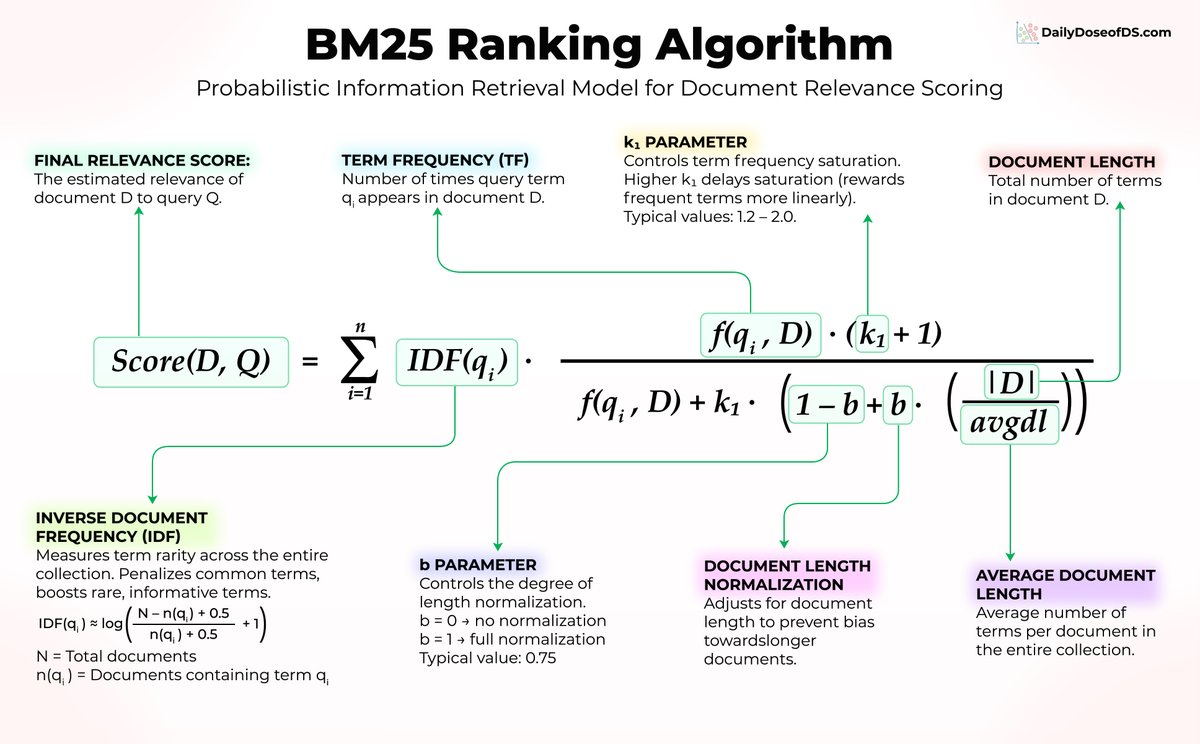
BM25 asks three simple questions:
"How rare is this word?"
Every paper contains "the" and "is", which makes it useless. But "transformer" is specific and informative. BM25 boosts rare words and ignores the noise.
→ This is IDF(qᵢ) in the formula
"How many times does it appear?"
If "attention" appears 10 times in a paper, that's a good sign. But 10 vs 100 occurrences won't make much difference. BM25 applies diminishing returns.
→ This is f(qᵢ, D) combined with k₁ that controls saturation
"Is this document unusually long?"
A 50-page paper will naturally contain more keywords than a 5-page paper. BM25 levels the playing field so longer documents don't cheat their way to the top.
→ This is |D|/avgdl controlled by parameter b
Three questions. No neural networks. No training data. Just elegant math (refer to the image below)
The best part:
BM25 excels at exact keyword matching - something embeddings often struggle with. If your user searches for "error code 5012," embeddings might return semantically similar results. BM25 will find the exact match.
This is why hybrid search exists.
Top RAG systems today combine BM25 with vector search. You get the best of both worlds: semantic understanding AND precise keyword matching.
So before you throw GPUs at every search problem, consider BM25. It might already solve your problem, or make your semantic search even better when combined.
These elongated skulls date to the Paracas Necropolis period, around 2,000 years ago, discovered near Pisco in northern Paracas, Peru. Their cone-like shape wasn’t the result of disease or mutation. It was intentional, done during infancy through prolonged head shaping while the skull was still soft.
What keeps people talking are the measurements. Some independent examinations have claimed unusually large cranial capacity, heavier skull mass, and altered eye and jaw proportions. At the same time, CT scans and osteological studies classify these skulls as fully human, with the differences attributed to external shaping rather than genetic deviation or a separate population.
Hundreds of intentionally modified skulls have been recovered from Paracas burial sites, making this one of the largest concentrations of cranial deformation ever found.
So the form is deliberate. The biology is human. The unanswered part is why Paracas elites pushed this practice to such extremes.
Regional Museum of Ica, Peru
#archaeohistories
If you have not seen 2000 Meters to Andriivka, I strongly recommend watching it.
After being here in Ukraine for three and a half years, I can say this film captures the reality better than almost anything else I have seen. I never fought on the front line, but I have been near it many times and spent time on it as well.
I have seen enough to understand the cost paid by those who fight every day. This film reflects that reality clearly and without filters.
This is not a polished narrative. It is the real experience of soldiers fighting through trenches, fear, exhaustion, and loss while trying to liberate a single village. Huge respect to the reporters and the entire team behind this film for having the courage to show the truth.
A stunning portrayal of trench warfare from the Oscar winning team behind 20 Days in Mariupol, produced with The Associated Press. It uses combat bodycam footage and powerful moments of reflection to follow a Ukrainian platoon in combat.
You can watch it here:
https://t.co/CmUisyfhMk
Slava Ukraini. Heroiam Slava. 🇺🇦
Data on fallen volunteer soldiers from different countries who gave their lives for Ukraine as of October 27, 2025.
Here are the 21 countries whose soldiers have made the greatest sacrifice.
In total, volunteer soldiers from 65 countries around the world have died defending Ukraine.