JUST IN: The U.S. @SECGov and @CFTC issue a joint interpretation officially classifying the LINK token as a digital commodity.
We congratulate the SEC and CFTC on this landmark milestone that provides a clear legal framework for the institutional adoption of digital assets.
$LINK is the exclusive asset for direct exposure to the success of @Chainlink
Unlike other projects that have sold both tokens and equity to investors (creating conflicting economic interests), Chainlink is not driving value to any equity and there is no IPO—there is only $LINK
Any claim or perception that the goal is to maximize the value of Chainlink Labs at the expense of, or in isolation of, LINK holders (e.g, Ripple stock vs XRP) is dead wrong
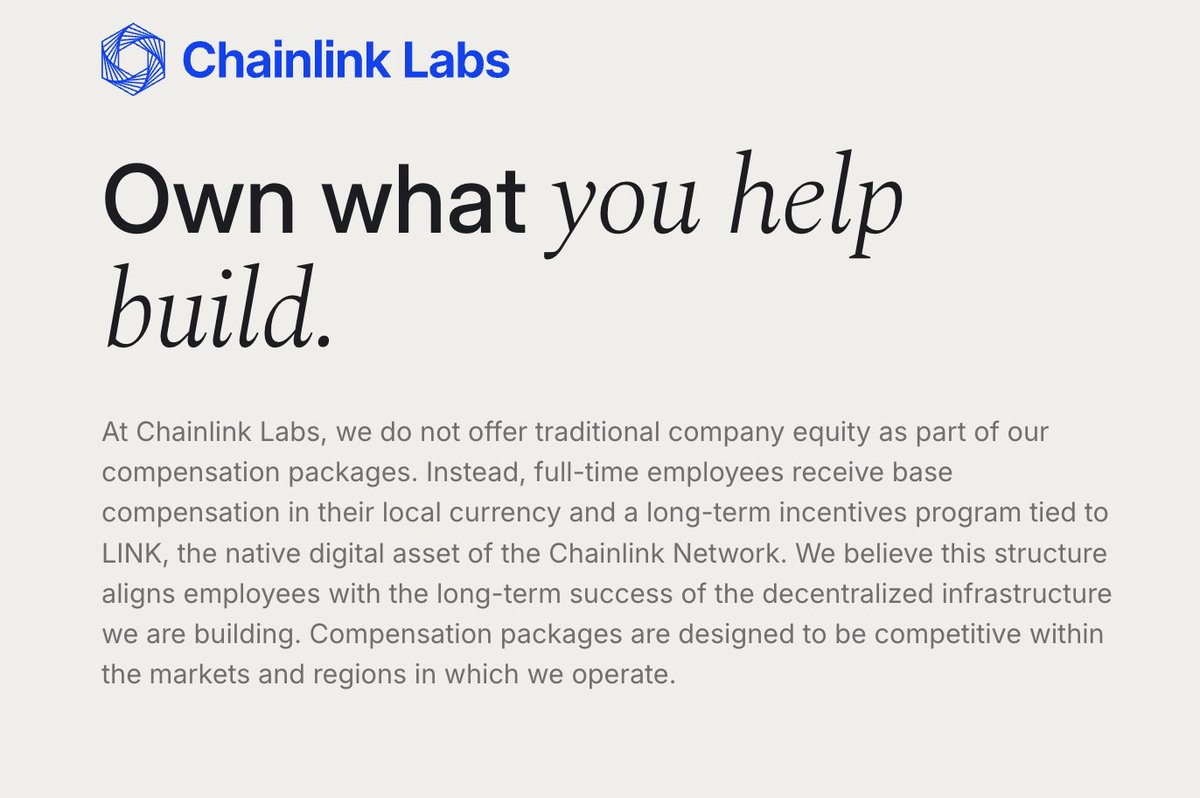
There's no better proof in this than how Chainlink Labs employee compensation works
Employees do not receive equity, they receive base comp in local currency and a long-term incentives program tied to $LINK
Interests are fully aligned via direct skin in the game
Think about it, any detrimental action toward LINK holders would directly impact the CLL employees building the protocol as well, makes no sense
Some of the largest $LINK whales I personally know work for CLL, there is an shared interest in seeing the token do well
Fundamentally, we are all in this together
🔷 Chainlink might be the single most important platform in the entire cryptocurrency industry.
Every day we see a new announcement involving @chainlink tech and infrastructure.
Meanwhile, its native $LINK token has grown to a valuation of more than $14 billion, and very few people actually know what it is and why it matters.
In our LINK deepdive article, we take a look at the asset's...
- Tokenomics and supply distribution
- Most important use-cases
- Key milestones and integrations
Get up to speed ⬇️
https://t.co/l0fhrOeZh5
Introducing Moodring
Your trades, sleep, work, relationships, wins, losses
Aura unified into a single metric
Not just another wellness app
Follow for early access
CLL can’t talk about $LINK the way people want because it risks being seen as marketing an investment.
If Chainlink Labs says “LINK benefits from adoption” or anything close, regulators can argue it’s a security sale. That’s the same mess Ripple got dragged through.
So they stick to the tech story and leave token talk in the shadows. It’s legal insulation, not indifference.
If the CLARITY Act lands and gives them room to actually market the token as a commodity, that’s when the tone and the tokenomics both have a shot at changing for real.
1/8
In recently wrote an article on whether the LINK token is actually needed for the @chainlink Network. This follow up tackles the next question I hear constantly. If Chainlink keeps landing major integrations, influencing regulators, and positioning itself as core infrastructure for the digital economy, then why hasn’t the LINK price taken off. Some jump straight to “tokenomics are broken”. The truth is, most people are judging LINK like a hype token instead of what it is. $LINK is an infrastructure asset, and it follows a completely different value cycle. Once you understand how value flows to LINK, the price action makes a lot more sense.
Let's review...
The Oct 11 Crypto Crash — What Really Happened
TL;DR:
Roughly $60–90M of $USDe was dumped on Binance, along with $wBETH and $BNSOL, exploiting a pricing flaw that valued collateral using Binance’s own order-book data instead of external oracles.
That localized depeg triggered $500M–$1B in forced liquidations, cascaded into $19B+ globally, and earned the attackers about $192M via $1.1B in BTC/ETH shorts opened on Hyperliquid hours earlier, but minutes before Trump tariff announcement.
It wasn’t a USDe failure!! It was Binance’s design flaw, timed with macro panic (Trump’s tariffs) for cover.
What looked like chaos was actually a coordinated exploitation of Binance’s internal pricing system, amplified by a macro shock and systemic leverage.
1️⃣ The Setup
Binance’s Unified Account let traders use assets like USDe, wBETH, and BNSOL as collateral.
Instead of oracle or redemption prices, Binance valued these using its own spot market - a major vulnerability.
On Oct 6, Binance announced a fix to move to oracle-based pricing, but rollout wasn’t until Oct 14, leaving an 8-day window.
2️⃣ The Exploit
During that window, sophisticated actors manipulated Binance’s order books, dumping ~$60–90M of USDe, driving it to $0.65 on Binance only (still ~$1 elsewhere).
Because the Unified Account marked collateral to internal prices, this instantly wiped margin value and triggered $500M–$1B in forced liquidations.
Then, Trump’s 100% China tariff headline hit, magnifying panic and liquidity stress.
3️⃣ The Profit Engine
The same day, fresh wallets on Hyperliquid opened $1.1B in BTC/ETH shorts, funded by $110M USDC from Arbitrum-linked sources.
As the Binance cascade unfolded, BTC and ETH cratered, those shorts netted $192M in profit before closing out at the bottom.
Timing, precision, and funding paths all suggest coordination.
4️⃣ The Contagion
Binance liquidations dumped BTC/ETH/ALTs into thin books.
Other exchanges mirrored the collapse through cross-market bots.
Market makers hedged across venues were forced to unwind everywhere.
Result: $19B+ global liquidations, with many alts down 50–70% intraday, all triggered by <$100M of manipulated collateral.
5️⃣ Who’s at fault?
Binance: design flaw + delay in oracle rollout = root cause.
Exploiters: executed and timed the manipulation, profited via external shorts.
Ethena (USDe): not at fault - protocol stayed 1:1 collateralized, redemptions normal, peg held everywhere else.
6️⃣ Aftermath
Binance admitted “platform-related issues,” promised compensation for affected margin/futures/loan users, and rolled out minimum price floors + oracle integration.
USDe remained operational, and the incident is now a case study in how exchange-side pricing errors can trigger system-wide liquidations.
Bottom line:
A ~$90M dump on Binance and a $1.1B leveraged short elsewhere sparked a $19B bloodbath.
Not a stablecoin failure, but a masterclass in exploiting flawed collateral valuation during peak macro stress.
The Oct 11 Crypto Crash — What Really Happened
TL;DR:
Roughly $60–90M of $USDe was dumped on Binance, along with $wBETH and $BNSOL, exploiting a pricing flaw that valued collateral using Binance’s own order-book data instead of external oracles.
That localized depeg triggered $500M–$1B in forced liquidations, cascaded into $19B+ globally, and earned the attackers about $192M via $1.1B in BTC/ETH shorts opened on Hyperliquid hours earlier, but minutes before Trump tariff announcement.
It wasn’t a USDe failure!! It was Binance’s design flaw, timed with macro panic (Trump’s tariffs) for cover.
What looked like chaos was actually a coordinated exploitation of Binance’s internal pricing system, amplified by a macro shock and systemic leverage.
1️⃣ The Setup
Binance’s Unified Account let traders use assets like USDe, wBETH, and BNSOL as collateral.
Instead of oracle or redemption prices, Binance valued these using its own spot market - a major vulnerability.
On Oct 6, Binance announced a fix to move to oracle-based pricing, but rollout wasn’t until Oct 14, leaving an 8-day window.
2️⃣ The Exploit
During that window, sophisticated actors manipulated Binance’s order books, dumping ~$60–90M of USDe, driving it to $0.65 on Binance only (still ~$1 elsewhere).
Because the Unified Account marked collateral to internal prices, this instantly wiped margin value and triggered $500M–$1B in forced liquidations.
Then, Trump’s 100% China tariff headline hit, magnifying panic and liquidity stress.
3️⃣ The Profit Engine
The same day, fresh wallets on Hyperliquid opened $1.1B in BTC/ETH shorts, funded by $110M USDC from Arbitrum-linked sources.
As the Binance cascade unfolded, BTC and ETH cratered, those shorts netted $192M in profit before closing out at the bottom.
Timing, precision, and funding paths all suggest coordination.
4️⃣ The Contagion
Binance liquidations dumped BTC/ETH/ALTs into thin books.
Other exchanges mirrored the collapse through cross-market bots.
Market makers hedged across venues were forced to unwind everywhere.
Result: $19B+ global liquidations, with many alts down 50–70% intraday, all triggered by <$100M of manipulated collateral.
5️⃣ Who’s at fault?
Binance: design flaw + delay in oracle rollout = root cause.
Exploiters: executed and timed the manipulation, profited via external shorts.
Ethena (USDe): not at fault - protocol stayed 1:1 collateralized, redemptions normal, peg held everywhere else.
6️⃣ Aftermath
Binance admitted “platform-related issues,” promised compensation for affected margin/futures/loan users, and rolled out minimum price floors + oracle integration.
USDe remained operational, and the incident is now a case study in how exchange-side pricing errors can trigger system-wide liquidations.
Bottom line:
A ~$90M dump on Binance and a $1.1B leveraged short elsewhere sparked a $19B bloodbath.
Not a stablecoin failure, but a masterclass in exploiting flawed collateral valuation during peak macro stress.
Stablecoin regulation in the US will kick off a wave of new stablecoins in the US and all over the world. They will all need proof of reserves and cross-chain connectivity to be used as a source of payment for the growing digital asset economy and tokenized funds.
Chainlink is the only platform that provides proof of reserves and cross-chain connectivity in one system.
This is before we look at the need for on chain identity and the ability to use stablecoins as a form of payment with minimal friction when fulfilling compliance requirements. Chainlink will then be the only platform to provide proof of reserves, cross-chain connectivity and on-chain identity/compliance in a single system.
As the complexity of blockchain transactions grows with more data, connectivity, compliance and other requirements, Chainlink will be being built as the only platform that can fulfill all those requirements in a single unified system of transactional standards.
All of these Chainlink capabilities can then be easily configured, deployed and managed in one piece of workflow code on CRE. So you're getting all the services you need to prove reserves, connect across chains, solve compliance/identity issues and manage all this complexity with a single piece of code, in one system.