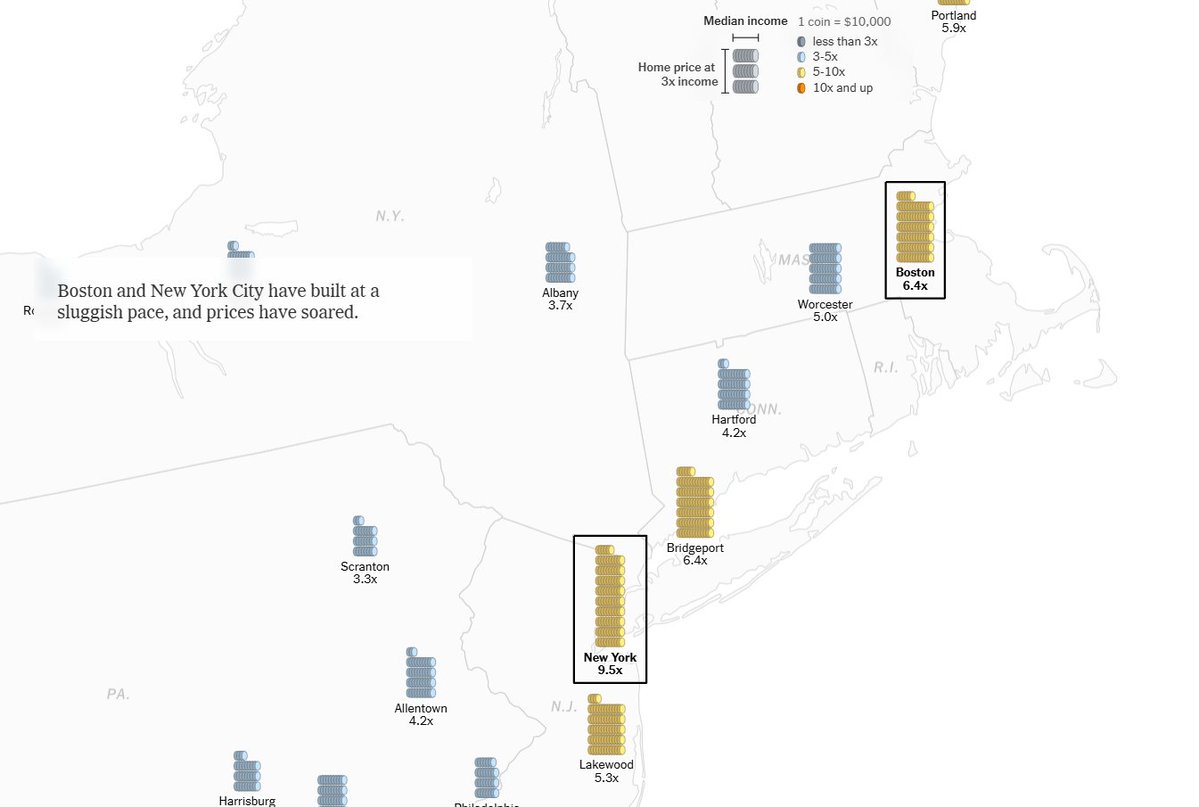
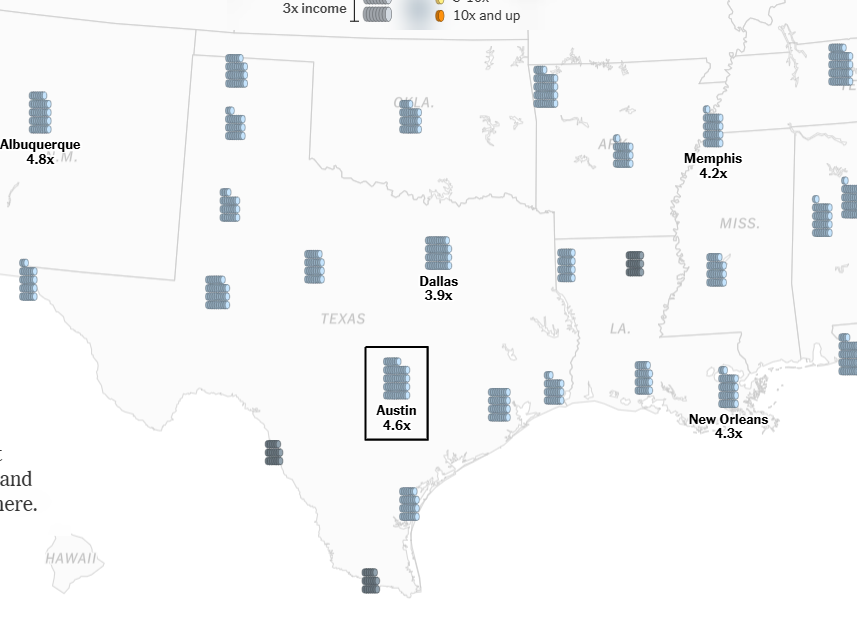
El editorial principal del NYT sobre la vivienda confirma con datos el principio económico más básico: donde se construye, los precios bajan; donde no, suben.
Dos ejemplos de los datos: San Francisco: solo 22 viviendas nuevas por cada 1.000 hogares en la última década, precio mediano 12 veces la renta mediana. Austin, que sí construyó (140 viviendas por 1.000 hogares): el precio mediano es 4,6 veces los ingresos.
El editorial señala que las zonas costeras caras, votantes demócratas y autodenominadas progresistas, han usado la normativa urbanística para maximizar el precio de la vivienda a costa de todos los demás. Muchos en Madrid (¡las cocheras de Atocha!) o en Pozuelo, o Barcelona deber��an leerlo dos veces.
El NYT recomienda reducir las barreras burocráticas donde construir es legal pero imposible en la práctica.
Que en España todavía se discuta algo tan elemental dice más de nuestro debate público que de la economía de la vivienda. Sin construir más, no resolveremos el problema.
https://t.co/36PbNuYq25
spain needs a different growth model.
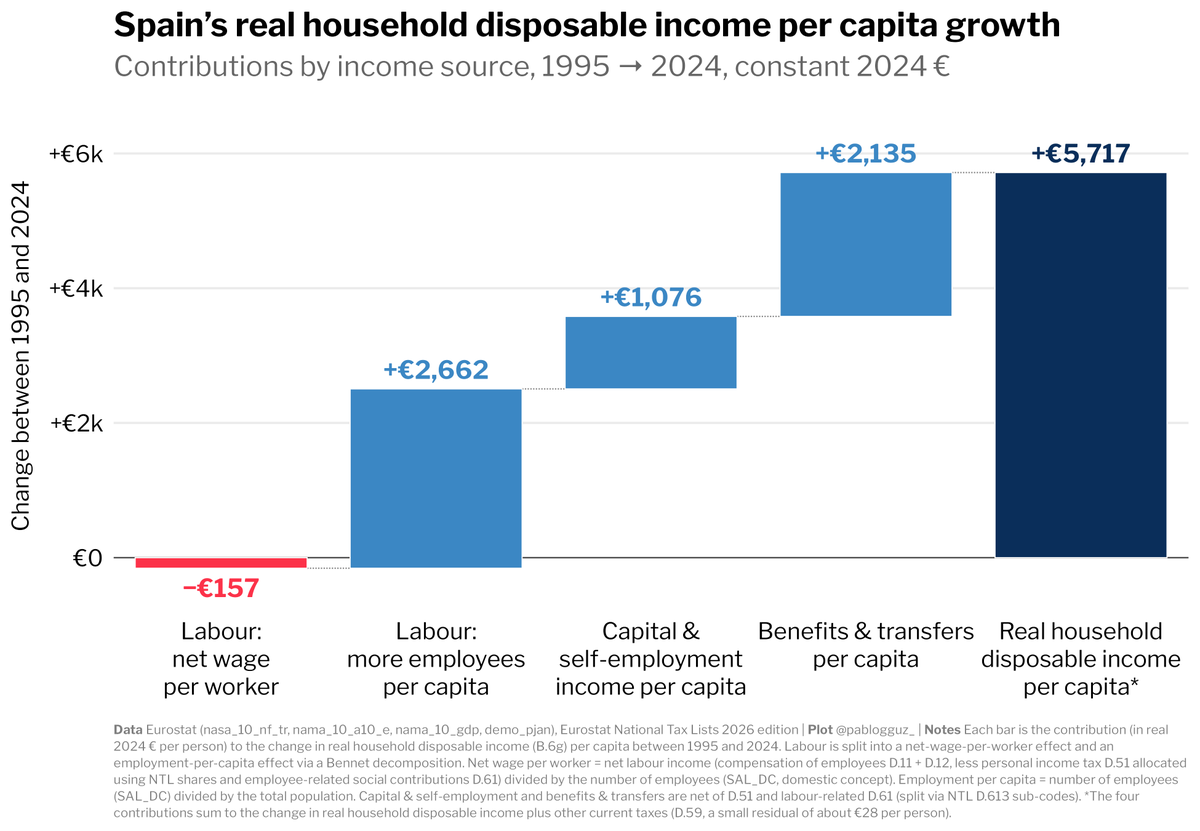
in the last 30 years, real household disposable income per capita has grown by roughly 38% in real terms (around €5.7k per person at 2024 prices). this can be decomposed into growth in net labour income per capita (+16.7 pp), cash benefits such as pensions (+14.2 pp), and capital and self-employment income per capita (+7.2 pp).
however, the labour contribution came entirely from the extensive margin (pulling more people into employment) rather than from higher real wages per worker. in fact, the average spanish employee takes home slightly less in real terms today than in 1995!
going forward, this model is unlikely to keep working. the extensive-margin gains came from two channels, both of which leaned on favourable conditions that are (most likely) not going to repeat. the first is that the working-age population grew faster than the total population during the 90s and 2000s, mainly because of the favourable age structure left behind by spain's baby boom (the large cohorts born in the 1960s and 1970s moved into prime working age while the cohorts behind them were smaller), but also because of immigration waves that were disproportionately working-age. this is what demographers often call a demographic dividend, which lifts the employment-to-population ratio purely by composition (even with no change in how much any given working-age person works). the second channel is that, within the working-age population, the employment rate rose substantially, from below 50% in the mid-1990s to around two-thirds today.
of course, none of this is bad, but there is only so much further either channel can go. the demographic dividend is already reversing: the baby boom cohorts are now moving into retirement, the cohorts replacing them are much smaller, and ageing will push the working-age share of the population down. the employment rate itself is approaching a natural ceiling -- there is still a gap relative to the average advanced european economy but it is not large, and closing it would only buy spain a few more years of compositional growth.
immigration, often raised as the way out, cannot realistically offset the demographic drag ahead. the scale of net inflows required to offset ageing on a sustained basis is multiples of any plausible figure consistent with social and political constraints in european countries, and even if such flows materialised, immigrants themselves age and accrue the same retirement pension entitlements as natives. in other words, sustaining the current demographic structure would require a permanent inflow large enough to offset both the ageing of the native population and that of past migrant cohorts, indefinitely. fertility, however, is now falling across virtually every region of the world, and the global working-age population is projected to peak within a few decades and then decline. there is simply no migrant pool waiting to be drawn from on the scale spain would need.
this is also why cash benefits cannot keep doing what they have been doing. it is worth being explicit about why retirement pensions, specifically, are at the centre of all this. spain runs a defined-benefit, pay-as-you-go public pension system: pensions are not the actuarial outcome of what each worker contributed, but a function of years contributed and final wages, paid out of the contributions of those currently working. the current system promises retirees an internal rate of return on their contributions that is significantly higher than anything the payments into the system can plausibly grow at. and because the payments into the system are, mechanically, the number of contributors times the average wage on which they contribute, a gap of that kind is sustainable only as long as the contributing base keeps expanding fast enough relative to the receiving one. the same demographic dynamics that enabled the extensive-margin growth of the last three decades are what allowed this to (sort of) work, but these are now reversing. on top of that, the system already runs a structural deficit: only about three-quarters of contributory pension expenditure is covered by social contributions, and the rest is financed out of general taxation paid by the entire population.
and pensions are not an independent source of household income. they are funded by taxes, and taxes have to be levied on income generated somewhere in the economy. in spain, as in any developed country, that income is overwhelmingly the wage bill: personal income tax and social contributions on labour. so the real question is whether labour income per worker is growing.
gross compensation per worker (including social security contributions) has in fact risen slightly in real terms since 1995, by around 5%. but the entire gain (and a little more) has been absorbed by a widening fiscal wedge, so that the take-home wage is marginally lower today than it was thirty years ago. in other words, the modest productivity gains the spanish economy has managed to deliver have not reached workers. they have been routed, in their entirety, into financing the rising weight of transfers.
one could argue, of course, that if wages eventually start growing, the additional income can simply be taxed away to keep financing rising benefits. but that is just another way of saying that the take-home pay of the average spanish worker is supposed to stay flat for the foreseeable future, and that whatever productivity gains eventually arrive will be routed straight through to retirees. i will leave it to the reader to judge what kind of social contract that describes.
thirty years of stagnant wages is already a long experiment in that direction. either policymakers start taking productivity growth seriously or the bill comes due on a model that was always going to run out of room.
@ruiz_ath@Gil_JavierGil@Jongonzlz@EconoCabreado No sé si hay mucha gente de izquierdas que piense en la insostenibilidad de las pensiones o en el problema de oferta de vivienda en España, pero estoy seguro de que quienes lo hagan ignorarán las tonterías que ha publicado Yago (o directamente a alguien como él).
@ruiz_ath@Gil_JavierGil@Jongonzlz@EconoCabreado No es buena la analogía.
Además, si hablamos de incentivos, @Gil_JavierGil o @EconoCabreado dependen hoy mucho más que Jon del relato que venden, a menudo equivocado o engañoso, para ganar dinero o impacto. De hecho, lo que dice Yago en el hilo no hace más que reforzar esa idea.
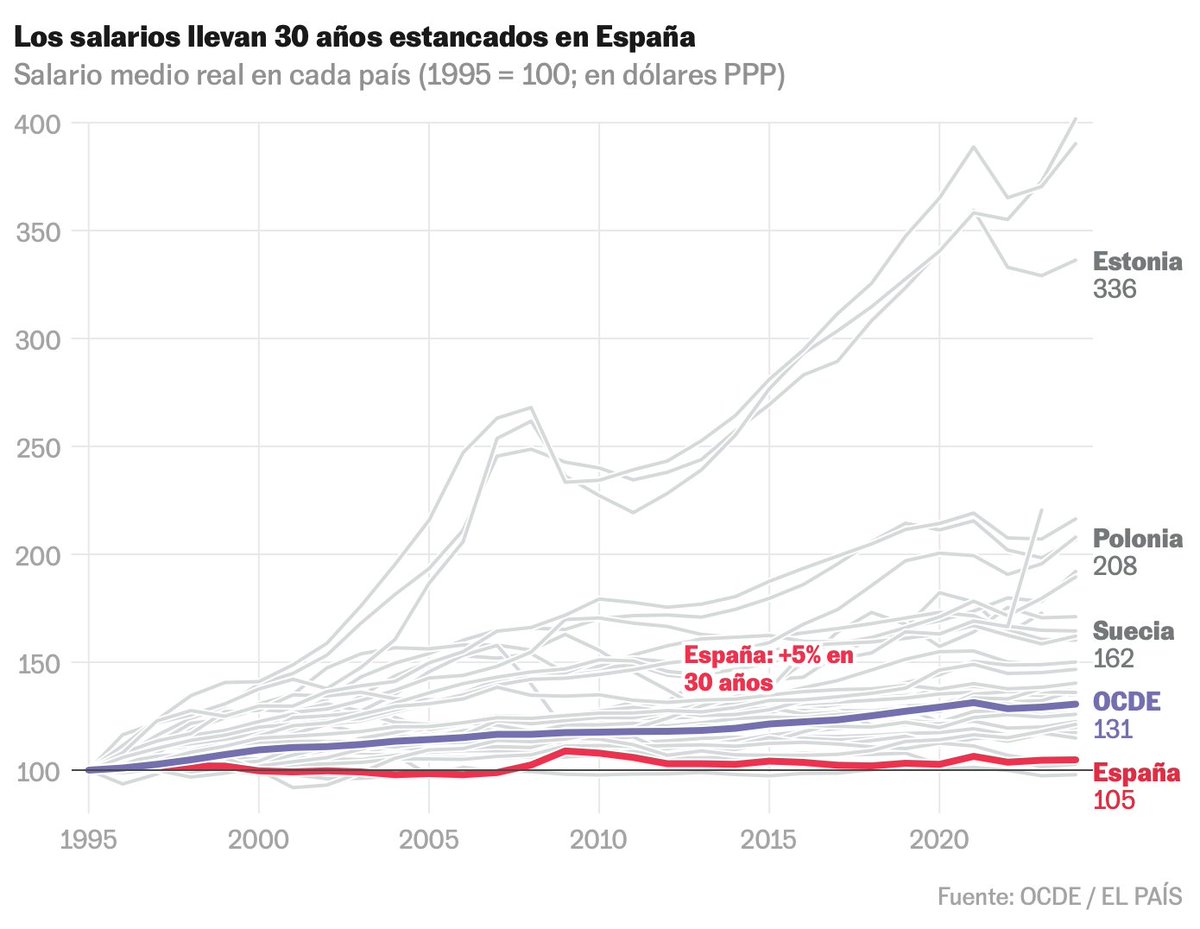
💰 ¿Suben los salarios en España?
En realidad llevan 30 años estancados. El sueldo medio real solo sube 5% desde 1995, frente al 31% de la OCDE.
Datos de sueldos, generaciones e impuestos:
Últimamente no he colgado nada en español porque la situación en España me deprime bastante.
Un ejemplo es este anuncio del PP sobre ocho medidas si llega al gobierno, que aquí incluyo.
Fijémonos en estas ocho medidas. Una, la ley sobre ELA, afecta a una minoría muy pequeña del país. Sí, tener esta enfermedad es una desgracia, pero estamos hablando de 900 casos al año en un país que se acerca ya a los 50 millones de habitantes. Es “buenismo” en su manifestación más mediocre. Otra, bajar el IVA de los productos básicos, es demagógica y en contra de la teoría económica básica. Modificar la Ley Presupuestaria para que haya un mayor control sobre el gasto en defensa y seguridad resulta irrelevante. Y las otras varían entre lo necesario pero no muy importante (la independencia del CIS) y lo esperpéntico (modificar la Ley de Costas).
España tiene cuatro problemas existenciales:
1) Fecundidad.
2) Inmigración.
3) Falta de crecimiento de los salarios reales.
4) Vivienda.
Ni una de estas medidas tiene nada que ver con 1)-4) (excepto, de pasada, la ley antiocupación). ¿Por qué? Porque cualquier cosa que de verdad contribuya a la solución de 1)-4) implicaría sacrificios para los votantes del PP: personas de más de 55 años que quieren dejar todo como está. De hecho, la ley antiocupación se menciona porque protege los derechos de propiedad de los mayores.
Feijóo y el PP, más en general, tienen la idea del futuro de España de una ameba porque a sus votantes el futuro de España les trae el fresco mientras su pensión se pague y el precio de su piso no caiga.
Y nada de lo que yo (o cualquier otro) pueda decir será capaz de mover ese macizo carpetovetónico.
Population pyramid of Asturias: The autonomous community with the lowest TFR on mainland Spain.
0-14: 9.80%
15-64: 61.84%
65 and over: 28.36%
Foreign population: 6.80%
@JesusFerna7026 Do you have data/intuition on how rapid TFR decline in origin countries might reshape immigration flows, given each destination's source-country mix?
@kikollan Lo que más me impresiona cuando hablo con gente no técnica es la brecha de adopción y la cantidad de usos potenciales que todavía quedan por implementar, incluso si el desarrollo de la IA se estancara.