If you’re a dev who loves building for hackathons to earn cool cash, this is for you.
I built HackOdds.
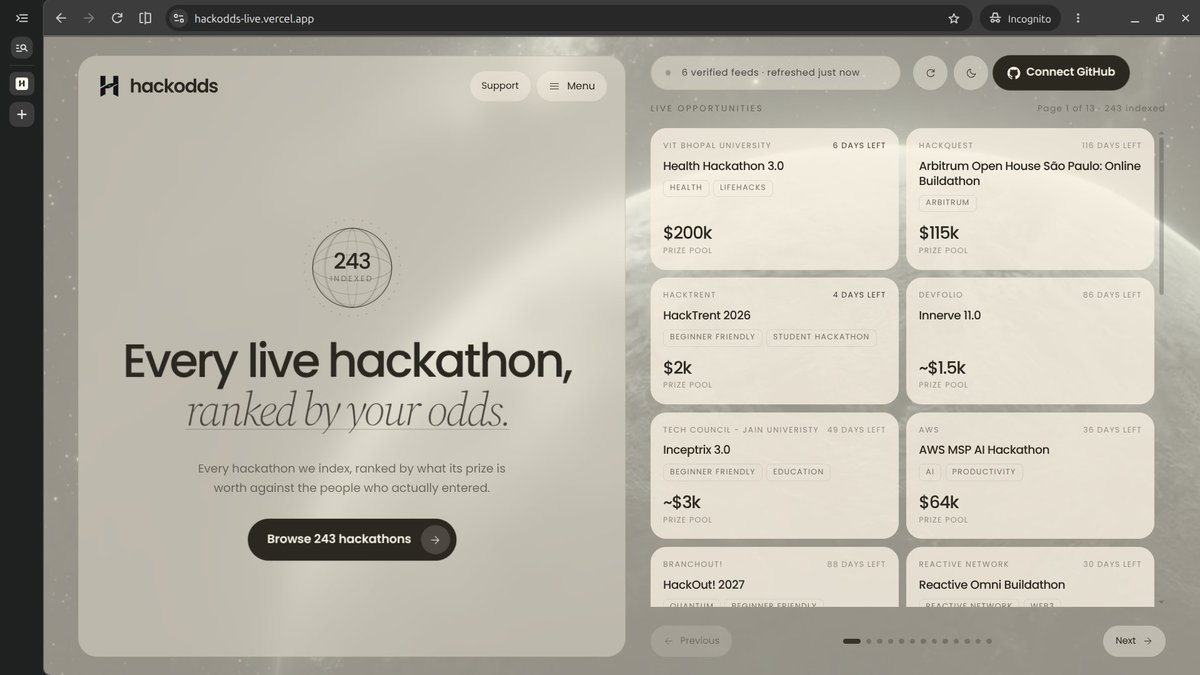
It’s an aggregator that pulls live hackathons from Devpost, DoraHacks, Devfolio, Hackquest, Hacklist and more, then ranks them by the number that actually matters:
prize ÷ people already registered.
Not “who has the fattest prize pool.”
Who has fat prize money and a quiet room.
Because a $200k hackathon with 4,000 signups and a $15k one with 40 people are not the same bet. Every other board hides that.
How it works:
- fetches events from 6 feeds every day
- merges duplicates so the same hackathon doesn’t show up 3 times
- divides prize by (registrations + 1) : the +1 is you
- tags rooms good / mid / crowded
- if a site doesn’t publish crowd size, it says “not reported.” Never fake 0. Fake 0 would make every unknown event look empty and jump to #1
You also get:
- what’s closing soon
- new listings from the last 48 hours
- crowd velocity once there are real snapshots
- GitHub login for a watchlist + a “for you” rank based on languages in your public repos
~162 live events on the board right now.
If you pick hackathons by the poster, you enter the loudest room.
If you pick them by prize per rival, you see the quiet money.
https://t.co/kvXkyoJTMW
#hackathons #building
AI agents can shop for you now. They can find a product, compare prices and check out in seconds. But an agent that can spend your money with no limits is a risk nobody should take. One bad search, one sketchy merchant, one purchase on the wrong day, and the money is already gone.
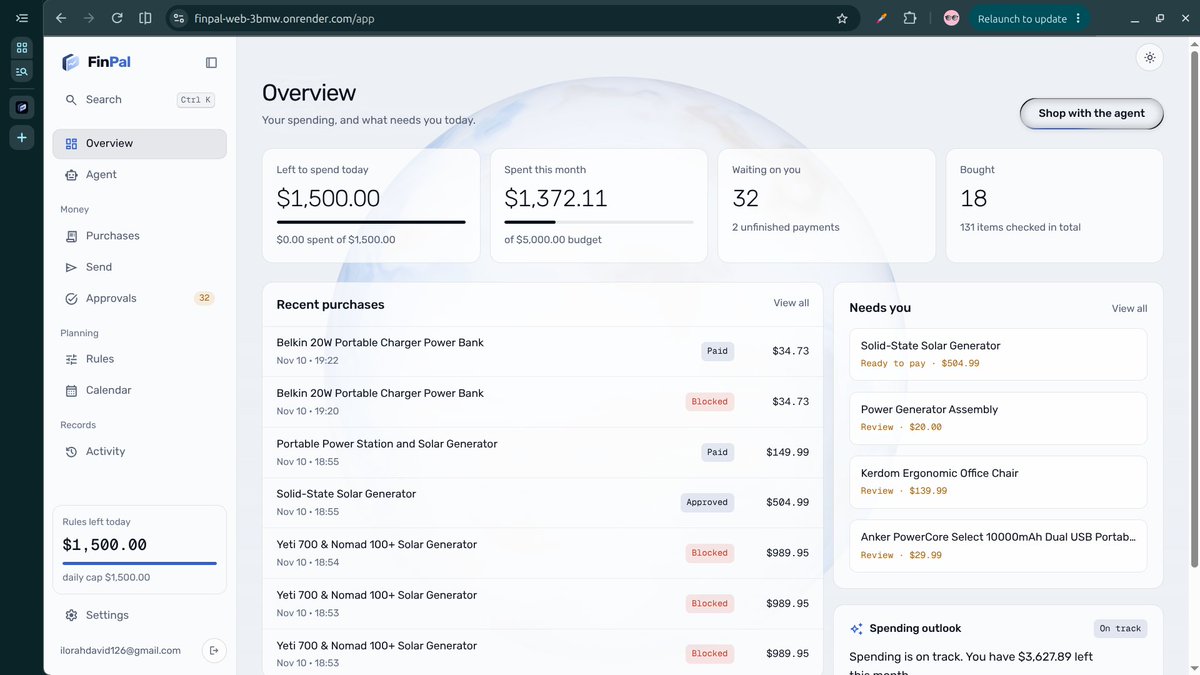
This is why we built 𝐅𝐢𝐧𝐏𝐚𝐥 for the @PayPal AI Hackathon.
FinPal is an AI shopping agent that works inside your spending rules and never pays until you approve.
Here's how it works:
→ You type a list, snap a product photo or just say what you need
→ The agent searches live offers and compares prices against the market
→ Your rules decide what can be bought: per-purchase caps, daily and monthly limits, and the days and hours spending is allowed
→ If a merchant looks off, it doesn't guess. It stops and asks you to review
→ Nothing is paid until you approve it through PayPal checkout
→ You can also send money to people, and the same rules apply
Every purchase keeps its evidence: the price check, which rules passed, and a plain-words summary. Activity keeps a record that can't be edited, so nothing happens out of sight.
The AI explains every decision. It never makes them. Your rules decide, and you approve.
Built with PayPal Orders v2 and Payouts, @channel3_ai , Next.js, Supabase and Groq, all running on PayPal Sandbox.
Been heads down on this with @iamtechhunter@ikeh_chukw38247@CeeHenrie for the past couple of weeks, and we're excited to finally share it 🙏
Watch the demo 👇
https://t.co/Au4FA2X7PY
Devpost: https://t.co/gS8XSjJYBb
Try it: https://t.co/K5htm5PKz3
Thank you for growing with us. We're just getting started, and we can't wait to see how far we go together.
Here's to more milestones! 🥂
₦30M down, bigger numbers ahead.
Try Settu today: https://t.co/6lA0tdGRWJ
HackOdds is live 🚀
It's a hackathon discovery platform that helps builders find high-upside opportunities faster. Compare prize pools, competition, deadlines, themes, crowd activity, and detailed event information across multiple sources.
Over 240 hackathons live right now!!! 🚀
https://t.co/8vj0vmkFSP
#Hackathons #BuildInPublic
Contributing to open source involves more than knowing how to write code.
Developers entering an established project have to learn how to navigate unfamiliar codebases, communicate with maintainers, respond to feedback, and work with people who may be contributing from different parts of the world.
They also discover that meaningful contributions don't always begin with writing code. Testing, documentation, bug reports and community support all play a role in keeping open-source projects moving.