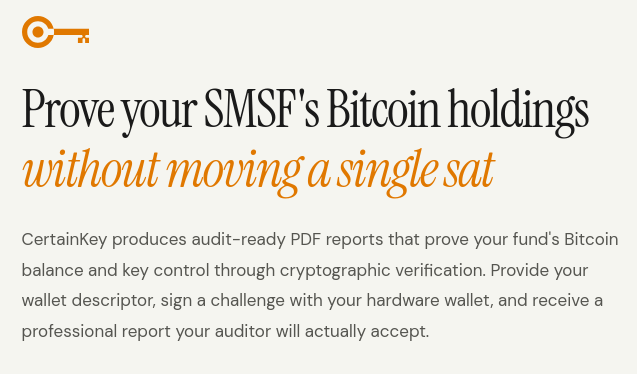
@Dale21M Auditors need to verify ownership and control of SMSF bitcoin holdings. Not all evidence is equal. Here's what the auditing standards say about evidence quality.
@FuturistOfMoney@Dale21M Listing addresses is the de facto standard but won't satisfy diligent auditors. What I mean is: How can an auditor know that you actually OWN and CONTROL the bitcoin at those addresses? Anyone can list an address they don't hold keys to.
@Dale21M Thanks Dale. For the curious: the trustee signs a message with their private key, proving control without moving funds. That proof is what the auditor gets. No screenshots needed.
ALSO
You guys act like we had The Bitcoin Fucking Standard and 500 different podcasts to listen to. All we had was a few sci-fi novels, Bitcointalk forums, Free Talk Live, and a bunch of fucking autists in New Hampshire that were using brass Chuck-e-Cheese tokens made by some guy named Mike Caldwell, and sent to us by some other guy named Roger Ver.
It took me like a year to understand that Bitcoin couldn't be "hacked" or that coins couldn't be duped. Hell, I barely understood the halving by the time the first one happened in 2012.
ON TOP OF ALL THAT WE WERE USING STUPID SHIT LIKE MTGOX AND BTC-E BECAUSE WE DIDN'T UNDERSTAND EVERY FUCKING ASPECT OF A REALLY COMPLICATED FUCKING THING. AND THE PEOPLE WHO DID UNDERSTAND SELF CUSTODY FORGOT THEIR COMPLICATED WALLET.DAT PASSWORDS OR THREW THEIR FUCKING HARD DRIVES AWAY.
The fact that any of us even have any fucking money today is a miracle.
If you used the same keys, you should see the following as your first receiving address.
bc1qslax28zh629uezhvkqkd659wj44gct95vk5dkzae7elf4hknuhss5pc95f
Next, we'll use https://t.co/RORU8TalOC to securely issue challenges and verify that keys are correct and available.
*Walkthrough guide to upping your multisig resilience*
Let's build a multi-sig bitcoin wallet together and then test the keys using https://t.co/RORU8TalOC. I'll provide keys for this demo but feel welcome to substitute some or all of your own.
A timely reminder that trading is mostly a bad idea. We have deeply ingrained psychological weaknesses that work against us. Stay the course or regret.
For all those "planning" on selling a significant portion of your stack at the top of this #bitcoin cycle to buy back lower in the subsequent bear market, here's some things to bear in mind:
1. Your technical analysis is unreliable
If there's one thing bitcoin is consistent with, it's breaking models. Whatever metrics you're using to predict "the top" are likely to be way off, resulting in you either selling way too early or missing your chance to sell.
2. You're unlikely to win against your own psychology
Unless you're a Taoist monk, you are unlikely to be able to stick to whatever plan you make, whether that's selling when you "should" or resisting buying back when you "shouldn't". The human psyche was not built to handle bitcoin's volatility. By putting trading on the table, you're likely to make some impulsive decisions you regret.
3. Buying back may not be so easy in future
"Getting back in" may become significantly restricted in the next couple of years, especially if bitcoin starts threatening the incumbent financial system. Retail buyers could be restricted in purchase amounts under "emergency" legislation. Self custody may get banned. Bitcoin holders with large amounts of bitcoin already in self-custody may be in a privileged position that is challenging to replicate in future.
4. Bitcoin is safer than stablecoins
If you're planning to "rotate into stablecoins" you're exposing yourself to 2-3 more layers of counterparty risk than a regular bank account. It's only a matter of time before a major stablecoin blows up, whether it's due to their own mismanagement or a third-party intervention. Even major banks have started exposing themselves as candidates for collapse.
5. Every trade erodes your privacy
You probably already purchased your bitcoin from a KYC source. But even with that in mind, every trade you make "refreshes" your identity footprint on-chain. The more you trade, the more you expose yourself to the global surveillance dragnet. Which could come back to bite you if leaked (exposing you to criminal threats) or if authorities start taking retributive action against bitcoiners.
No one has ever regretted hodling bitcoin. But most sellers wind up regretting selling. Based on my anecdotal experience, by trying to play the market, you're far more likely to end up with less bitcoin than you started with. There's a reason "hodl" is a bitcoin meme.
@QLD_HODL Crushing bureaucratic impositions on building and development sounds good though! Lets see:
1. More competition between regions, even at the very local level
2. More freedom to experiment in design and development
3. Stronger property rights (i.e., using property as you wish).
@QLD_HODL Maybe they would. Or maybe not for unintended consequences. When I look at that list, I see:
1. More taxes
2. More taxes
3. Market intervention
4. Market intervention
5. Removal of redistribution
6. Movement intervention
I'm not interested in govt "solutions".