The Fear of the Jesuits in 17th-century Poland and Lithuania: The First “Cult�� Panic https://t.co/Xk4I1A7qnm An exploration of anti-Jesuit polemics reveals a much older genealogy behind today’s campaigns against groups branded as outsiders, manipulators, or “cults.”
This is why libraries and bookstores will always be one of the best places in the world. Picked up a book I did not know existed, which I did not know I wanted, but which I find absolutely fascinating (an anthropological history of how various cultures have interacted with the “undead”: it strongly appeals to my love of the gothic aesthetic and literature…). Serendipity. @Boghallen
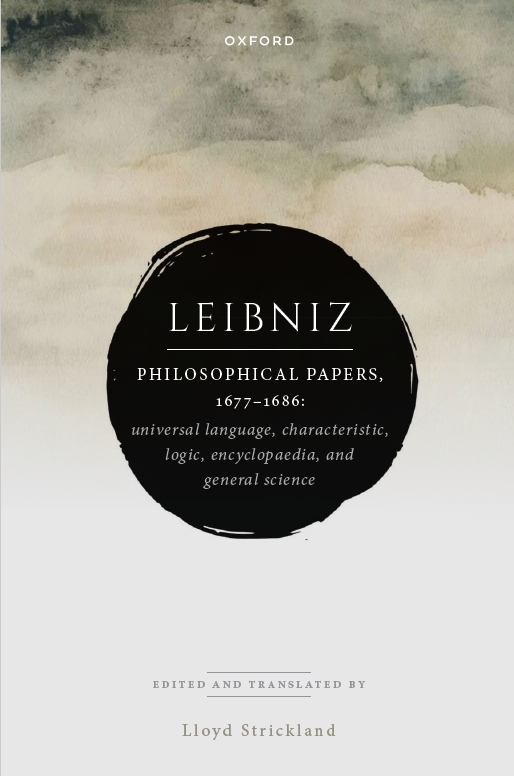
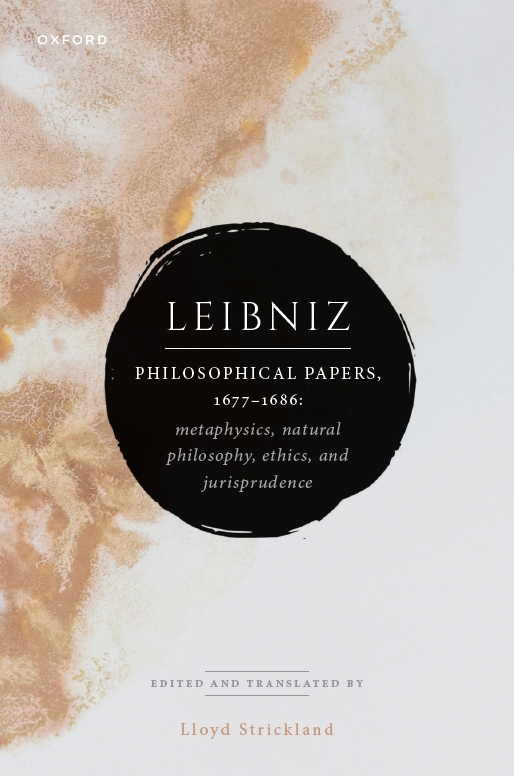
Did you know? 203 of the texts in the new edition of “Leibniz’s Philosophical Papers” appear in English for the first time. A transformative resource for students, scholars, and anyone interested in early modern thought. https://t.co/EUQQdlQBaW
@vrundasays_ in Jacobine and revolutionary France mathphy embodied abstract-analytic rationality associated with the management of the state, hence a task for men, vs imaginative-metaphysical thinking considered expression of "female intelligence". In some ways this ideology is still at play
Open access resource. 26,002 Neugebauer's file cards digitized: "Neugebauer wrote by hand the very detailed and meticulous notes that he used for research and publication throughout his career." Besides, all vols of the journal Aestimatio are there too. https://t.co/l5L1zoWR4k
With Jemma Lorenat and Kim Plofker, I am now responsible for the Abstracts section of Historia Mathematica (feel free to send suggestions of books and papers for the next issue): https://t.co/8mpKNBX9RG
I am very excited to share my recent contribution to Nuncius: Journal of the Material and Visual History of Science. It was such a wonderful experience working with them to get this across the finish line. Very pleased with the coloured figures, too! https://t.co/n0evzsC6v3
Keep track of time with the "New and thorough instructions: How to use a universal method to construct large sundials on any flat surface" by J. Doppelmayr. At the time he was a renown prof. of maths in Nurnberg. A copy exists in Prague, it was bought by T. Kherbaum, a theologian
Practicing mathematics in the Habsburg lands: a Zotero database with manuscripts of student and teachers' lecture notes in mathematics, mainly in German and Latin. A few sheets by Bolzano's brother with Bolzano's corrections was an interesting discovery. https://t.co/alqN6IuUmn
@kareem_carr I think it is correct to say that the status of infinitesimals (but not of calculus) was in flux at the time. Cantor criticized infinitesimals a few years after Marx, even if on less naive grounds. Marx critique reminds of Berkeley's Analyst from 1734.
In 12 days Petra Hyklová and Petra Stankovic will talk about mathematical and astronomical communities in the 19th and 20th centuries (https://t.co/oueFYpNxPg).
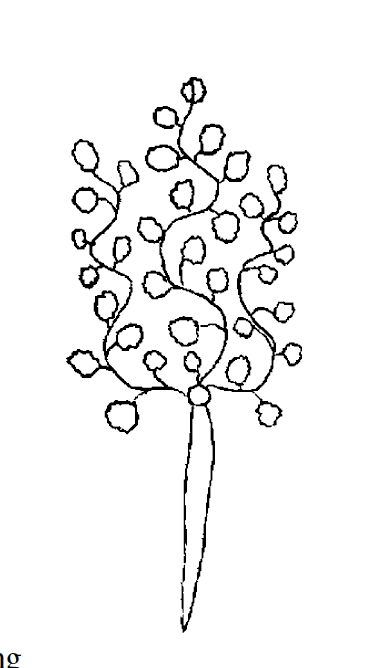
When Jacopo da Firenze talks about approximating square roots...he actually draws a plant with its roots (pic from J. Høyrup, "the world of the Abbaco").
I found an early (perhaps the earliest?) occurrence of "metamathematics" in an obscure work from 1701, "de mathesi nova non nova disputatio". Here "metamathesis" means what is common to arithmetic geometry, i.e. algebra. "Metageometria" was a more common term.
My friend Elías Fuentes Guillén is doing an interesting research on and around Bernard Bolzano in Prague. Here you can read more about results, outcomes and future directions of research: https://t.co/jVhH6Lyg3i
Was learning maths or any other science via etymologies common in the early modern period? In these marginal notes to Dechales' Euclid someone carefully reconstructed the Greek and Latin origins of several geometrical terms.
Jesuits having some (drunken?) fun. A disputation on "vinosophy" at the university of "Wien-Bier", which included "bibalectica", "bibisica" and "metabybisica". There is a count of of Trink-Haus (of course) and it is presided by Witrivius Flasch.