Refactoring legacy code is like playing Minesweeper blindfolded.
Rename a core API function and suddenly every screen in your app is yelling at you.
Tried Trae v3.5.13’s Cue-Pro (not the chat, the proactive sidebar) on my movie app, total chaos, 10/10 would break again.
Building 3D assets used to feel like assembling IKEA furniture from memory.
One wrong step and you're staring at a polygon disaster.
Tried Meshy 3D Agent.
You chat.
It brainstorms.
It generates options.
It turns the good one into a 3D model.
Even answers your "why does this look weird?" questions along the way.
We're getting closer to AI tools that participate in the workflow instead of sitting at the end of it.
Dangerous for my weekend productivity.
Introducing Meshy 3D Agent 🚀
→ https://t.co/yGO7XA5vll
Introducing Meshy 3D Agent 🚀 The world's first AI agent for 3D creation, now in Beta.
Just chat — the agent will:
🧠 Brainstorm with you, pitching directions first
🎨 Generate visuals in batches, refined through chat
🧊 Turn your favorite into 3D — print, download, anywhere
📚 Answer your 3D questions in-line
Create 3D in conversation with Meshy Now → https://t.co/3g1voTIUhY
We just launched Sites into Codex!
Software creation was always about more than writing code. Sites in Codex fundamentally gives the power of end-to-end software creation to every user, no matter their technical fluency.
These Sites are fully deployed to a URL, private to workspaces, come with authentication, can have static files, and can store dynamic data in databases.
It is in preview for business and enterprise teams and will be rolling out to all workspaces over the next day. Give it a try by typing @ Sites into Codex and ask it to build anything!
This project took a massive amount of effort across hundreds of people at OpenAI - proud that we were able to get this out and excited to see what you all build with it!
AI can give researchers the freedom to pursue “crazier” ideas.
For Terence Tao, AI creates more room to experiment, test unexpected paths, and discover what might otherwise stay out of reach.
Thank you for being here today. Your support means a lot to the whole team. We will get back to flight, and we will get to the Moon. Gradatim Ferociter.
@ego_agent The interesting part isn’t “AI using a browser.”
It’s finally giving agents a browser state stable enough to behave like actual coworkers instead of caffeinated interns opening 47 broken tabs.
AI is accelerating execution, but what remains scarce is the one who makes the judgment.
ego lite doesn’t replace that judgment—it amplifies it. Your agents run in parallel Spaces inside the same browser, handling multiple tasks without interrupting your flow or your tabs.
By moving browser actions into native JavaScript execution and keeping real Chrome state intact, it reduces friction, cuts overhead, and makes agent workflows faster and more direct—while you stay in control of the decisions.
Browsers were never built for agents.
Those Chrome-bridging solutions, windows flying everywhere, login states breaking at random. Not bugs. Just bridge limits.
Same task. 20% to 245% faster. Not magic.
ego lite is rebuilt from the kernel up.
Your AI agents, Claude Code, Codex, OpenClaw and more, inherit your login state directly, run in fully isolated spaces in the background, never touching your tabs.
What they get isn't a handful of CLI commands, but complete JS functions: complex multi-step operations, written once, executed once. Not "run two commands, stare at output, run two more" on repeat.
Your browser, Your agent. Together, for the first time.
Excited to share our most powerful new Claude Code feature: dynamic workflows!
Mention "workflow" in a prompt and Claude will dynamically create an orchestration plan that it strictly follows, allowing you to confidently trust that every stage happens in the right order even across 100s of agents.
Today Reactor is coming out of stealth. We’ve raised $59M in Seed and Series A funding, led by @lightspeedvp, with participation from @AmplifyPartners, @wndrco, @Sky9Capital, and @FPVventures.
Reactor is the platform for building in the World Model era: the infrastructure that lets developers build with them at global scale for the first time. Stream from a frontier World Model to your app, in real time, all in under 10 lines of code.
World Models represent the next major shift in AI: pixels, audio and actions are generated on the fly, in real-time, in response to user inputs, and to the environment. Every time computing has made a shift from passive to interactive, entire industries appeared that didn't exist before. We're standing in front of such moment again.
Over the last 6 months, we’ve assembled an all-star team with alumni from Apple, Meta, Google, Luma AI, Netflix, and Replicate. We're already partnering with some of the biggest names and labs in the world, and hundreds of developers are already building on Reactor.
The World Model era starts now.
Today we're announcing Figure has signed a commercial agreement with Catalyst Brands to deploy humanoid robots at scale
Catalyst operates iconic brands including JCPenney, Aéropostale and Brooks Brothers. Figure will start initial deployment in Reno, NV
Introducing Runway MCP. Now you can connect Runway directly into Claude, ChatGPT, Cursor, Replit and more.
Generate polished images and videos with state-of-the-art models, like Gen-4.5, Seedance 2.0, GPT Images 2.0, Kling and more. Right from where you're already working.
Connect the MCP to your agent in seconds at the link below.
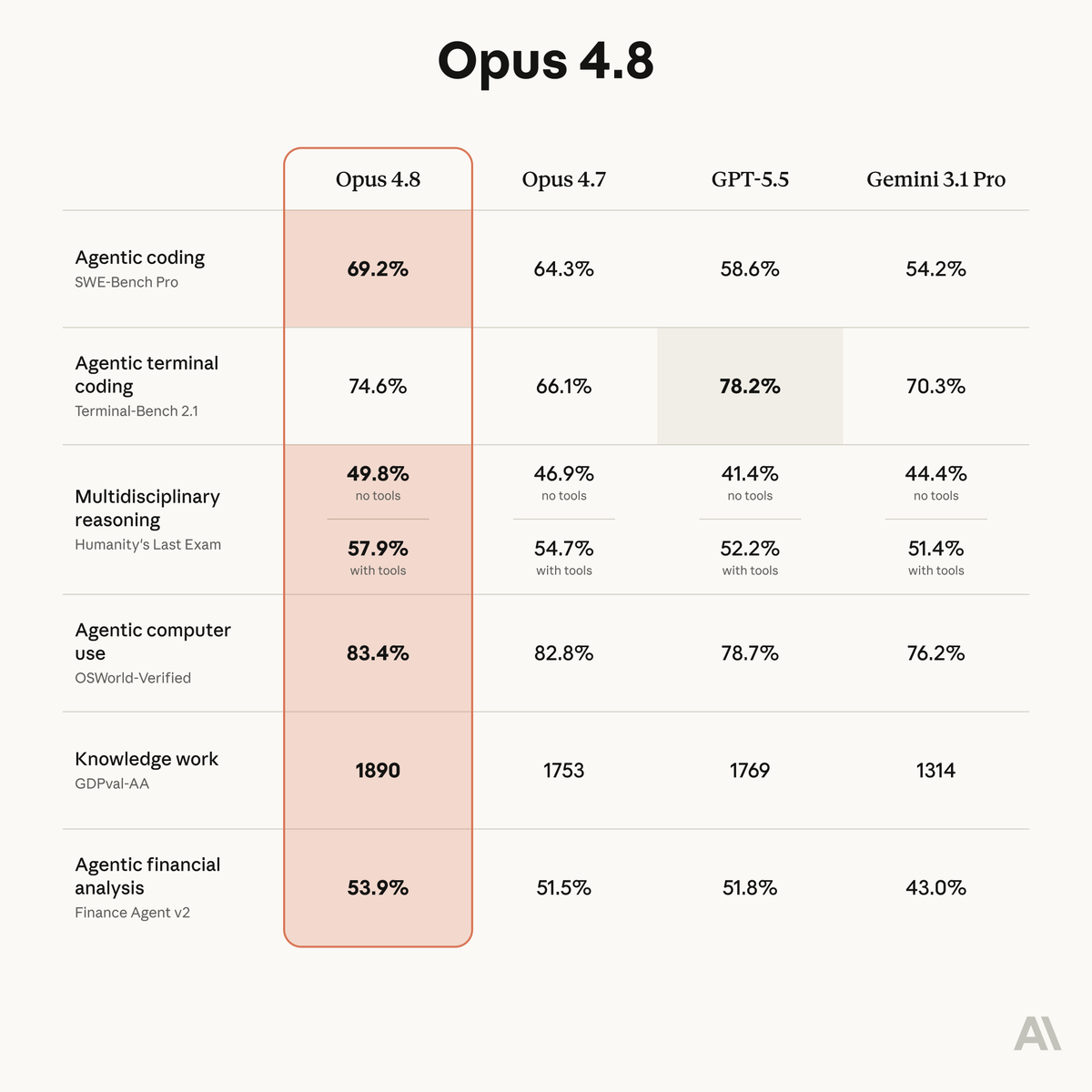
Introducing Claude Opus 4.8: it builds on Opus 4.7 with sharper judgment, more honesty about its own progress, and the ability to work independently for longer than its predecessors.
Available today at the same price.
Personal update: I've joined Anthropic. I think the next few years at the frontier of LLMs will be especially formative. I am very excited to join the team here and get back to R&D. I remain deeply passionate about education and plan to resume my work on it in time.
Recently I’ve been thinking that video creation is quietly changing.
The hardest part today is often no longer filming or editing, but the structure of the video. How the opening captures attention, how the story develops, and why some videos keep people watching while others get skipped.
Most AI tools today focus on generation, such as producing text, images, or video clips. But the deeper challenge is structure, which means finding repeatable content patterns that can consistently hold attention.
Recently I’ve been testing a tool called Wizstar. One feature I find particularly interesting is Video Reference. It allows you to use a high performing video as a reference, analyze its narrative structure, and generate new content using a similar attention flow for different products or topics.
It does not copy the original video. Instead, it reconstructs the underlying logic, including the opening hook, how shots progress, and how the content maintains attention.
It can also keep a product or character consistent across different shots, even when lighting or camera angles change. This is especially useful for e commerce content.
Technically it is based on Seedance 2.0, and supports face input and multi model collaboration.
What makes it interesting is that it turns video creation into a workflow where content structures themselves can be reused.
Just one try and you can get video results like this.
Wizstar also offers free credits for new users, and the first subscription is available for $19, which includes a 30 second Ecommerce Agent trial.
If you are experimenting with AI for video creation, Wizstar is worth trying.@WizstarAI
#Wizstar #AIVideo #GenerativeAI