Findings reveal that sexual assault training programs of varying duration/dosage can significantly improve police perceptions, knowledge, and behavior, and thus a considerable effect on officers' enhancing police response to sexual assault.
Training was correlated with improving police officers' perceptions, decisions in hypothetical case, content knowledge, and police behaviors. Analysis of follow-up data showed effects remained stable over time.
New study published w/ @BradCampbell3 and Katelyn McMahon (Awesome Doc Student with @JusticeUofL) in Policing & Society. We use a Solomon 4-group design to evaluate whether officer jurisdiction type moderated the effect of @KYDOCJT sexual assault investigators training.
Results showed training significantly reduced rape myth acceptance and improved misperceptions about trauma, regardless of the geographic region officers reported working. However, rural officer had less knowledge of trauma.
https://t.co/grmEfBmmcv
👀New study w/ @DavidLapseyCU@AlondraDenise@amandagoodson90 & Franklin in Journal of Experimental Crim. We examined the effects of @KYDOCJT 40-hr sexual assault investigations training on officers’ intentions to arrest and use procedural justice. https://t.co/RRlDUbHCSM 1/4
Link to new article published by @BradCampbell3 , Ivan Benitez, and I in JCJ. We examined the impact of focal concerns theory on arrest and prosecution in sexual assault cases. https://t.co/rzSphVZmjA
We reviewed >1,000 effect sizes across 46 studies. Overall, focal concerns robustly impacted arrest and prosecution, although focal concerns may be better suited to explain charging decisions made by prosecutors.
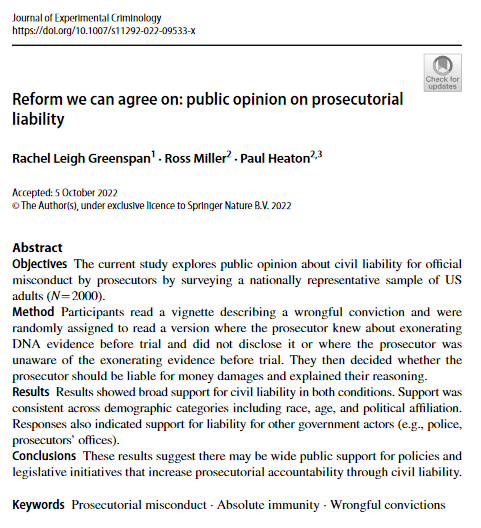
ABSOLUTE immunity doesn't capture interest like mere qualified immunity. A very interesting experiment here shows huge gaps b/t public opinion and doctrine. Big majorities of the public want civil liability for prosecutors, which is currently impossible.
https://t.co/mtoaJOaiT6
New article shows perception that school rules are fair are related to lower likelihood of repeated bullying among students
@DavidLapseyCU
https://t.co/bO5aapwWs2
👀New paper w/@DavidLapseyUofL in Criminal Justice & Behavior @SAGEcriminology. We use a Solomon 4-group design to examine whether education or impulsivity moderated the impact of @KYDOCJT sexual assault investigator training on knowledge and perceptions https://t.co/EIzzG7huqD
@erynnicoleoneal Thanks a lot, Dr. O'Neal! Your work helped inspire and motivate me to study this topic. I'm also super grateful to have you as a member of my dissertation committee. Thanks again for your useful comments today.
New meta-analysis from @DavidLapseyUofL in Trauma Violence & Abuse (@SAGEcriminology) examining focal concerns and arrest in sexual assault cases. Main takeaways: (1) police perceptions about victim engagement are the strongest predictor of arrest, (1/3) https://t.co/V3RVn7t2aE
Study comparing fatal and non-fatal incidents of IPV, with Suzanne Overstreet and @DavidLapseyUofL, now published in Homicide Studies: https://t.co/NM93aWXlSz
@uofl@IUSoutheast