AI fatigue is real. Enterprises face slow decisions, low engagement, and vendor skepticism. It's not AI rejection, but burnout from hype, complexity, and unmet expectations. The market needs to slow down and listen. #AIFatigue#TechTrends#BusinessStrategy
The Neocloud Market Is Finally Getting the Analysis It Deserves — And That's a Big Deal
The neocloud market is still finding itself. Month to month, the definition, the players, and the use cases are evolving. It's been challenging to write about this space with any real authority because the research just hasn't been there.
That's why I'm excited to see pieces like the recent coverage on VAST Data and the neocloud ecosystem starting to get into the specifics — who's using these platforms, what workloads they're built for, and where the model is heading. This kind of grounded analysis is exactly what the industry needs right now.
We need more of this. The neocloud space isn't just some footnote in the AI infrastructure story — it's becoming a central player in how enterprises access GPU compute at scale. When we see research that actually breaks down the economics, the architecture decisions, and the trajectory of these providers, it helps everyone — architects, decision-makers, and the vendors themselves.
The reality is that neoclouds started as a scrappy alternative, built by teams who pivoted from crypto mining and found a real market in AI workloads. Now they're evolving into something more sophisticated — multi-tenant infrastructure with consumption-based models, positioned to challenge traditional cloud providers in specific high-performance scenarios.
That's a meaningful shift, and it deserves serious analysis. Keep this coming. I'll take any well-researched perspective I can get on where this market is heading.
https://t.co/crShYXGgCx
Organizations keep making the same IT adoption mistakes. Employees are told to use new tech without understanding its impact on their jobs. #TechAdoption#AI#DigitalTransformation
Check out the latest article in my newsletter: Linthicum Research LLC Announces Groundbreaking Six-Month Enterprise Technology Report Series: Pragmatic Analysis to Help Enterprises Select, Deploy, https://t.co/lQAL9UdZ9C via @LinkedIn
AI integration is everywhere, leading to 'AI brain fry.' Fatigue is real, causing errors, decision overload, and even intent to quit. Companies must consider culture and purpose before widespread adoption. #AIFatigue#TechTrends
Digital exhaustion is real: 75% of workers battle it, leading 65% to 'productivity theater' – pretending AI boosts their output. Without the human element, AI initiatives fail. True AI impact requires human buy-in and understanding. #AI#Workplace#DigitalTransformation
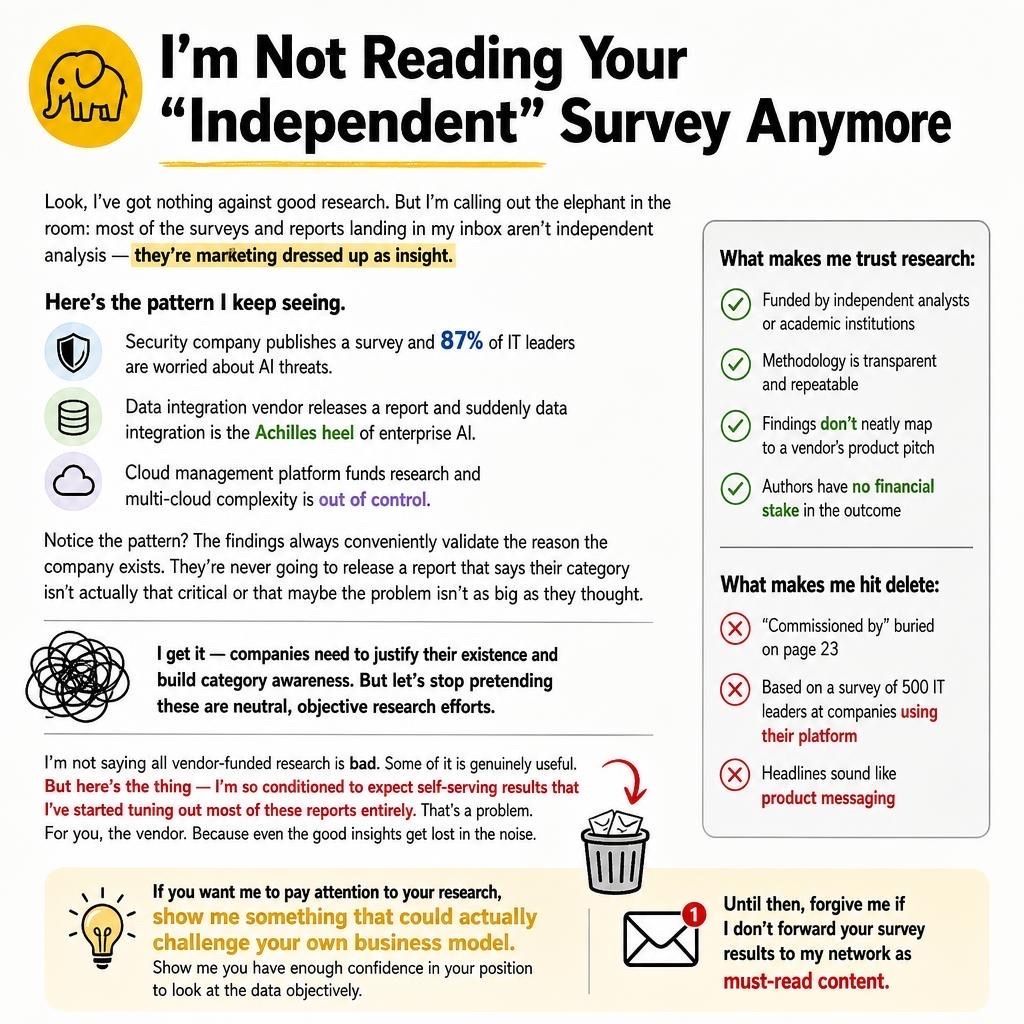
I'm Not Reading Your "Independent" Survey Anymore
Look, I've got nothing against good research. But I'm calling out the elephant in the room: most of the surveys and reports landing in my inbox aren't independent analysis — they're marketing dressed up as insight.
Here's the pattern I keep seeing. Security company publishes a survey and 87% of IT leaders are worried about AI threats. Data integration vendor releases a report and suddenly data integration is the Achilles heel of enterprise AI. Cloud management platform funds research and multi-cloud complexity is out of control. Notice the pattern? The findings always conveniently validate the reason the company exists. They're never going to release a report that says their category isn't actually that critical or that maybe the problem isn't as big as they thought.
I get it — companies need to justify their existence and build category awareness. But let's stop pretending these are neutral, objective research efforts.
What makes me trust research is when it's funded by independent analysts or academic institutions, when the methodology is transparent and repeatable, when the findings don't neatly map to a vendor's product pitch, and when the authors have no financial stake in the outcome. What makes me hit delete is when I see "commissioned by" buried on page 23, when it's based on a survey of 500 IT leaders at companies using their platform, or when the headlines sound like product messaging.
I'm not saying all vendor-funded research is bad. Some of it is genuinely useful. But here's the thing — I'm so conditioned to expect self-serving results that I've started tuning out most of these reports entirely. That's a problem. For you, the vendor. Because even the good insights get lost in the noise.
If you want me to pay attention to your research, show me something that could actually challenge your own business model. Show me you have enough confidence in your position to look at the data objectively.
Until then, forgive me if I don't forward your survey results to my network as must-read content.
AI anxiety is rampant among employees as generative AI evolves rapidly. Companies push adoption faster than people are comfortable with, leading to confusion and fear of being left behind. #AI#EmployeeAnxiety#FutureOfWork
The Vector Database Reckoning: An Enterprise Guide to Picking Winners and Losers in the $4B Search Wars
We're About to Drop the Most Honest Vector Database Report You'll Read This Year
After three decades of covering enterprise tech, I've learned to spot when a technology category is ready to shake out. Vector databases? That time is NOW.
I've been tracking this space for two years, and I'm finally ready to publish my comprehensive evaluation. This isn't a marketing piece. This is the report I wish I had when enterprise clients started asking me which vector database to bet their AI strategy on.
Here's what's in the report:
What is a vector database — and why the definition matters more than vendors want you to think
What it actually does — beyond the RAG buzzword bingo
When to use one — and when you're just fine with pgvector in your existing Postgres instance
How to evaluate and implement — practical criteria based on real enterprise deployments, not benchmarks from vendor websites
The complete vendor landscape — with hard evaluations, winners, losers, and the ones to watch
The vendor list we're covering includes Pinecone, Weaviate, Milvus, Qdrant, Chroma, pgvector, Azure AI Search, OpenSearch, SingleStore, and a few surprises.
Each one gets an honest assessment on: scalability, enterprise readiness, total cost of ownership, support, and yes — which ones will still be around in 24 months.
Why now?
Because enterprises are past the pilot phase. They're deploying RAG at scale. They're realizing that the vector database layer is becoming mission-critical infrastructure, and picking the wrong one is a 6-12 month detour you can't afford.
We're publishing late August 2026. Drop a comment if you want early access, or if you want to share your own experiences with these platforms.
This is going to ruffle some vendor feathers. Good.
The Incredibly Shrinking Big Consulting Workforce
If you've been noticing that a lot of people here on LinkedIn and X are announcing their departure from one consulting firm or another — Deloitte, PwC, EY, KPMG, Accenture, McKinsey, BCG — you are NOT alone.
I've been tracking this trend for the past year, and when I looked into it, the numbers are striking. These firms aren't just experiencing normal attrition. They're actively incentivizing people to leave — offering generous packages for early retirement or clean exits to move on to other opportunities. The Big Four have collectively shed over 9,000 jobs through multiple rounds of layoffs. Even the MBB firms are cutting staff. Something is fundamentally broken.
So why is this happening? I've got some thoughts.
The leadership is substandard. Most of these firms are run by partners who made the most friends, not those who actually understand where the industry is heading. Vision? None. Strategy? We'll figure it out. Direction? Good luck finding it.
There's no real plan for AI. These firms keep trying to drive the old tire model — billable hours, body shops, same playbook they've used for decades. It's not working anymore. Clients are waking up to the fact that they're paying premium rates for commoditized work that AI can do better, faster, and cheaper.
They're reinventing nothing. The consulting world is in desperate need of new thinking. Better delivery models. Real value creation. Actual innovation. Instead, we see leadership protecting the status quo while the talent walks out the door.
Here's the thing — if these firms were properly managed, they could absolutely find a path to greater success. They have the talent, the client relationships, the brand recognition. What they lack is the will to change. Reinvent what you do, how you do it, and who leads you — and suddenly you've got a future again.
I suspect this is going to get worse before it gets better. Some of these firms need to hit rock bottom before they find a new direction and a new path.
By the way — while the Big Four are shrinking, my consulting firm has grown 900% in the last two years. Funny how that works when you focus on delivering real value, building modern practices, and actually listening to what clients need.
What are you seeing? I want to hear from the folks on the ground.
AI's Ability to Self-Improve Isn't New—So Why Are We Pretending It Is?
I've been working with AI since the 80s. And I need to say something that's probably going to be unpopular in some circles:
AI learning dynamically, recursively improving itself—that's not a novel sci-fi capability. That's the whole point. That's always been the feature. If an AI system can't grow, adapt, and teach itself, it's not really AI worth using. It's just a lookup table with extra steps.
So when I see headlines about AI companies warning that their models might "improve themselves without human involvement"... I have to ask: what exactly are you complaining about? You're describing the product. That's like a car company warning that their vehicles can reach high speeds.
And here's the other thing that's been bothering me. If this technology is truly dangerous—if it genuinely poses existential risks that warrant warnings—then take it down. Go out of business. Regulate it properly before release. Stop putting it in the hands of the public.
But instead, we get this bizarre "humble brag" marketing from major AI providers. "Our technology is so powerful it's dangerous!" Cool story. Still selling it though.
Either you believe it's dangerous and act accordingly, or you recognize it's a valuable tool that can be managed responsibly. You can't claim both.
I'm genuinely curious—is there something I'm missing here? Is this a genuine safety concern, or is this just making old technology look new to justify valuations and regulation shields?
Anthropic Warns AI Will Soon Improve Itself Without Human Oversight https://t.co/gXukj9qYGr
What do you think? Am I off base here?
Why Enterprises Taking AI In-House Is a Nightmare for Consultants and Cloud Providers
Why are enterprises approaching AI so differently from cloud? In this video, we break down the major shift happening inside large companies as they move away from depending heavily on consulting firms and public cloud giants like Microsoft, Amazon, and Google. Instead of outsourcing strategy, architecture, and execution, many enterprises are building internal AI teams, creating their own roadmaps, and deploying homegrown solutions in data centers they control. We explore why AI is pushing companies toward ownership, customization, cost control, data security, and long-term competitive advantage. You’ll see how concerns around vendor lock-in, rising inference costs, regulatory pressure, and the need for proprietary workflows are changing the enterprise technology playbook. We also look at why this moment feels different from the cloud era, when companies were much more willing to rely on outside partners. If you want to understand where enterprise AI is really going, and why self-reliance is becoming the winning strategy, this video gives you the key arguments, visuals, and talking points you need. Whether you work in tech, consulting, infrastructure, or the C-suite, this analysis will help you explain the trend clearly and see what it means for budgets, operating models, and enterprise power dynamics next ahead.
Why We're Not Seeing AI ROI in 2026 — And Why That Won't Change This Year
The numbers are in, and they're uncomfortable.
Despite billions flowing into AI, we're not seeing the returns. And here's the uncomfortable truth: we won't see them for the remainder of 2026 either.
The ROI Gap is Real and Growing
PwC's 2026 CEO Survey reveals that 56% of CEOs report no measurable revenue increase or cost reduction from AI investments. Only 12% report achieving both. That's not a technology problem — that's a strategy and execution problem.
Bain & Company's research shows that while 37% of organizations targeted cost reductions of 11-20%, nearly 40% landed below 10%. Yet 90% are increasing their budgets anyway.
Gartner's latest data: 72% of AI projects in infrastructure and operations fail to fully meet ROI expectations. Only 28% succeed outright.
The Problem Isn't the Technology
Here's what the research keeps telling us but we keep ignoring:
We're automating broken processes. Bain puts it bluntly — AI doesn't fix workflow debt; it locks it in, speeds it up, and makes it vastly more expensive to unwind. We're throwing AI at processes that were never optimized in the first place.
Data is still the wall. 41% of organizations cite data access and integration as the #1 barrier to AI progress. After a decade of data modernization investments worth hundreds of billions globally, we still can't reliably get access to our own data.
The "autonomous" agents aren't autonomous. Only 7% of companies are running fully autonomous agents in production. The dominant model requires human approval. Yet investment cases are built on full automation economics. The gap between the business case and reality is bankrupting CFOs.
We're funding the next wave with savings that never arrived. 44% of companies plan to self-fund AI agent investments from "prior automation savings" — but those savings consistently came in below target. We're compounding risk, not managing it.
Usage doesn't equal value. Most AI deployments are still doing low-complexity work — summarization, basic Q&A — that doesn't move the needle.
What the 12% Are Doing Differently
CEOs who report financial returns are 2-3x more likely to have embedded AI extensively across decision-making and demand generation. They haven't just bought licenses — they've rewired operations. They've treated AI as a CEO-level mandate, not an IT project.
The Hard Truth
The era of unmeasured experimentation is over. We spent 2024-2025 celebrating pilots and "AI strategies." Now the board wants auditable outcomes, not slide decks about potential.
We need to stop asking "Where can we apply AI?" and start asking "If we were designing this process from scratch today, what would it look like?" Only then should the technology conversation begin.
The window to get this right is narrowing. The organizations that figure this out in 2026 will have a compounding advantage. The rest will keep writing checks hoping the ROI eventually shows up.
It's not showing up. Not until we fix the fundamentals.
So here's a question I've been wrestling with: am I an AI bully?
For the last four years, I've been in countless briefings with people who have no idea what generative AI actually is. Not the buzzword. The technology. And I've tried to be patient.
Then I started pushing back. Asking the hard questions: Why is AI in your product name? What's the model actually doing? Why do you call this agentic? What happens when it fails?
And you know what? People get uncomfortable. Then I get the follow-up messages: "You were kind of mean in that meeting." "You're being a bully."
Am I?
Here's the thing. Wandering from dumb idea to dumb idea while tech companies chase the latest Gartner quadrant has created a chasm between Silicon Valley and enterprise IT leaders just trying to keep their businesses running. A chasm that wasn't nearly this wide ten years ago.
I think I'm pushing back for the business. I'm tired of watching leaders make million-dollar decisions based on marketing decks and FOMO. I'm tired of AI-washing being the path to funding.
So here's my question: am I being mean? Am I being a bully? Do I need to just shut up and let tech companies AI-spline me into submission?
Or is it possible we need more people asking hard questions before we throw money at another "AI-powered blockchain metaverse solution"?
Genuinely curious what you all think. And if you've made it this far, congratulations—you've read more than most people read in a single scroll.
The Emperor's New Agentic Clothes: Why "Agentic" Marketing is Wearing Thin
Been sitting through briefings this week from HPE Discover in Las Vegas, and the agentic announcements are fresh in my mind. HPE just announced GreenLake Intelligence transforms the GreenLake cloud into an agentic-AI-powered hybrid cloud capable of learning, acting and optimizing IT in real time. But honestly? I'm a bit exhausted.
We've entered the era of "put agentic in front of everything." Agentic networking. Agentic databases. Agentic operations. Agentic this, agentic that. HPE is doing it. Everyone's doing it. It's become the new "AI-powered" — a phrase that lost all meaning about three years ago.
Here's what gets me: the people giving these briefings often have no real concept of what agentic AI actually is, when it should be applied, or when it absolutely shouldn't be. They're just tacking the word onto existing products because it's trending. And the irony is, most of these "agentic" capabilities have existed for years under different names. We're just rebranding things to ride the wave.
I get it — marketing teams need to sell. But this low-effort approach to naming conventions and technology positioning is actually working against you. People are fatigued. When everything is "agentic," nothing is. It makes vendors look silly and amateurish, like they're scrambling to keep up rather than leading anything.
The marketing strategy of "add agentic to the slide title and call it innovation" needs serious rethinking. Spend more than 20 minutes on your positioning, folks. Actually explain what the technology does and why it matters.
We've all seen this pattern before. Cloud washing. Mobile washing. Blockchain washing. Now agentic washing. The sad part is the people making purchasing decisions are getting smarter and seeing through this stuff.
To every vendor out there: if you're going to use the term, at least understand it. If you're going to claim agentic capabilities, be prepared to explain the actual architecture, the actual use cases, and the actual limitations.
Good luck out there. We're all tired.
https://t.co/MdEDVKOAGb
OpenSharing Could Be the Missing Layer Enterprise AI Has Needed
One of the biggest issues in enterprise AI and data today is simple: for all the discussion around ecosystems, monetization, interoperability, and collaboration, there’s still very little real sharing happening.
Most enterprises are still stuck with copies, exports, one-off integrations, and custom pipelines whenever they need to exchange data or AI-related assets across business units, partners, suppliers, or customers. That approach doesn’t scale, and it certainly doesn’t support where AI is headed next.
That’s why I see OpenSharing as a step in the right direction.
What makes this interesting is that it’s not just another conversation about moving data. It’s an open, vendor-neutral approach aimed at sharing a much broader set of assets, including tables, volumes, models, and agent skills. If we’re serious about building practical AI ecosystems, that’s exactly the kind of foundation we’re going to need.
I also think it matters that this effort builds on Delta Sharing instead of trying to replace everything that came before it. That kind of evolutionary approach tends to be far more realistic in the enterprise. Organizations are much more likely to adopt something that extends an existing model than something that demands a complete reset.
The zero-copy angle is also important. Enterprises want the benefits of collaboration, but they don’t want to lose control over governance, security, lineage, and compliance. Keeping assets where they are while enabling controlled access is a much smarter direction than continuing to proliferate copies everywhere.
Is this the final answer? Probably not. It’s early, and standards mature over time. But the market does not need more fragmentation. It needs better ways to share data and AI assets securely, openly, and consistently.
Right now, there’s almost no meaningful sharing happening at the level the market actually needs. If OpenSharing helps move the industry toward a more open and usable model, that alone makes it worth watching.
https://t.co/lfV0uFtUDf
From the Stands to the Frontline: https://t.co/iPgvsvewVT Just Scored Big for Kansas City and Cybersecurity
When I heard that https://t.co/iPgvsvewVT had been named the Official Cybersecurity Partner of the Kansas City Chiefs, I smiled. Not just because I'm a fan of innovative moves in our industry, but because this partnership represents something bigger than just another sponsorship.
For those who don't know, https://t.co/iPgvsvewVT is an agentic-native, human-led security operations company founded by operators with deep experience at Google Chronicle and leading AI labs. They've already caught the attention of Andreessen Horowitz, who led their seed round in 2025. And now? They're protecting one of the most iconic franchises in American sports.
Why does this matter?
Look at what they're protecting: millions of fans who rely on seamless broadcasts, digital experiences, and stadium connectivity. The modern sports organization isn't just about what happens on the field anymore—it's about the digital ecosystem that keeps fans engaged, ticketing systems humming, and operations running 24/7. That means cybersecurity isn't optional; it's foundational.
What I love about this announcement is the vision: Tenex will provide AI-driven detection and monitoring, human-validated investigation, and around-the-clock protection. That's not just deploying tools—that's delivering a comprehensive security posture that scales with the organization's needs.
Eric Foster, Tenex's Founder and CEO, said it best: "Championship organizations succeed by staying ahead of the play." That's the mindset we need more of in cybersecurity. Reactive defense is losing ground. Proactive, intelligent protection is how you win.
The Chiefs made a smart bet. Kevin Higgins, their VP of IT & CISO, acknowledged they needed the right blend of innovation, speed, and reliability. That's exactly what Tenex brings to the table.
This is the future of sports-tech partnerships—where the game extends beyond the field and into the digital arena. Congratulations to https://t.co/iPgvsvewVT and the Kansas City Chiefs. This is how you play long-term defense.
Read the full announcement here: https://t.co/6sv87OTtml
#Cybersecurity #KansasCityChiefs #Innovation #SportsTech #TenexAI
🔴 Why I Called It: Regulatory Risk Is the AI IPO Killer Nobody Wants to Acknowledge
When I said "Heck yeah there's regulatory risk" in reference to Anthropic's upcoming IPO, I meant it. And if you're an investor in any of these AI companies, you should have seen this coming.
Here's what I told Fortune's Eva Roytburg in her article on Anthropic's mounting government challenges:
"Pour trillions into building something powerful enough to scare people, and the government's interest is clearly part of the deal."
That's not pessimism—that's pattern recognition. When you spend enormous resources creating technology that national security agencies view as a potential threat, don't be surprised when those same agencies pull the plug.
The current standoff—where Anthropic took Fable 5 and Mythos 5 offline after export controls—will likely resolve quickly. I expect "within 48 hours, Anthropic and the administration will kiss and make up."
But this isn't a one-time event. I anticipate a cyclical pattern of confrontation and resolution that will keep rocking the industry.
And here's the real cost nobody's talking about:
"This reactive regulatory style creates a 'chilling effect' on research, potentially causing companies like OpenAI to hesitate before shipping their next models, and pushing foreign customers toward homegrown alternatives."
This is the price of building powerful AI without a clear regulatory framework. The uncertainty doesn't just hurt Anthropic—it damages the entire ecosystem.
For anyone betting on AI IPOs: price in the government as a permanent stakeholder.
📖 Read the full article here:
https://t.co/6X4tiBfAva
#AI #IPO #TechInvesting #CloudComputing #Anthropic #RegulatoryRisk #ArtificialIntelligence
The Local AI Revolution: Why Your Next Laptop Might Run ChatGPT-Style AI Without the Internet
I just wrote about NVIDIA's RTX Spark, and honestly, this feels like a pivotal moment in how we'll deploy AI going forward. RTX Spark is a platform that puts AI agents, models, and data directly on your machine — no cloud required.
Here's why I'm paying attention:
Cloud-first AI got us here. But centralized models aren't always the answer. When latency, privacy, or connectivity are non-negotiable — think medical diagnostics in remote areas, field engineering, or sensitive government work — local AI changes the game entirely.
I predict a hybrid future. Cloud will still dominate for shared knowledge and collaborative intelligence. But for scenarios where data sovereignty, edge performance, or round-the-clock local agents matter? That's where local AI wins.
The question isn't whether local AI will replace cloud AI. It's which use cases each serves best. And that segmentation might be the most important architectural decision enterprises face in the next five years.
What's your take — is local AI the next frontier, or will cloud remain king?
Read my full analysis: https://t.co/tWNExu5mC0
#ArtificialIntelligence #MachineLearning #EdgeComputing #NVIDIA #EnterpriseAI #CloudComputing #AIRevolution #TechStrategy #DigitalTransformation #FutureOfWork