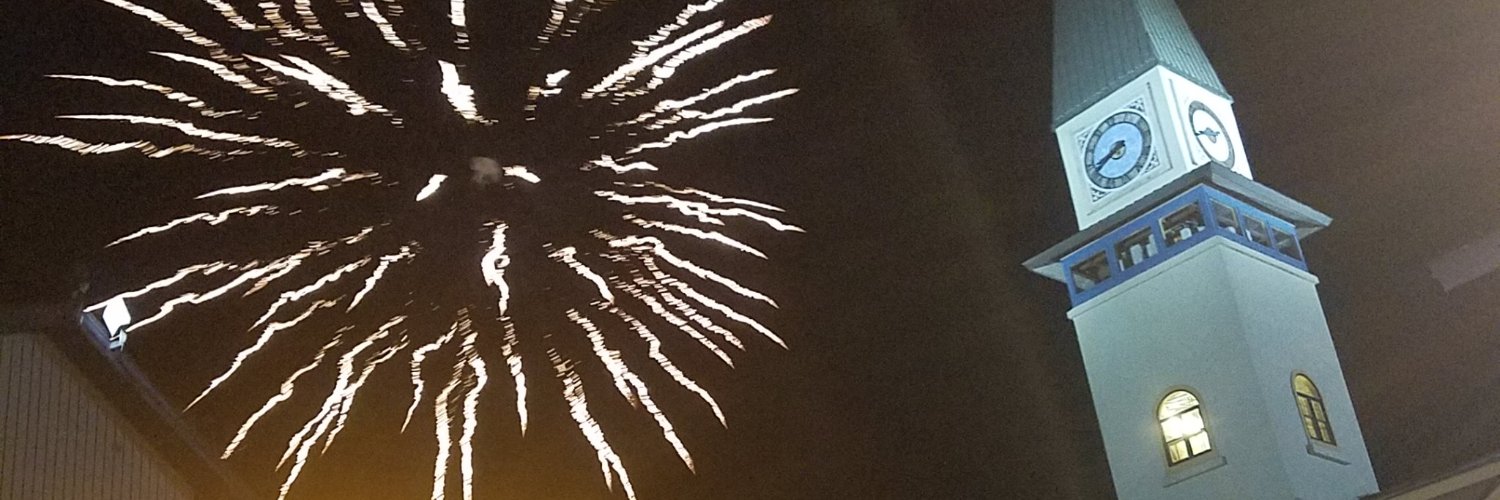
Stunning sunset.
This happens because of a phenomenon called Rayleigh scattering: cirrus clouds scatter the longer, red wavelengths of light and give the sky an orange or reddish hue.
Archaeologists have officially discovered a massive, completely lost ancient civilization hidden deep beneath the Amazon rainforest using advanced LiDAR laser technology. A sprawling, pre-Columbian network of cities that completely rewrites human history.
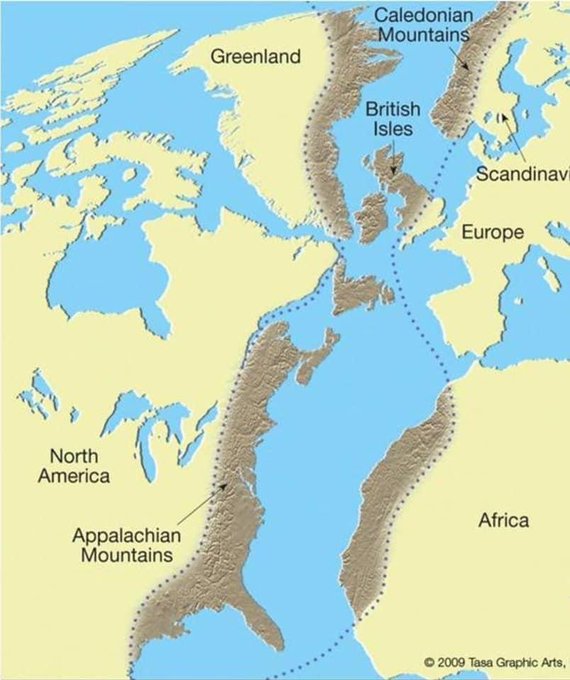
One pretty cool geological fun fact is that the Appalachian Mountains, the Atlas Mountains, the Scottish Highlands, the Watkins Range and Scandinavian Mountains were all once part of the same mountain range, the Central Pangean Mountains.
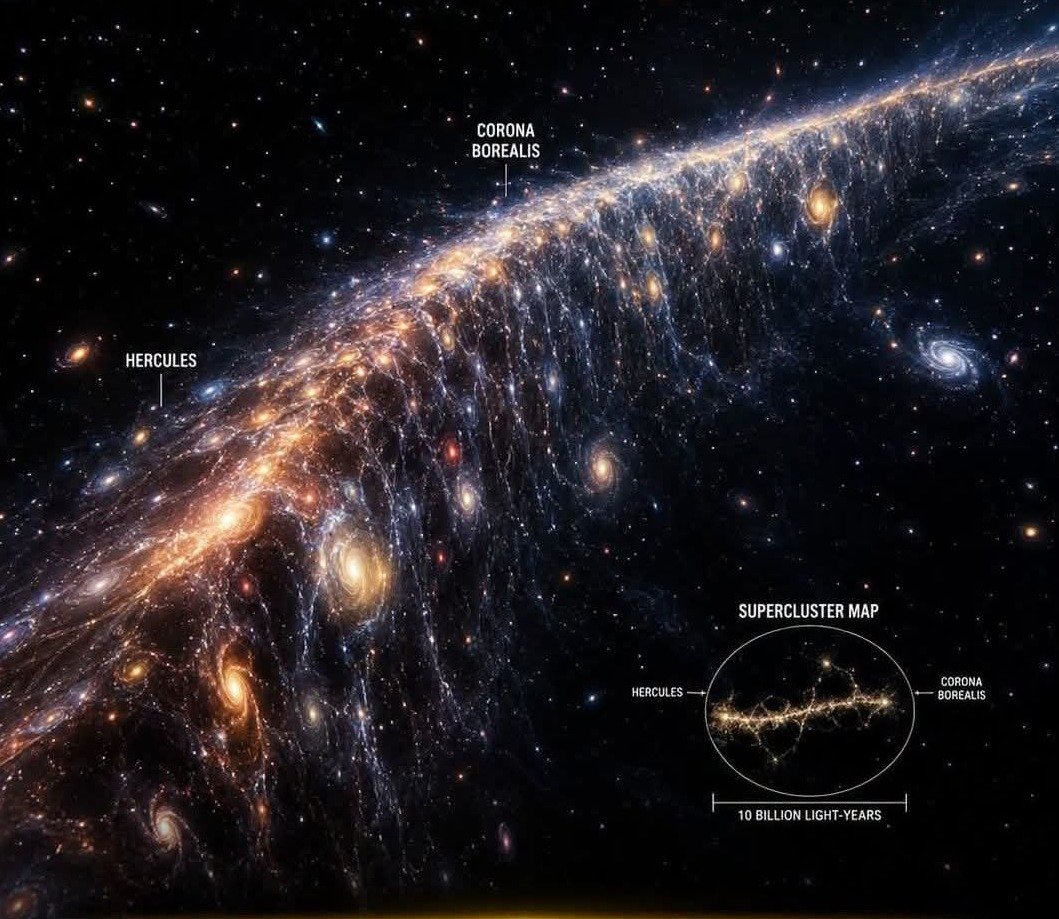
🌌 THE LARGEST STRUCTURE IN THE KNOWN UNIVERSE?
Picture something so vast that a beam of light—racing at nearly 300,000 kilometers every second—would still take billions of years to cross from one end to the other.
That something is the Hercules–Corona Borealis Great Wall, currently one of the largest known structures in the observable universe.
Don’t picture a solid barrier. This “wall” is a colossal filament of the cosmic web: a sprawling concentration of galaxies, galaxy clusters, and dark matter stretched across an estimated 10 billion light-years.
Astronomers first spotted it in 2013 while mapping gamma-ray bursts—the most violent explosions in the cosmos. An unexpected clustering of these distant beacons revealed a gigantic overdensity of matter spanning roughly one-tenth the diameter of the entire observable universe.
For scale: our Milky Way is about 100,000 light-years across. The Hercules–Corona Borealis Great Wall is roughly 100,000 times larger.
Its sheer size poses a serious challenge to the cosmological principle, which assumes that on the largest scales the universe should look roughly the same in every direction. Most models predicted that coherent structures shouldn’t grow much beyond about 1.2 billion light-years. This one appears to smash that limit.
Researchers continue to debate whether it is a single, truly connected structure or a statistical alignment of smaller clusters. Either way, it ranks among the most mind-bending discoveries in modern cosmology.
The universe is not a random scattering of stars and galaxies. It is woven into patterns so immense they defy everyday imagination—and somewhere inside this gargantuan wall of galaxies floats our own tiny Milky Way, a humble reminder of just how small our place in the cosmos really is.
The James Webb Space Telescope has done it again: revealing a breathtaking structure now dubbed the “Cosmic Vine”: a string of 20 galaxies stretching across a staggering 13 million light-years!
What makes this discovery so shocking? This colossal formation dates back nearly 11 billion years, forming just 3 billion years after the Big Bang, a time when galaxies were thought to still be forming in isolated clumps. Instead, JWST captured a massive, organized structure linking galaxies together much earlier than expected.
[image: artist's impression]
A billionaire trader has spent 40 years trying to delete a one-hour documentary. It shows him making $100 million in a single afternoon. He predicted the crash that made it possible three months in advance. He has never explained why he wants the film gone. His name is Paul Tudor Jones. The film is on YouTube.
The documentary is called "Trader." PBS filmed it in 1987, three months before Black Monday. Jones was 32 years old, working from a small New York office, wearing shorts and a t-shirt, yelling at his phones, throwing paper across the room, and sleeping under his desk. The film captures him and his research partner Peter Borish overlaying a chart of the 1929 market on 1987, month by month. The two charts tracked within one percent. Borish said this is exactly what happened in 1929. Jones said if the analog holds, October is when it breaks.
On October 19, 1987, the Dow fell 22.6 percent in a single day. It remains the largest one-day percentage loss in stock market history. That afternoon, Tudor Jones covered his shorts and made roughly $100 million. He was 33 years old. He was one of the very few traders on the street who came out ahead.
He tried to bury the tape because it made him look reckless in a professional world that punished swagger. Twenty years of legal effort did not delete it. Someone kept a copy. It is on YouTube. It has fewer views than most makeup tutorials.
The film is not really about a crash. It is about a specific philosophy of trading. Jones is shown building conviction slowly, sizing carefully, then striking hard when the setup arrives. He is never once shown making a random bet. He is shown doing the same thing five times a day, every day, for three months.
His signature line, repeated across a 45-year career:
"The most important rule of trading is to play great defense, not great offense."
He does not try to be right. He tries not to lose. He sets stops tight, cuts positions fast, and never averages down on a loser. Every trade in the film follows this template.
Tudor Investment Corp, the fund he founded in 1980, has compounded at roughly 19 percent a year for 45 years. He is 71 years old and still trading. His method has not changed since the film.
The lesson: greatness in markets is a refusal, not a talent. Refusal to be reckless. Refusal to be certain. Refusal to average down. Refusal to trust yourself in a drawdown. Tudor Jones has refused those refusals for 45 years.
The tape is free. The philosophy is repeated in every trade. Most traders will never watch it.
ChatGPT has been keeping a shadow dossier on you one you’ve probably never gotten to read.
Every line you type becomes another entry. It watches your rhythms and repeats, sketching out your quirks, routines, and tendencies details you never explicitly handed over.
Here are 7 prompts to surface what it thinks it knows about you, and erase anything you didn’t knowingly sign up to share:
A guy bought a $1,500 Samsung TV 3 years ago.
He watched Netflix. He watched YouTube. He thought the picture looked fine. He assumed that's just what a TV looks like.
His friend, a home theater installer who calibrates TVs for a living, walked into his apartment and looked at the screen for 5 seconds.
"You're watching everything in demo mode. The motion smoothing is on. The eco dimmer is cutting your brightness by 40%. Your TV is taking a screenshot of your screen every 30 seconds and selling your viewing data to advertisers. And you're watching a $1,500 panel in the same picture mode Best Buy uses under fluorescent lights to make TVs pop on a showroom wall."
He changed 9 settings in 12 minutes.
The picture looked like a different television. The soap opera effect disappeared. The colors became natural. The TV stopped spying on him.
Here's every setting he changed 🧵
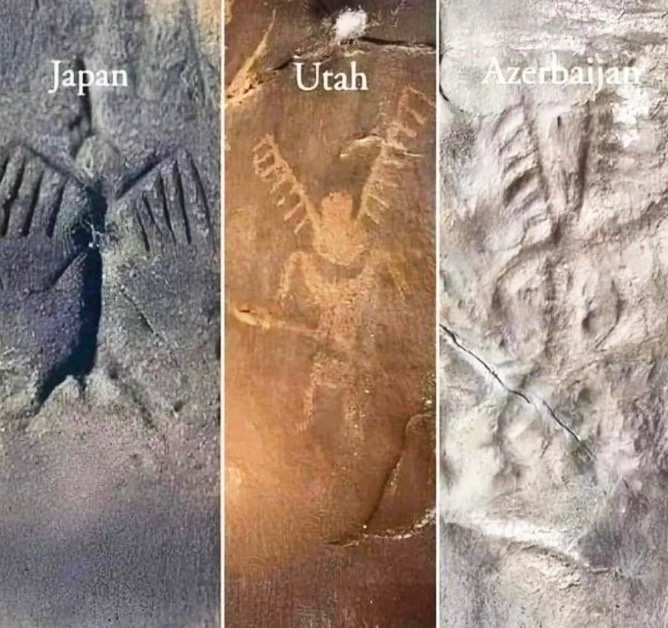
These ancient carvings were discovered across three separate landmasses divided by enormous oceans.
The three figures shown here come from cultures separated by thousands of miles and, in some cases, separated by thousands of years.
The Gobustan petroglyphs in Azerbaijan date back roughly 10,000 to 5,000 years, the carvings in Japan’s Fugoppe Cave were created around AD 200 to 400, and the famous winged figure in Utah is generally linked to the Fremont culture, dating to approximately AD 950 to 1250.
Despite their striking similarities, archaeologists have found no evidence that these societies ever interacted. The resemblance is usually explained as a case of convergent artistic expression — different cultures independently developing similar symbols to represent spiritual beings, ceremonial figures, ritual leaders, or sources of power.
Although the images appear remarkably alike, they are generally viewed as separate creations rather than evidence of a shared civilization or ancient contact across oceans.
«I believe that scientific knowledge has fractal properties, that no matter how much we learn, whatever is left, however small it may seem, is just as infinitely complex as the whole was to start with»
— Isaac Asimov (I Asimov, 1995)








![Rainmaker1973's tweet photo. The James Webb Space Telescope has done it again: revealing a breathtaking structure now dubbed the “Cosmic Vine”: a string of 20 galaxies stretching across a staggering 13 million light-years!
What makes this discovery so shocking? This colossal formation dates back nearly 11 billion years, forming just 3 billion years after the Big Bang, a time when galaxies were thought to still be forming in isolated clumps. Instead, JWST captured a massive, organized structure linking galaxies together much earlier than expected.
[image: artist's impression]](https://pbs.twimg.com/media/HN0j2srWIAAsjf7.jpg)