CARDIOLOGY REALITY CHECK:
A NORMAL STRESS TEST DOES NOT MEAN NORMAL CORONARY ARTERIES.
This distinction is still surprisingly misunderstood — by patients, and sometimes even in the way we communicate test results.
A stress test primarily asks a functional question:
CAN WE DEMONSTRATE MYOCARDIAL ISCHEMIA?
It does NOT directly answer another, very different question:
DOES THIS PATIENT HAVE CORONARY ATHEROSCLEROSIS?
You can have:
• no demonstrable ischemia
• no symptoms
• excellent exercise capacity
…and still have coronary atherosclerosis.
Sometimes quite a lot of it.
Why?
Because atherosclerosis is a disease of the ARTERIAL WALL, not simply a disease of severe luminal stenosis.
It can develop silently for years or decades before becoming sufficiently obstructive to produce ischemia or symptoms.
This is why we need to stop using:
“Your stress test is normal”
as if it meant:
“Your coronary arteries are normal.”
Those are NOT equivalent statements.
Stress testing can provide extremely valuable information when appropriately indicated.
But if the question is:
“How much coronary atherosclerosis does this individual actually have, where is it, and what does it look like?”
you need to LOOK at the coronary arteries and their walls.
That is where modern CCTA fundamentally changes the information available to us.
ISCHEMIA ≠ ATHEROSCLEROSIS.
Different biological questions.
Different information.
Different implications.
Good cardiovascular medicine needs to understand both.
# Cardiac CT Is No Longer a Niche Test. It's Becoming Everyday Cardiology.
For years, Cardiac CT has been viewed primarily as a test for ruling out obstructive coronary artery disease. Yes it has been focused on the triage of obstructive CAD.
This new EACVI Clinical Consensus tells a very different story.
Cardiac CT is now presented as a comprehensive imaging platform, extending well beyond coronary stenosis to include valvular disease, cardiomyopathies, cardiac masses, congenital heart disease, pericardial disease, and large-vessel pathology.
The message is clear:
**Cardiac CT has moved from a specialized examination to an integral part of routine cardiovascular care.**
## The Critical Point
Perhaps the most important shift is conceptual.
The document no longer frames CCTA as a tool that simply detects stenosis.
It emphasizes plaque characterization, plaque burden, high-risk plaque features, calcium scoring, functional assessment, and patient-specific clinical pathways.
This reflects the broader evolution of cardiovascular imaging:
**from identifying anatomical narrowing...**
to **understanding cardiovascular disease biology.**
## My Take
The question is no longer *"Can Cardiac CT do this?"*
It is:
**"How do we integrate Cardiac CT into everyday clinical decision-making?"**
That is exactly where the field needs to go.
Technology only changes medicine when it changes clinical pathways.
And there is where the document is weak IMHO.
I believe the weak point of this document is that it does not actually provide sufficient insight into the Anatomical (and Functional and soon Tissue) imaging standard in Cardiology which is Photon Counting CT.
## Where PCCT Fits
The consensus already recognizes **Photon-Counting CT** as the next technological step, highlighting its **0.2 mm spatial resolution** and its potential in challenging scenarios such as heavily calcified plaques, in-stent restenosis, and myocardial injury—while correctly acknowledging that randomized clinical evidence is still limited. However, there are already 600+ Photon Counting CT scanners installed in the world... and the technology is available since 2021.
To me, as I said several times many years ago, the key message is:
- PCCT is not simply another scanner.
- it represents a NEW imaging modality.
If conventional CCT has now entered everyday practice, the next challenge is ensuring that **Photon-Counting CT translates its technical advantages into measurable improvements in diagnosis, clinical decision-making, and ultimately patient outcomes.**
That—not higher resolution alone—will define its success.
#CardiacCT #PhotonCountingCT #PCCT #CardiovascularImaging #CCTA #PreventiveCardiology #PrecisionMedicine #Radiology
Paso de Mahoma es el último gran obstáculo para quienes buscan alcanzar la cima del Aneto. Un estrecho paso aéreo a más de 3.400 metros de altitud que pone a prueba los nervios de los montañeros antes de coronar el techo de los Pirineos
📸 : @aguilatrail_
Novo Nordisk provides update on the ZEUS phase 3 trial in people with ASCVD, CKD and inflammation another disappointing finding with inflammation as a therapeutic target! IL-6 inhibition fails to improve cardiovascular outcomes! @SIAC_cardio@ESC_Journals@secardiologia
Spain’s entire budget will be destroyed by illegal migrants.
It’s basic math: if Spain offers free stuff to migrants that is above 90% of the living standard of Earth, they create a forcing function for 90% of Earth to move to Spain, which is around 7 billion people!
Hacer trampas en el fútbol está mal. Pero es común: simulaciones, manos, fueras de juego inventados. Se critica un rato y se olvida.
Hacer trampas con la educación de toda una generación es otra liga.
En PISA 2025, Cataluña seleccionó a 2.545 alumnos de 51 centros. Y excluyó a 591. Un 23,2 % de la muestra.
El máximo que permite la OCDE es el 5 %.
¿Con qué criterio los excluyeron? 493 por «problemas cognitivos, conductuales o emocionales» y 92 por «no dominar la lengua de la prueba».
El Ministerio les avisó en abril de 2025. Tuvieron meses para corregirlo. No hicieron nada.
¿La consecuencia?
Cataluña juega el partido, pero no cuenta:
→ Sus resultados saldrán en el informe español con una nota técnica: muestra no válida. → No aparecerán en el anexo internacional de la OCDE. → No se podrán comparar ni con el resto de España ni con sus propias ediciones anteriores.
Marcar goles que nadie apunta, en un partido que no sale en la clasificación.
Y aquí está lo grave: esto no es un «error técnico».
Cuando excluyes precisamente a los alumnos con más dificultades, no estás midiendo tu sistema educativo. Lo estás maquillando.
La foto sale mejor. La realidad sigue igual. Y los 591 alumnos borrados de la muestra siguen en las aulas, con los mismos problemas que ayer.
Eso es lo que debería indignarnos. No perder un ranking: haber intentado ganarlo escondiendo a los que más ayuda necesitan.
Una vergüenza para Cataluña. Y un aviso para todos los demás.
@Monica_Garcia_G Pero usted no es Ministra de Sanidad y tiene a toda la casta médica de culo ? Porque no gasta tiempo en solucionarlo y no tanto en desmontar bulos …
L'any passat van decidir no fer les proves de competències bàsiques a totes les escoles, sinó només a alguns centres "escollits aleatòriament".
Ara deixen fora de les proves PISA a gairebé el 25% de l'alumnat.
Pretenen tapar la desastrosa realitat a les aules manipulant resultats
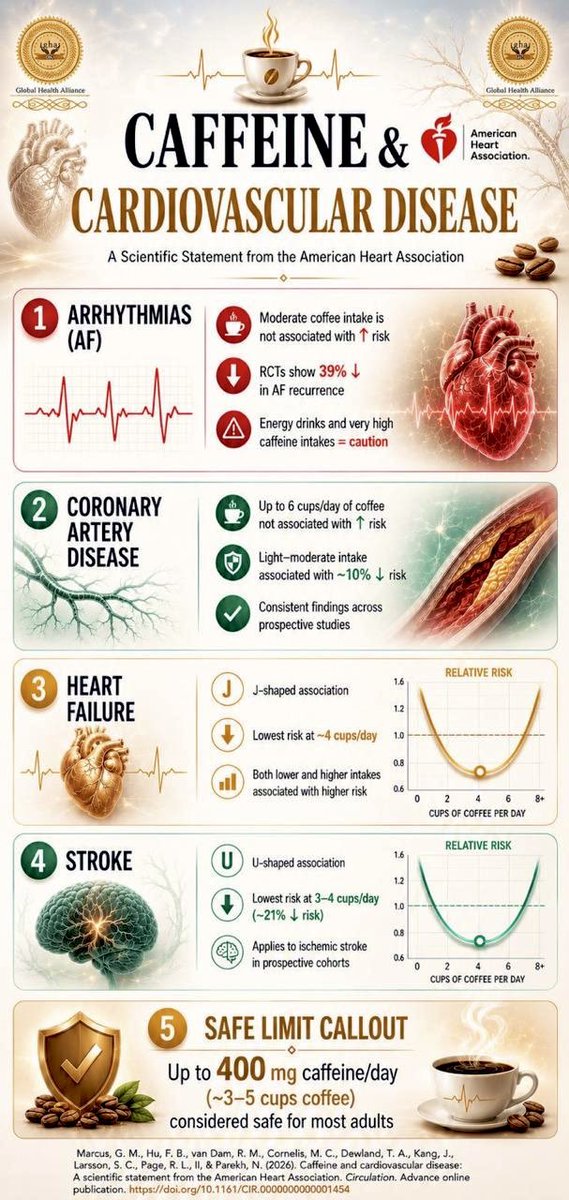
☕ New AHA Scientific Statement just dropped:
Moderate coffee (3–5 cups/day) is linked to LOWER risk of AF, coronary disease, heart failure & stroke.
Your morning coffee might be protecting your heart, not harming it. 🫀
#HeartHealth#Coffee#Cardiology#AHA#Ghahealth
We Keep Predicting Risk. The Plaque Already Knows.
For decades, preventive cardiology has revolved around estimating the probability of obstructive CAD.
Age.
Sex.
Symptoms.
Risk factors.
This study asks a different question:
**What if the best predictor isn't the probability of disease... but the amount of disease already present?**
Using AI-based quantitative CCTA in more than **6,000 symptomatic patients**, the CONFIRM2 investigators found that **total plaque volume (TPV)** was the main driver of future cardiovascular events, regardless of whether patients had a very low, low, or moderate pre-test likelihood of obstructive CAD.
The numbers are striking.
At 4 years, MACE rates increased from:
- **1.4%** with no plaque
- **3.3%** with minimal plaque
- **12.6%** with TPV 250–750 mm³
- **18.6%** with TPV >750 mm³
And these event rates were remarkably consistent across all clinical likelihood categories.
That should make us pause.
For years we have refined clinical scores to estimate the likelihood of finding obstructive stenosis.
Meanwhile, the **actual burden of atherosclerosis** appears to carry far more prognostic information.
## The Bigger Message
This is another piece of evidence supporting a shift that has been emerging for years:
**Risk factors don't cause events.**
**Plaques do.**
Risk factors help us estimate who *might* have disease.
CCTA allows us to measure who *already has it*.
Those are fundamentally different questions.
## My Take
This paper is not really about AI.
AI simply makes comprehensive plaque quantification scalable.
The real story is that cardiovascular prevention is gradually moving away from a **risk-factor paradigm** toward a **disease-based paradigm**.
The artery has become the biomarker.
And once you can quantify the entire atherosclerotic burden, it becomes increasingly difficult to argue that stenosis should remain the center of the conversation.
## Where PCCT Comes In
This study used conventional CCTA.
Now imagine combining this biological approach with Photon Counting CT.
- Higher spatial resolution.
- Better characterization of non-calcified plaque.
- Improved detection of subtle high-risk features.
- More reproducible plaque quantification.
If total plaque volume is already one of the strongest predictors of outcome, improving how we measure plaque—not just stenosis—may be where the next leap in preventive cardiology occurs.
**Treat the plaque. Not the probability of finding one.**
#CardiacCT #CCTA #Atherosclerosis #PreventiveCardiology #TreatThePlaque #PhotonCountingCT #PCCT #ArtificialIntelligence #CardiovascularImaging #PrecisionMedicine
💻❤️Ante un #infarto de miocardio "el tiempo es músculo".
Por ello es vital detectarlo al primer síntoma. En el BSC estamos desarrollando junto a @HospitalSantPau un algoritmo de #IA que sea capaz de interpretar 📈 electrocardiogramas.
El objetivo: que el personal de enfermería de un CAP, gracias a esta herramienta, pueda rápidamente reconocer un infarto sin tener que esperar a un especialista en cardiología.
Esta celeridad en el diagnóstico ayudaría a salvar muchas vidas.
Nos lo explica la investigadora Paula Petrone.
✨💻 #IAcción