Hey folks, I'm going to spend less time here and more on other platforms.
To keep in touch:
Bluesky: @davidzipper.bsky.social
Linkedin: https://t.co/2H8ofYFJfC
Mastodon: @[email protected]
Paved with Good Intentions, my free newsletter: https://t.co/Zt2YSAGozU
FYI, I'm not posting here anymore.
To follow my articles/musings, follow me on Bsky (same handle) or sign up for my free newsletter, Paved with Good Intentions: https://t.co/Zt2YSAFQKm
Which #s do carmakers use to market EVs?
My conclusion, in @FastCompany:
“Rather than auguring a future of useful & efficient EVs, automakers are emphasizing metrics that portend disappointed customers, wasted resources, & needless road deaths.”
https://t.co/GhPKOwOSMC
In US cities, ~2/3 of crash deaths occur on streets owned by the state – not local gov.
Outdated, deadly state roads are preventing cities from building the safe, comfortable, and transit-friendly streets residents want.
My deep dive, in @voxdotcom
https://t.co/ToEOjzzvuQ
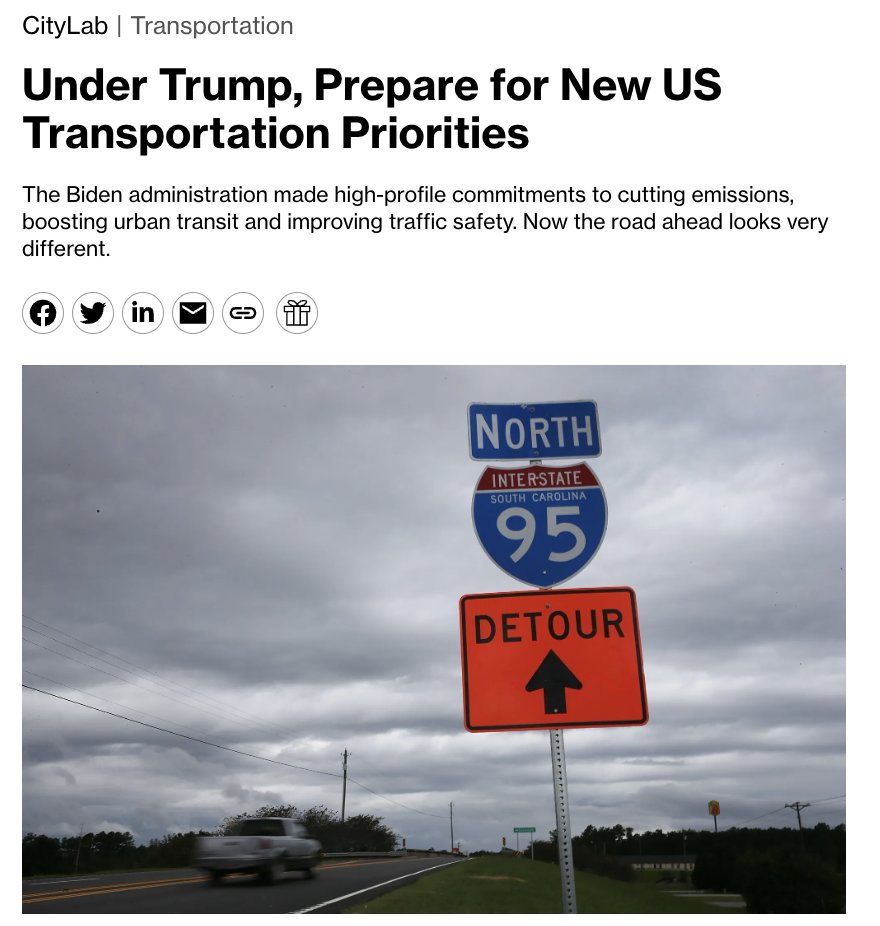
My latest story in Bloomberg CityLab: An interview with @BethOsborneT4A exploring what Trump's election means for US transportation policy.
I have a thread with much more info on Blue Sky. Find me there: @davidzipper.bsky.social
https://t.co/LRBft71Mq6
A Trump presidency means the feds won't be restraining car bloat. This NHTSA proposal looks doomed.
The path for reform now goes through states and cities, where officials can impose fees on the heaviest cars, outlaw truck lifts, and give smaller cars preferential parking.
Finally, the Biden administration is taking a stand against car bloat.
@NHTSAgov has proposed banning SUV & pickup hood designs that are especially likely to cause head injuries.
In @FastCompany, I explained why this could be a watershed moment. 🧵
https://t.co/q6371sIfzh
Impact of congestion pricing in Stockholm:
- Car traffic ⬇️ 20%
- Center city air pollution ⬇️ 10-15%
"Congestion pricing isn't even a controversial subject anymore; it's more akin to talking about speed limits or traffic signals."
https://t.co/FYs1uFwdzg
"An e-bike won’t make sense for everyone. But, for those looking for a new way around town or to save on the high cost of owning a car, it could be a game changer. For me, it might be what makes me sell the Chevy."
https://t.co/PvjzOMpngH
As of today, Paris has banned thru-traffic in the center of the city.
Cars owned by central zone residents/workers/visitors are still OK -- but no thru-traffic.
Motor vehicle counts are expected to decline up to 30%.
https://t.co/I41qedDyBD
Many Vision Zero cities/states in the US now have more crash deaths than before they "committed" to VZ.
VZ is a policy structure built around the idea that humans make mistakes, and they shouldn't be fatal. But in the US, it's often just a talking point.
https://t.co/LHrnEsMaqp
Warsaw is the latest European city to reach a new low in crash deaths.
Vision Zero consistently works in Europe, but not in the US. Key reason: American officials resist doing the hard work of redesigning streets and slowing down cars.
https://t.co/0pUeKLvxRu
Research I'd like to see:
A study exploring how much of drivers' antipathy toward bike lanes is due to jealousy that cyclists don't get stuck in congestion.
Lessons for other cities from Denver’s e-bike rebates:
- Expect *massive* demand at launch
- Use drawings, rather than first-come,-first-served
- Treat bike retailers as close partners
- Get ready to see a lot more people demanding bike lanes
https://t.co/ussJJsiqS2
E-bike rebates might be the most wildly popular transportation policy in the country right now.
I visited Denver – the first US city to offer them– to see if reality matches the hype.
In @CityLab 🧵
https://t.co/ussJJsiqS2
Despite the popularity of Denver’s e-bike rebate, its days may be numbered.
The reason: Colorado now provides a basic $450 rebate -- more than Denver – and the two discounts aren’t “stackable.” The city may reallocate voucher $ to other programs.
https://t.co/rtiM49l8Qw