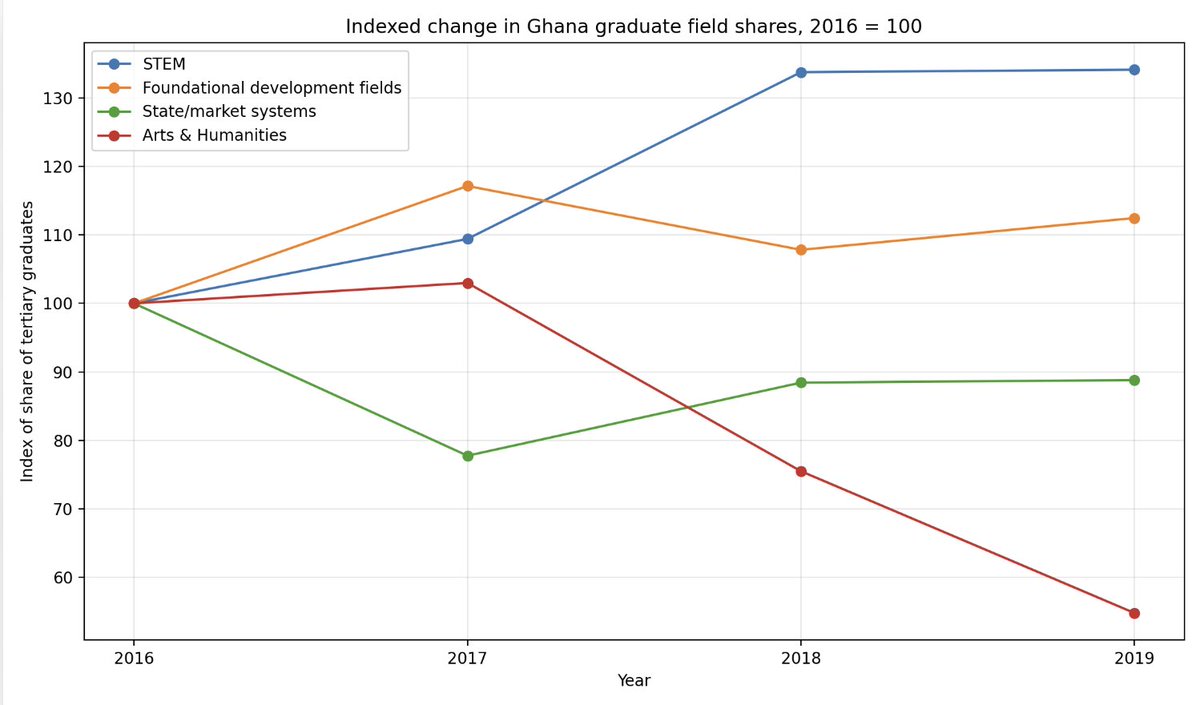
The "useless courses" debate sparked by Ghana's former education minister has so far not really benefitted from data based analysis.
Most of the justifications of the former Minister's comments I have seen bring up two main points.
1. We need to favour STEM and move away from humanities; and
2. Employability.
These are shallow arguments. No economy is made up 100% STEM workers. Not everyone is mentally inclined towards STEM. And STEM jobs don't emerge just because you create STEM courses or move students into them.
Worse, most folks who make the STEM priority and employability arguments don't even seem to have looked at the data.
Attached are some charts. Study them carefully.
1. The official STEM share of all graduates in Ghana was 16.58% as of 2023.
2. STEM's share of the graduate base is the fastest growing among major courses.
3. The biggest share of graduates is in the "developmental fields" of Education + Health/Welfare + Agriculture. Their share rose from 26.13% in 2015 to 43.25% in 2019.
4. The Social Sciences/Journalism/Information + Business/Administration/Law cluster saw its share fall from 39.72% in 2015 to 26.73% in 2022.
5. The Arts and Humanities share fell sharply, from 16.12% in 2015 to 5.62% in 2022.
6. STEM employability itself is not uniform.
7. A tracer study of mechanical engineering graduates from some Ghanaian universities found that about 84% of them had jobs. That suggests a 16% unemployment rate. Which is lower than the youth unemployment rate but much higher than the general unemployment rate.
8. More intriguingly, it also found long delays after national service: about 29%, 41%, and 19% experienced unemployment lasting one, two, and three years after national service, respectively.
9. More worryingly, a tracer study of civil engineering graduates from some universities found that 66% were gainfully employed and 57% worked in the construction industry. But among unemployed graduates, 54% cited “no job opportunities.” The study also found curriculum gaps, including limited exposure to current construction software and insufficient research training.
10. Ghana's STEM share of its graduate base also seem typical for its current level of development.
In short, we need policy debates that generate more light than heat and more signal than noise. Less katanomics and more data-based analysis.
My Kenyan friend who is now discovering Ghana sent me a long lamentation.
He says he saw a "modern cafe" somewhere in East Legon and went in to have tea.
Ermmm...okay.
He ordered a pot for GHC 60. But because he is lactose-intolerant, he asked for soya milk.
Ermmm...okay.
When the bill came, he had been charged ~GHC 30 more for the soya milk.
He thought it was a mistake so he protested and asked for the supervisor.
The man came in and in sweet humble Ghanaian English confirmed that yes, soya milk costs an EXTRA GHS 30.
Looked like my friend was pained and needs consolation. He says why should Ghana punish him for his lactose-intolerance?
So, I sent him a warm message:
"Please, welcome to Accra. Every bill you see in East Legon, you must take it like that, please"
[Thank you for your attention to this life-saving announcement.]
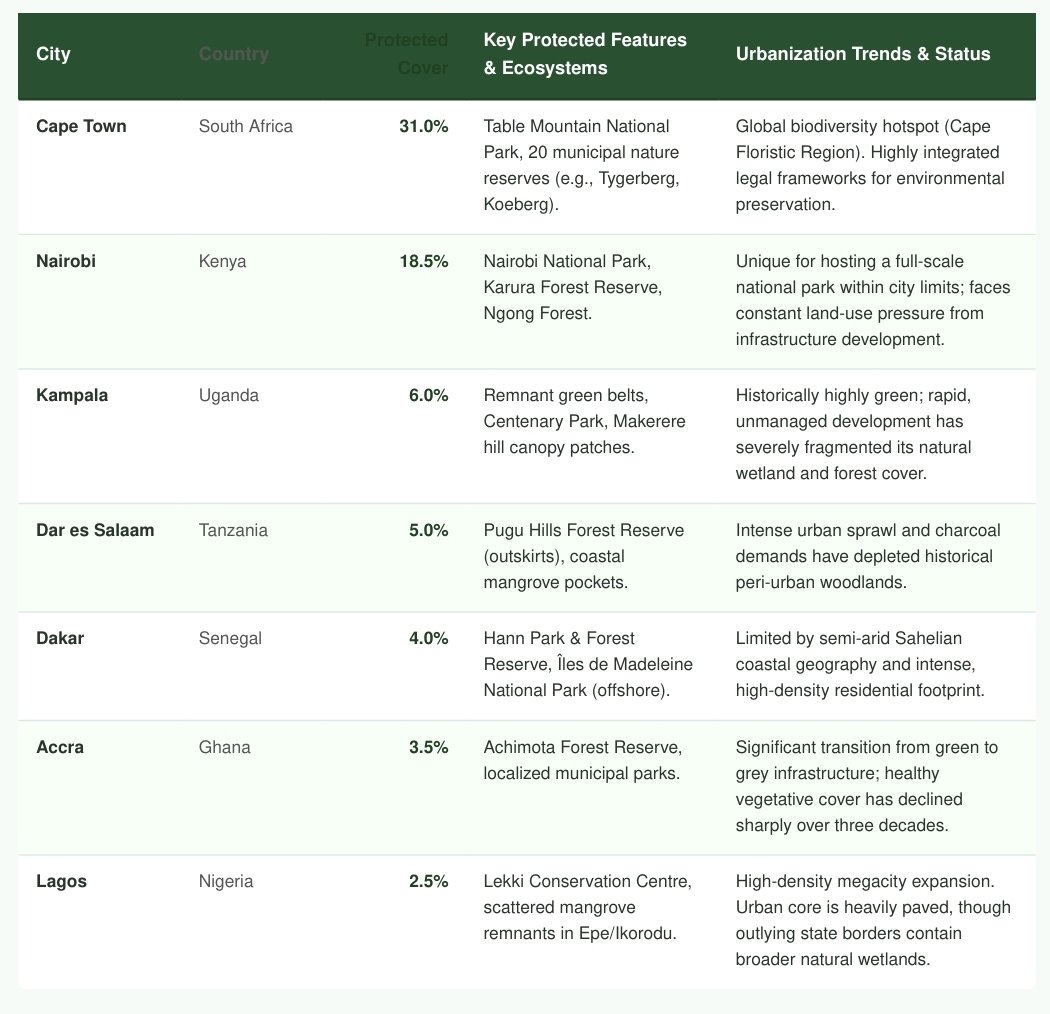
Whilst we rightly abhor the many negative stereotypes about Africa, sometimes even the positive stereotypes hold us back.
Like the idea that Africa is a lush, green, continent.
If you fly as much as I do, you can't help but notice on descent how ungreen the continent is becoming and how greener cities in Europe, for e.g., have become.
The WHO says the average person needs a minimum of 9 square meters of green space to be healthy (ideally, 50 square meters.) Most major African cities barely provide 3 square meters.
I have attached a brief list of cities around the world & what percentage of their landmass is covered by greenery. It's really something.
Part of the problem is the "aniteɛ" concept I was describing last time where each person maximises their strategic intelligence and the whole society becomes dumber as a result.
One easy example: how mega-developers behave in Accra.
The Accra Mall has triggered a new high end district around Boundary Road. Expensive condos all over.
Yet, each developer has decided in their boundless wisdom not to spend any land on pavements. Like zero pedestrian walkways. Forgetting that the prices of condos are affected not just by the quality of the build but also how livable the neighbourhood is. Green spaces don't just clean the air; they also minimise flooding and heat waves.
Would smart folk who won't even sacrifice a bit of profit for pavements create any green space? Would municipalities who make their money from commercial buildup care about pavements and green parks?
Your guess is as good as mine.
I am watching a fascinating video of military relief operations in & around Tema Newtown, rescuing residents stranded by floodwaters. See the GAF PR attached.
The Sentuo Refinery footage is very revealing.
Ghana imports most of its refined fuel despite having domestic crude. So, naturally, Sentuo is seen as a totem of the country's industrial future.
The flooded refinery would no doubt spark more moralising about “building in waterways.”
For good reason.
6 years ago, EPA resisted the refinery site. They said the land sat in a sensitive wetland & flood-buffer system linked to Chemu Lagoon.
Tema City authorities disagreed. They insisted that Ghana must industrialise & create jobs. Sentuo land was thus rezoned.
That is the real tension of SERIOUS POLICY.
There are at least 5 levels of analysis when it comes to the intersection among waterways, flood risk & urban development. From direct obstruction to buffers to accelerants.
A city & its natural setting are both living organisms. There is no fixed hydrological or urban reality.
Yet elites continue to treat it as simple with their lazy moralising. Identify structures. Demolish them. Punish offenders. Problem solved.
In the theory of katanomics, that only answers WHAT.
The HOW is where the mess lives & where elites are too aloof to go.
Who mapped the waterway? By which flood standard? Is the wetland legally protected? Did the assembly, TDC, Lands Commission, EPA & Hydrological Authority agree on one binding map?
Sentuo was given permission because they promised to develop a drainage channelway for that whole part of Newtown. I can't see it. Can you?
Is there a group of elite Tema citizens that paid attention? Demanded permit conditions? Studied & published dissent or modifications? Mobilised civic pressure? I will save you the hassle. No.
This is katanomics in its rawest form.
It is easy to see the WHAT: free waterways.
But the real burden is in disaggregated execution: buffer widths, culvert levels, catchment maps, retention ponds, permit triggers, maintenance bonds, etc.
It is not our busy Makola mothers who work from 4am to 7pm and then rush home to cook that can mount such citizen surveillance. Only the educated Middle Class elites can. "Critical Policy Audiences" in the katanomics vocabulary.
If only they would sacrifice a few English Premier League matches.
Moralising is cheap. It makes people feel good about themselves. Digging for info, organising, thinking deep about alternatives, & then mounting civic pressure is HARD.
That is why it is seldom done. But elites in some places get it.
In Curitiba, Brazil, citizens made drainage, transport and zoning civic obsessions. They scrutinised flood maps & pushed neighbourhood drills. In Taiwan, citizen groups have forced environmental review and industrial-siting questions into public politics. Officials hold public sessions & folks video proceedings for social media.
That is the katanomic remedy: critical policy audiences.
“I am not your regular MP. If your MP respects himself, I do not. So I will not sugarcoat things—If you build in a waterway, your home will be flooded.”
—Gomoa Central MP, Kwame A-Plus claps back at critics after the viral video of him lambasting a constituent.
[🎥: 1957News]
We rationalise underdevelopment when we justify low thinking & poor imagination by blaming poverty.
If I got a dollar anytime someone said to me that so and so shallow reasoning outcome should be excused because so and so people are disabled by "bread and butter issues," I would have beat Musk to a trillion dollars.
I blame Maslow. He made it too easy for his ideas to be bastardised. Now, the "poverty blocks thinking" excuse has a pyramid to hide behind.
The animated video attached to this post depicts the so-called "Antikythera Mechanism." It is more than 2000 years old.
Discovered in fragments in 1902 by a Greek Politician, several experts worked day & night to reassemble and unlock its inner workings.
The machine, sometimes called the world's first analog computer, embodies 500 years of Greek conceptual thinking. But for what?
It tracked the moon, aligned calendars, & modelled the cosmos.
Why was such exquisite and painstaking engineering deployed to grasp such distant phenomenon?
Didn't the Greeks have mouths to feed? Leaking roofs to patch? Textiles to weave?
They did, but the stars could not wait.
We like to tell ourselves a tidy story about progress. First bread, then stars. First fix the roads, the drains, the clinics, the hunger - and only then, much later, may a poor society permit itself to dream about higher concepts. Survival first then imagination.
What the Antikythera machine tells us is that progress doesn't have that patience.
The Greeks realised that watching the constellations could help manage harvests better. Reading Orion might save a fortune from drowning. Learning about fluids and screws together can overcome an invading army.
Meeting basic needs also opens the door to climbing higher logic.
Imagination is not the scarce resource we like to pretend it is. It is everywhere, already at work, disguised as survival.
Given the reputation of the Greeks as pioneers, you might be tempted to think that this was merely the product of broad social enlightenment.
Well, the period during which the pieces that became Antikythera were being assembled over hundreds of years were far from advanced. Thw average Greek was far from Plato.
Most Greeks then were poorer than the average Botswanan or Moldovan today. Most couldn't read. Life expectancy was barely 40.
In some Greek towns then, when a pandemic hit, random people were selected, painted, slapped & tossed out of the town in the hope of abating the disease (read about "pharmakos"). Hardly Xanadu.
Yet there were pockets, subcultures, of mind-boggling genius. People calculated the size of the Earth using sticks & shadows. And the distance to the moon using rods and discs.
Such pockets can be found today in Kokompe and Suame Magazine too, in the little folds of our daily lives.
The spirit is in the soups that take 4 hours to make. And the funeral mourning display and its sequenced rhythms.
Do these elaborate tapestries not flourish in the midst of poverty because they matter more than food?
The real question is why so little of these sparks of elaborate imagination and creativity accumulate into broad changes in our societies.
Into industrialisation, modernisation, city planning, and all the higher order systems we seem to crave.
Funny enough, Antikythera also begs this same question.
That machine did not start an industrial revolution. It became a fossil. The workshop vanished, the patrons died, the knowledge stayed trapped in too few hands - and the sea swallowed the rest.
What was missing was not genius. It was a big enough subculture to grow around it. Call it a conversion belt. Think of it as the difference between a miracle and a civilisation.
And this is exactly where too many of our economies stall today. We celebrate the occasional hero, the sudden breakthroughs, but fail to form clubs to sustain the spark.
Yes we are saddled with "bread & butter issues," but we can always choose to make it about "bread & stars" if we want.
1. "Research gathering dust on the shelves" is a statement you must have heard so often if you live in Ghana, Nigeria, or Kenya that now you tune out when you hear it.
2. Often followed by a recitation of the evils of not being able to crack "industry - academia collaboration."
3. Residents of Eindhoven, a city in the Netherlands few have on their holiday radar, file twice more patents than the whole of Africa combined.
4. Dresden, another off-radar city in Germany, file more patents than Africa combined minus South Africa.
5. Roche, a Swiss pharma company, has a bigger R&D budget than the public research institutes of all West, Central & Eastern African countries combined.
6. On and on and on. List after list of why industry-academia linkages don't exist and the consequences of that non-existence.
7. The question, however, is: whose duty is it to forge this linkage? Government? University Administrators? Academic Researchers? Corporations? Industry associations? Student Unions? Investors (including VCs)? IP lawyers? National IP Offices?
8. The correct answer, of course, is all of the above. Which immediately makes it an ecosystem issue.
9. Now, here is the secret: ecosystems don't form because some genius policymaker starts talking about it in a manifesto. Or some agency of a government adds a line to its vision statement. Or a university updates its mission charter.
10. Ecosystems are built by groups of highly sophisticated people working together. Often for free. The people I described in an earlier post as devoted to social problems often at the expense of their own personal success. The Probonarii, to use a crude Latin term.
11. A fly-in USAID consultant won't do. A Minister who speaks like Napoleon won't cut it. Neither would VC Kwapong brought back from Heaven to resume running Legon.
12. In the spirit of celebrating the Probonarii, here is a concept I find utterly brilliant from TTK University in Estonia. Student final projects displayed in a pop-up gallery of the country's most prestigious and visited shopping hub: Viru Keskus.
13. Thousands of shoppers suddenly find themselves immersed in visionary ideas of transformation from young minds.
14. One student carries forward the post-communist struggle to preserve Estonia from soulless consumerism and industrial blandness by reimagining a decaying paper mill. Another wants to turn a forsaken harbour into a coastal paradise.
15. Miniature worlds envelope each installation.
16. But the beautiful thing about this is that this is not the story of one university's boldness.
17. Getting these exhibitions into high-end public spaces required principals of KTA, the venerable design house, and their allies to become Probonarii.
18. The Probonarii had to work their socks off grooming students, nurturing projects, liaising with civic activists pushing these regenerative projects in the real world, and, of course, aligning with the commercial real estate industry.
19. All for free, in time they could have billed for loads of cash. Yet, their names appear no where on the installations.
20. Howzat?
21. Industry-academia collaboration in Ghana or Nigeria won't fall from heaven.
22. A group of "dumb geniuses" would need to drag it down.
Why don't the local & "national champions" go and partner GNPC to find fresh oil in the Voltaian basin? And then mount the rigs to drill the billions of barrels? Why is it that it is only already developed mines and oilfields that trigger the clamour for local ownership? 🤷🏾♂️
“Meeting Dr. Sam Jonah I realized destiny helpers, givers and great people never keep people waiting to help them”
This interview will open your eye and mind Chale ❤️🔥🫶🏾🇬🇭🔥🔥
Famous funnyman, Trevor Noah, just shared that old story about how Uber got its fingers burnt in Nigeria.
It showed up & started dishing out fat bonuses to drivers per ride to boost uptake. At some point it started even giving bonuses to riders as well.
Before long, drivers figured out that they could create fake rider accounts, call themselves up, take quick rides, and keep scooping up bonuses.
Some then upped the ante. They installed GPS spoofing apps. Now, they didn't even have to move. You just park, rack up fake rides, grab bonuses till you taya, then go house & bed.
When Uber finally figured out the game, they were so shocked by the sheer scale that they suspended the incentives structure WORLDWIDE.
(Clearly someone at Uber didn't take his economics lessons seriously & probably never took the course on perverse incentives like "moral hazard," "Campbell's Law," "Goodhart's Law," & "Peltzman Effect." 🤦��♂️)
Now, Trevor is just trying to get us to have a good laugh at the expense of some too-smart-for-their-own-good Silicon Valley tech bros. Just like in some Akan & Caribbean communities, folks laugh at Ananse the spider when he gets tied up in his own schemes of trickery.
But then he used the word "ingenuity" to describe the drivers' actions. Which prompted a recall of my now fading stock of classical Greek learning.
You see, in ancient Greece, they distinguished between SOPHIA and METIS. Sophia was the stuff frequently translated as "wisdom." But we call "philo-sophers" and "philo-sophy" by those terms because "sophia" reflects the deeper use of intellect to solve problems one believes afflict the WHOLE SOCIETY. Metis is primarily about applying one's brain power to serve their own, or their group's, parochial problems or interests.
Simple enough distinction, but I argue that it is an essential device in the plot of every society's transition story.
In the 1000-year old Norse sagas, the Scandinavians begin very much with a cunning Ananse-like character called Loki. He was always the soul of all witty plays. He made the stories tick. Pure ingenuity!
Then he tricked someone to kill the god, Baldr, Lord of Light, truth, & beauty. Loki is finally unveiled as the chief enemy of the universe's progress.
Is it "ingenuity" if in the end it breaks the world?
😊
The Akans does not have a unifying word like Sophia for the use of the intellect to advance collective progress. They have several.
But they do have a pretty compact word for the kind of low cunning used to "mumu" Uber. They called it "aniteɛ" - keeping one's eyes opened. It starts off being about shrewdness,in which form it is generally admired because it prevents others from taking one for a fool.
But soon, ANITEƐ becomes a barrier to sound cooperation in a complex society. A society with too much aniteɛ or metis struggles to get enough people to sacrifice - to "close their eyes" to certain self-interests - in order to advance greater collective smartness.
It is hard to quibble with the truism that in low-trust situations, defensive cleverness is essential. But how then would one ever start to build trust?
At any rate, too much individual cleverness can manifest in common solutions becoming dumber. Like why there are no pedestrian walkways in Accra Airport City because every real estate developer maximises the gain from every square meter of land.
To repeat: too much personal ingenuity can sometimes lead to less social intelligence.
I have spent the last few weeks digging into a subject that gets more twisted the more I look.
1. Generally speaking, Ghana has two types of philanthropists in the business world.
2. One type gives through organised structures like foundations, endowments, and other professional channels. They usually don't court massive publicity and may, as a result, not be high-profile.
3. The other type gives in ad hoc fashion. No structures. No professional staff. No mechanisms to determine eligibility (i.e. the blessings seem random.) No reporting or impact measurement. Just generosity in large doses. But massive, seriously massive, publicity.
4. Bizarrely, I am finding that the second type - massive publicity but no formal pholanthropic structures (like a foundation with professional staff, etc.) - also tend to have another feature. Not always, but much too often to be random. They tend not to like paying suppliers/vendors. And they generally do not have a stellar reputation in the business world.
5. One such case study I have been digging into involves a Ghanaian business world philanthropist whose giving was mostly in a religious context. Like building large worship centers and dishing out loads of alms during prominent religious ceremonies and holidays. Yet, across his businesses, it was standard practice to drag out payments for vendors for as long as humanly possible. Sometimes culminating in total default.
6. For this latter type of business-folk philanthropists, it would seem that their social reputation is inversely correlated with their business reputation. Whilst most people in the business world who know them well think rather lowly of them, their standing remains very high with the general public.
7. It is pretty straightforward to unpack what is going on here. In Ghana, as in many African countries, business tends to be super-opaque.
A. One's business reputation thus rarely shapes one's social reputation.
B. A strong enough social reputation can, however, override a weak or poor business reputation since many new business counterparties or partners would only know of the social reputation. At any rate, social reputations have a third-order effect, as explained below.
C. A business partner may think poorly of one's business practices and yet acknowledge that one's social capital can open doors or solve problems.
D. Especially in highly informal societies where decisions are rarely data-driven, it is not too hard for even hard-nosed business people to overlook a record of not paying bills if the business person in question has ties to social forces in politics, religion, and traditional/chieftaincy circles. That is to say, reputational assessments are super-holistic and account for factors that matter more in informal societies, like the capacity to resolve conflicts impeding access to lucrative opportunities.
E. Elite conflict resolution, in particular, is a massive social capital issue because the courts, regulatory agencies, and official ombudsmen are generally so inefficient that they are not considered serious options in many conflict situations to begin with.
8. In short, ideas like "image laundering," "greenwashing," and similar concerns about the manipulative uses of philanthropy simply don't resonate in places like Ghana.
9. In fact, being too "professional" about philanthropy as a rich business person could actually lead to accusations of "stinginess" and lower your social reputation.
10. And, of course, in societies where so many are barely living above the poverty line, feats of charity can by themselves exude the cool factor that elsewhere must be procured by launching rockets to Mars or indulging in death defying stunts a la Branson.
In this case Vetting is a deep dive background check to minimize citizenship fraud because other Africans in fear of xenophobia might claim to be Ghanaians too and though we’re all part of the African community, for now, we’re prioritizing our citizens.
This is a polite response on the assumption that you didn’t know what vetting seeks to achieve.
I just finished reading the judgment of the Court of Appeal in the GN Savings & Loans license revocation saga.
(Quite a few people seem confused. The ruling wasn’t about “GN Bank.” There was a prior downgrade to the Savings & Loans category done with the consent of GN Bank’s directors before the license revocation.)
Reading the judgment, I kept smiling because it reinforces my long-held view that policy literacy requires multidisciplinary fluency.
In no serious way can that judgment be made sense of without some basic familiarity and willingness to engage with law, banking, public finance, financial regulation, accounting, auditing, risk management, etc. etc. And, of course, political economy.
But this reality seems lost on quite a few people who believe that somehow the complex policy issues facing society can be addressed through siloed commentary. Anyways.
The judgment is well argued, at least judicially. But I think their Lordships retreated to their comfort zone and made the whole issue about constitutional “fairness and reasonableness” tests when quite a big part of the dispute relates to PRUDENTIAL REGULATION.
The judgment, if it becomes precedent, will thus seriously clip the wings of the Bank of Ghana. I doubt very much that this was the intention of their Lordships.
Fans and friends of the Nduom family deserve to bask in the court victory. They have suffered for long. But, as I show in some detail in the Scarab essay below, the hard work is only now beginning and the choppy waters have yet to recede.
https://t.co/6Oti0qyyfU
1. I fear that low awareness about HOW AI tools like ChatGPT get smarter will lead to poor societal thinking and decisions down the line.
2. Take this Mythos saga that exploded a few weeks ago, for instance. Anthropic claimed that its new AI tool, Mythos, was so powerful it was only doing "controlled release," to enable banks, governments, & others to catch up.
3. During the limited release, Mythos was applied to operating systems, browsers, open-source libraries, and partner codebases.
4. Anthropic says it scanned more than 1,000 open-source projects and found an estimated 6,202 high- or critical-severity vulnerabilities among 23,019 total findings. Most independent security researchers agree that Mythos did find these security defects in many popular software systems.
5. For the average person, the only interpretation is that AI has suddenly grown super-smart, and we are at a point where we may have to hand over everything wholesale for AI to manage.
6. But this is really not true. Yes, compared to AI models that existed before Mythos, the latter does show an increase in ability. But as you can see in the attached chart, on many important measures of how smart AI is, Mythos was only marginally better than the likes of ChatGPT 5.4 Pro. Meaning the gap is likely smaller compared to the latest competing models.
7. In the chart, I intentionally chose measures that are in areas such as knowledge, search, browser persistence, or generic UI/terminal operation. I.e. intuitively related to human operations.
8. So, why did Mythos do so well in finding software bugs? Why did it trigger such panic among sophisticated financial regulators and leaders? Simple, and this is reflected in the measures it outperforms other frontier models on by a significant measure: it specialised in persistent/long-horizon, wide-range, NON-AI TOOL use.
9. That is right. We are giving AI tools autonomous control of a vast range of human-created tools.
10. Because they are not human, how they combine, recombine, decompose, and throw the tools at things in their way are very hard for a human to anticipate. Almost all of our software security was built in the belief that it is a human that will be trying to break in.
11. It is like finding a 10-year old, highly energetic child, pouring whisky down his throat and then connecting a bunch of missile systems, satellites, drones, and other weapons to his Nintendo game system and then watching him blow up all manner of things all over the world as soon as he is asked to do so.
12. And then opening your mouth and eyes wide as lucifer's wings and going damn!!! What an incredibly smart kid!!! Damn! He is smarter than all the generals in the Chinese CMC and NATO NORAD and Shaka the Zulu! Look how much more effective he is in lethally and ferociously blowing ish up!
13. Howzat?
14. I think we need leaders to better understand how AI harnesses human intelligence & fast!
15. That's why I've created the Social Edge Framework. In the coming weeks, I shall be collaborating with others to highlight the policy- and business- innovation implications of the Framework.
Stay tuned.
1. Sometimes, I find it very difficult understanding Ghanaian elites.
2. When I raise issues about E&P, the powerful mining services company which now wants to become the dominant mining company in Ghana, I come from a place of genuine concern.
3. African countries like Ghana absolutely need "national champions" to light the way and prove to national compatriots that IT CAN BE DONE! Nothing short of a mindset revolution will get Africa to catch up.
4. The continent went from over 5% share of all world (goods) trade in 1960 to LESS THAN 3% in 2025. After 65 years, competitiveness nearly HALVED! I think if you include services, the situation is probably more alarming!
5. But we all know it is not really countries that trade. It is companies that do.
6. In Q1 2026, two companies accounted for almost 45% of all South Korea's exports - Samsung and Hynix. Around 2000, Nokia alone accounted for ~21% of Finland's exports. Debswana accounts for over 65% or so of Botswana's exports. So, yes, national champions matter! Greatly!
7. But national championship is about PERFORMANCE more than nationality or the passport cover of the main owner. Capital has become so complex that if you obsess over nationality alone you would miss the bigger factors.
8. Morocco had no car exports just ~15 years ago. Then companies like Stellantis and Renault responded to strong policy signals and set up shop in the country. With careful strategy, the government got them to embed and embed. Think of it like NATURALISING.
9. Like the one million or so Ghanaians that have naturalised elsewhere and are sweating day and night to grow those economies. Like Zoomlion that is busy trying to build roots in half a dozen countries beyond Ghana. It's not easy, but that's how it works.
10. Due to the work of the likes of Renault & Stellantis, cars and "car value chain" outputs are now ~35% of Morocco's exports. ~224000 jobs have been created. Of the 600k cars exported out of Morocco in 2024, ~540k came from the two companies. Who inspected the passports of all investors in those two companies before counting the billions flowing into Morocco now?
11. So, we need to WISE UP. A national champion should be judged on how it IMPROVES PERFORMANCE year on year & DEEPENS Ghana's (Africa's) COMPETITIVENESS in local and, especially, international markets.
12. That requires TOUGH LOVE. Companies like all human collectives need DISCIPLINE.
13. That is why E&P and its advisors continue to disappoint me!
14. Why are they selling gold from a mine when their lease has yet to be ratified by Parliament? The law is clear. UNTIL Parliament ratifies a lease, the gold in any concession belongs to the State, and no other company. E&P has no right to be selling the gold. Even if these are stockpiles left by Gold Fields, they belong to the State. And then they make it look like they are doing Ghana a favour.
15. Without discipline, national champions become national problem children. The way to build national champions is to create conditions that toughen them up for competition even as you support their growth. It not by bottle-feeding them. Hope someone listens.
Regulation by Invoicing: The Systemic Flaws in NITA’s Licensing Push and the Threat to Ghana’s Digital Trust
By John Sitsofe Mensah , Technology Policy Analyst, IMANI.
9 mins read
The architecture of a nation’s digital economy relies entirely on the integrity of its regulatory frameworks. When the rules governing technological innovation are clear, predictable, and legally sound, Digital Public Infrastructure (DPI) thrives, and digital trust is established. However, when regulatory bodies bypass foundational legislation in favor of administrative bootstrapping, the entire ecosystem is placed at risk.
The recent push by the National Information Technology Agency (NITA) to mandate licenses for individual ICT professionals and general private tech businesses presents a textbook case of regulatory overreach. By leaning on the Fees and Charges (Miscellaneous Provisions) Act, 2022, and its subsequent 2023 Regulations to justify this sweep, NITA is attempting to extract a substantive regulatory mandate out of a consolidated financial instrument.
A rigorous analysis of the underlying issues, laws, and frameworks surrounding this development reveals structural legal contradictions, a glaring historical legislative void, and a reactive regulatory posture that threatens to stifle local innovation and erode the very digital trust the agency was established to protect.
*The Foundational Blueprint: Strict Statutory Boundaries*
To understand the current friction, one must examine the original 2008 regulatory architecture. NITA was established by the National Information Technology Agency Act, 2008 (Act 771), with a companion framework provided by the Electronic Transactions Act, 2008 (Act 772).
These laws were designed with a specific, corporate-focused regulatory intent:
- Infrastructure over Individuals: NITA was tasked with regulating the "provision" of ICT, managing networks, and ensuring quality of service at the enterprise level.
- Strict Licensing Limitations: Act 772 explicitly limits NITA’s certification powers to highly sensitive corporate services, specifically encryption and authentication.
- The Individual Prohibition: Most crucially, Section 38(1) of Act 772 contains an unambiguous, specific prohibition: "A licence shall not be issued or granted by the Agency to an individual."
Under the 2008 framework, a data analyst or software developer simply utilizing ICT infrastructure to practice their trade operates entirely outside NITA’s licensing purview.
*The Legislative Void and the Pivot to "Regulation by Invoicing"*
To operationalize a primary Act—especially one establishing a "Certifying Agency" with highly technical mandates—a detailed Legislative Instrument (LI) is legally required. Despite multiple drafts circulating over the years, no comprehensive, sector-specific LIs were ever formally enacted to operationalize NITA’s broad statutory mandates under the 2008 Acts.
Without an operational LI, NITA found itself holding broad enabling legislation but completely lacking the subsidiary legal tools required to actually execute its mandate. This legislative vacuum directly explains the agency's current reliance on the Fees and Charges (Miscellaneous Provisions) Act, 2022.
By sliding pricing schedules for "IT Professional Licenses" and broad business certifications into a general financial instrument, the agency engaged in administrative bootstrapping—hoping the authorization to collect a fee would be interpreted as the legal mandate to establish the regulatory regime itself.
This approach is legally flawed:
- The Fallacy of Revenue as Regulation: The Fees and Charges Act is a consolidated national pricing catalog. Passing a financial schedule that sets a price tag for a "Software Developer Certification" does not magically grant the agency the substantive legal authority to create or enforce that professional guild. Pricing does not equal permission.
- Hierarchy of Laws: A fundamental rule of statutory interpretation dictates that general laws cannot implicitly repeal specific laws. A line item buried in a general fees schedule cannot override the explicit prohibition against individual licensing found in Section 38(1) of Act 772.
*The Fallacy of the IT Guild: Why State Gatekeeping is Needless*
While legislative integrity demands that any move to regulate human capital must occur through rigorous primary legislation, we must ask a more fundamental question: Should the state be licensing IT professionals at all? Attempting to shoehorn the tech sector into a traditional, state-mandated professional guild is a profound misunderstanding of how the global digital economy operates. Creating a mandatory IT guild is entirely needless for two core reasons:
- Global Standards Already Exist: The IT sector is inherently borderless and already governed by rigorous, globally recognized standards. International certification systems—ranging from vendor-neutral accreditations like CISSP, CompTIA, and ISACA to vendor-specific credentials from AWS, Cisco, and Microsoft—are continuously updated to reflect the bleeding edge of technology. A localized, state-run certification system cannot hope to outpace or out-rigor these global benchmarks. Rather than mandating a redundant local license, policy should encourage and perhaps subsidize the acquisition of these internationally recognized credentials.
- The Meritocracy of Self-Taught Knowledge: Unlike medicine or law, the tech ecosystem thrives on decentralized learning and the open-source movement. A developer's competence is proven by their code repositories, their problem-solving logic, and their deployment history, not by a state-issued piece of paper. The sector is famously meritocratic, heavily relying on brilliant, self-taught innovators. Erecting a mandatory guild system risks disenfranchising these self-taught experts, creating artificial barriers to entry that will ultimately starve the local industry of talent.
*The Path Forward: Fostering Enablement Over Gatekeeping*
In 1865, as the first motorized vehicles emerged, the British Parliament panicked. To maintain control over a disruptive new technology, they passed the Locomotive Act—famously known as the "Red Flag Act." It required every motorized vehicle to be preceded by a man walking on foot, waving a red flag to warn pedestrians. While intended to create order, the law effectively strangled the British automobile industry in its crib, allowing nations with more enabling frameworks to leapfrog them.
Today, attempting to force the modern, decentralized IT sector into a localized, state-mandated licensing guild is the digital equivalent of the Red Flag Act. It imposes analog constraints on a purely digital frontier.
Furthermore, in structural engineering, there is an unforgiving truth: you cannot build a skyscraper on a foundation poured for a bungalow. You can add as many floors as you like, and you can paint the facade to look modern, but eventually, the structural reality will assert itself, and the edifice will collapse. The exact same principle applies to regulatory frameworks.
A regulatory regime built on the fragile foundation of a pricing catalog will inevitably fracture under the weight of actual enforcement and legal scrutiny.
To foster innovation and build enduring digital trust, Ghana does not need to mandate professional guilds via invoices. We require:
Regulatory Clarity: Agencies must operate strictly within the bounds of their enabling Acts.
- Incentivizing Global Competence: The state should encourage the use of rigorous, existing international certifications to raise the national skill floor, rather than forcing practitioners into a localized licensing trap.
- Transparent Recourse Mechanisms: The industry needs mandatory performance metrics and operational data publication from regulators to ensure accountability and prevent administrative overreach.
If Ghana is to build a secure, effective, and globally competitive digital economy, its regulatory foundation must be grounded in robust law and an architecture of enablement, not merely in a schedule of fees.
John Sitsofe Mensah is a Technology Policy Analyst with IMANI. @JoyNewsOnTV@Joy997FM@Nuetey@Citi973@Channel1TVGHA@STARRNEWS@starr1035fm@NiiMoiThompson@mocghana@samgeorgegh@Graphicgh@utvghana@starr1035fm@tv3_ghana@radiogold905fm@3fm927@AccraFM1005@gbcnews_@ghonetv@Citi973@Ghanaian_Times@Adomonline@onua951fm@OnuaTV@Peace1043fm @LuvFM995
Work hard ,do your best and leave the rest to the ALMIGHTY… ✍🏽 Big respect to @akabenezer0 l'm forever grateful🙏🏽❤️
...big ups to everyone.. The Love still continues..🥹






![BBSimons's tweet photo. My Kenyan friend who is now discovering Ghana sent me a long lamentation.
He says he saw a "modern cafe" somewhere in East Legon and went in to have tea.
Ermmm...okay.
He ordered a pot for GHC 60. But because he is lactose-intolerant, he asked for soya milk.
Ermmm...okay.
When the bill came, he had been charged ~GHC 30 more for the soya milk.
He thought it was a mistake so he protested and asked for the supervisor.
The man came in and in sweet humble Ghanaian English confirmed that yes, soya milk costs an EXTRA GHS 30.
Looked like my friend was pained and needs consolation. He says why should Ghana punish him for his lactose-intolerance?
So, I sent him a warm message:
"Please, welcome to Accra. Every bill you see in East Legon, you must take it like that, please"
[Thank you for your attention to this life-saving announcement.]](https://pbs.twimg.com/media/HMgpKz3XMAANozK.jpg)