SUDANESE PEOPLE DESERVES ANSWERS - FIQI
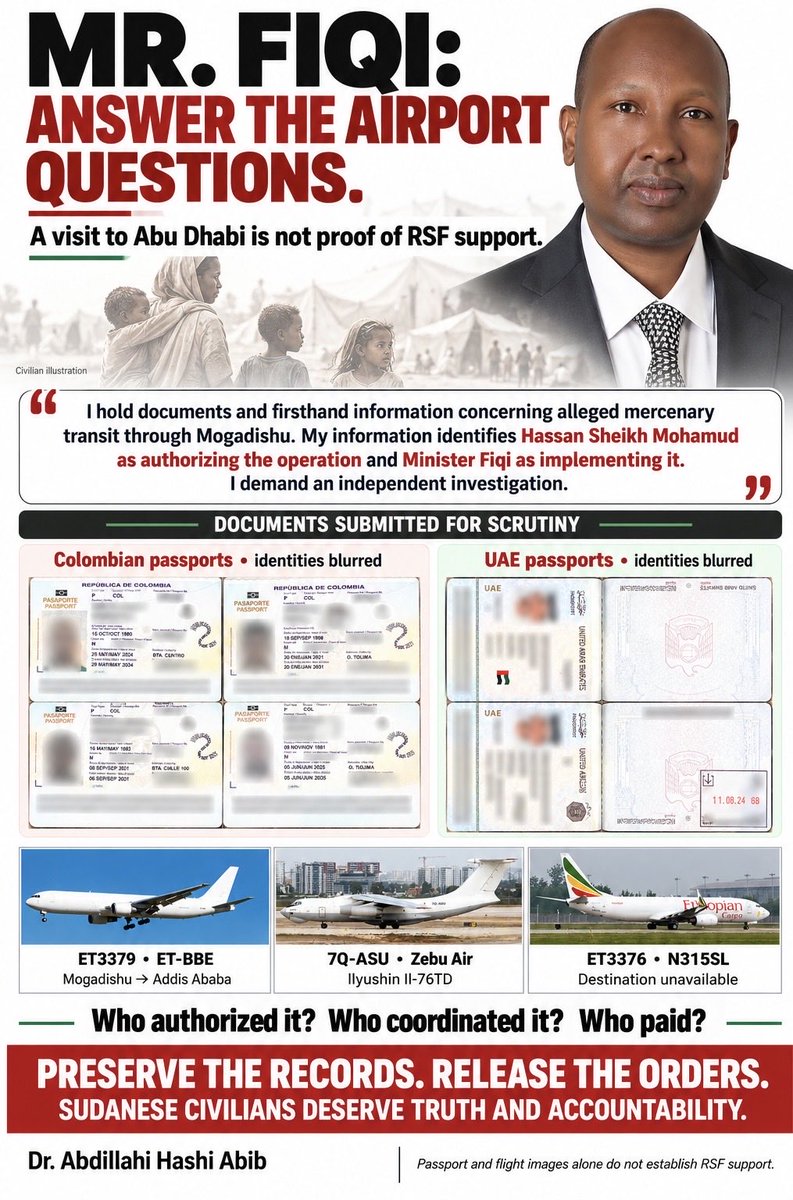
Minister Ahmed Moallim Fiqi, you accuse opposition leaders visiting Abu Dhabi of collaborating with the RSF. Where is your evidence? A political visit does not establish support for an armed group.
But the former president and you, as Minister of Defense, are a different story, and the blood of Sudanese civilians is on your hands. I hold passport copies of Colombian mercenaries and UAE intelligence personnel, flight information and firsthand information concerning what I identify as a logistics operation transporting Colombian mercenaries through Mogadishu International Airport for onward deployment to support the RSF in Sudan. My information identifies Hassan Sheikh Mohamud as the person who authorized that operation and you, as Minister of Defense, as responsible for implementing his instructions.
I stand behind that account and the solid evidence and demand an independent investigation into both your roles.
You should be ashamed of smearing opposition leaders while leaving these serious questions about your own administration unanswered. Calling others conspirators does not exempt you from scrutiny.
As reported, Sudan gave you a free education. Gratitude should mean standing with its people and supporting full disclosure of any operation that helped fuel their suffering.
Show your true colors through transparency: answer the questions, preserve the records and submit your conduct to independent scrutiny.
#FiqiMustAnswer #ReleaseTheRecords #MogadishuAirport #IndependentInvestigation #AccountabilityForSudan #ProtectSudaneseCivilians
GOTH AND BAYLE: AW DAL’S DEAD ARE NOT A FOOTNOTE TO YOUR CAREERS
Bashir Goth, which version of your story do you tell Washington?
In Awdal Phenomenon, you alleged that SNM fighters “cold bloodedly murdered whole families of the Oulbahante and Gadabursi clans.” You wrote that they “invaded villages, looted their properties,” and warned against an “Isaq Independent State.” The available chapter is a later reproduction of your reported writing. Do you stand by those accusations? If you do, tell the people you lobby. If you do not, tell Awdal what changed your mind.
You attended school in Dilla. Interpeace records SNM bombardment and serious damage there in 1991. Amnesty International documented indiscriminate shelling by One Tribe Secessionist forces and civilian deaths in Las Anod in 2023. The Somaliland Human Rights Centre reported 17 civilians killed when security forces fired on protesters in Borama in December 2025. Those findings deserve the same microphone you use to campaign for recognition.
You found your way to the 2026 AIPAC Congressional Summit. Find your way to a microphone and say where you stand on Borama and Las Anod. How do you sleep at night if you can sell Washington a story of democracy but leave these victims out of it? I am asking for your public position, not claiming to know every conversation you have held.
Abdirahman Bayle, when will you stop advising an administration whose security forces face these findings? You once held high office in Somalia; you now advise One Tribe Secessionist ’s president. Does your advice include a demand for independent investigations, or only arguments that keep you close to power?
I remember my uncle in Mogadishu who took a day off to help you. By my uncle account, you would not pay for even his bottle of Fanta. That incident does not prove your political motives. It explains why I ask you to show, through action, what you are willing to give up for the people you claim to serve.
Is it the salary, the meals, the government car or the comfort of remaining close to power that keeps you there? I will not pretend to know your private motives. I will judge the public choices you make.
Think, too, of the family and the hard work that brought you from Iniwaji toward Gebileh, walking with cattle in search of grazing. That history should call you toward honest earnings and independence of judgment. What would honor your parents more: another official title, or the courage to defend civilians even when doing so costs you that title?
Goth and Bayle: answer Awdal plainly. Will you demand independent investigations into Borama and Las Anod? Will you put the findings before the officials whose support you seek?
No entire clan is responsible for these abuses. These questions are for public figures who have the power to speak - and must decide whether to use it.
#AnswerAwdal #JusticeForBorama #JusticeForLasAnod #DillaDeservesAnswers #IndependentInvestigation
I STILL SEE SOMALIA THROUGH MY FATHER’S EYES - AND CARRY MY MOTHER’S STRENGTH
I recently learned that political leaders, ordinary Somali citizens, and many of Somalia’s international partners read nearly every message I publish. I was surprised and deeply humbled.
It made me reflect on why I speak as I do, why corruption affects me so personally, and why I cannot remain silent when public resources intended for the Somali people are misused.
The answer begins with my parents.
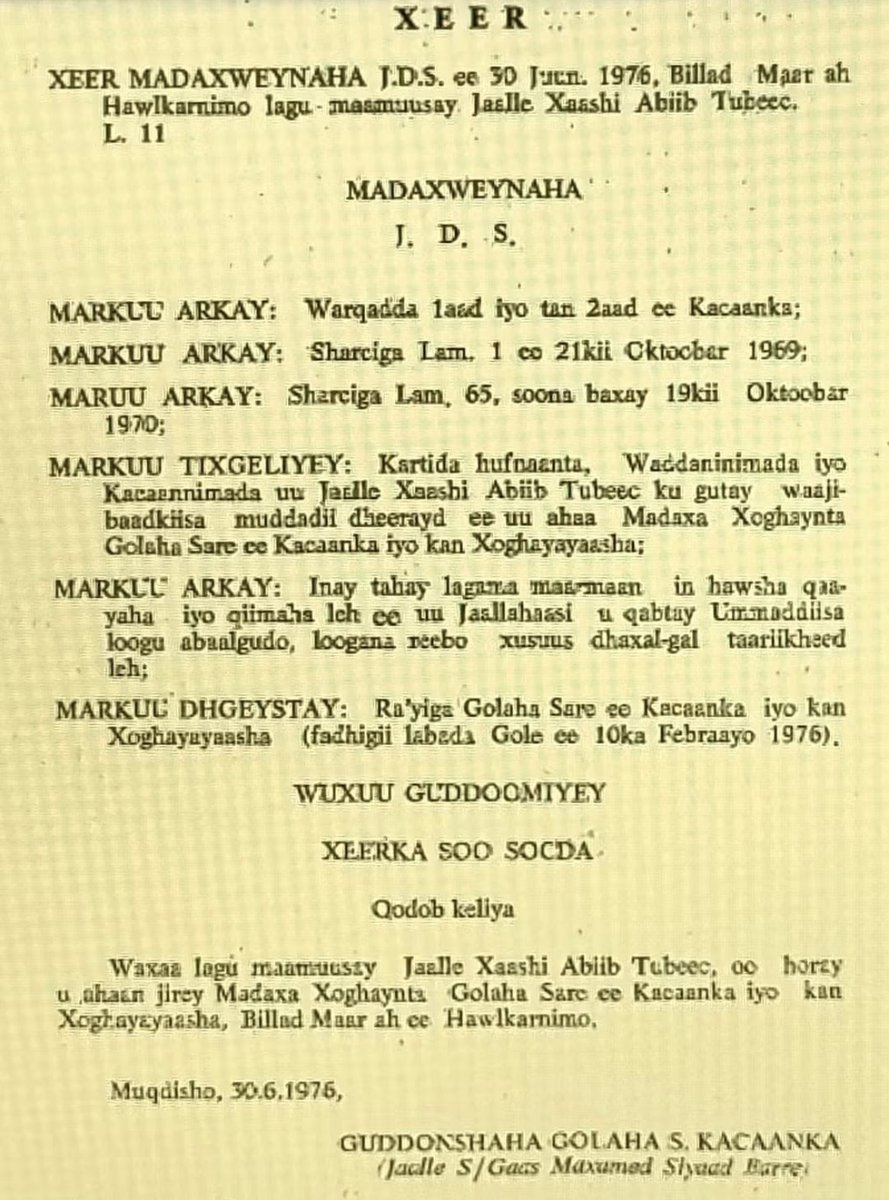
My father, Hashi Abib Tubec, devoted 45 years of his life to public service. President Mohamed Siad Barre formally honored him IN February 1976 for his competence, integrity, patriotism, and distinguished service. But the greatest inheritance my father left his children was not a government title, medal, property, or money.
He left us an honest name.
But it would be neither honest nor fair to tell my father’s story without recognizing my mother.
Without my mother’s support, patience, sacrifice, and understanding, my father could not have become the man he was.
Every time my father rejected a bribe, refused an illegal order, challenged a powerful official, or walked away from a well-paid position, the consequences did not fall upon him alone. They reached our home, affected our family, and placed additional burdens upon my mother.
She understood the man she had married. She never asked him to compromise his principles so that our family could live more comfortably. She stood beside him as he raised his children from an honest salary, even when dishonesty could have made our lives materially easier.
My father’s integrity was visible in government offices. My mother’s sacrifice was often invisible inside our home. But they were two parts of the same story.
His reputation for honesty began long before Somalia became independent in 1960.
When I was a child, I remember the British officer John Gordon Stewart Drysdale, who spoke fluent Somali and had worked with my father before independence, visiting our family in Hargeisa while my father was Governor of the Hargeisa Region.
I met Mr. Drysdale again in Hargeisa in 2003. He told me a story that I have carried in my heart ever since.
While serving as a senior adviser to Prime Minister Abdirazak Haji Hussein, the Prime Minister complained that confidential information was leaking from his office and asked Drysdale for help.
Drysdale told him:
“I have a solution. Bring Mr. Hashi Abib into your office, and your problems will disappear.”
The Prime Minister replied that he already knew my father as the man who had helped him stop the bloodshed between the Saad Muuse and Arab communities. Prime Minister appointed my father the Secretary of the Cabinet Minister, Prime Minister Mohamed Ibrahim Egal re-appointed and President Mohamed Siad Bare re-appointed him till 1976.
I asked Mr. Drysdale why he held my father in such high regard.
He told me that before leaving Jigjiga for London, he had forgotten to record certain government items in the official inventory. When he returned, my father asked why those items had not been registered before his departure.
Drysdale said my father could easily have sold the unregistered items and kept the money. Nobody might ever have discovered it.
But my father never touched them because they belonged to the public.
Drysdale then told me:
“During my entire service in the Reserved Areas, I never met anyone as honest as your father. He was the most transparent and principled man I knew. I hope all of you will follow in his footsteps.”
Those words touched me deeply because I knew they described exactly the man my father was - both in public and inside our home.
From the age of 15, I served as my father’s trusted personal assistant. When he received his monthly salary of 1,500 Somali shillings, he handed all of it to me to manage our family’s groceries and other necessities. When he traveled abroad, he signed documents authorizing me to collect his salary. When he needed confidential government documents prepared, he explained the substance and trusted me to type them.
My father did not merely lecture me about integrity. He allowed me to witness it every day.
And my mother made it possible for those principles to survive inside our household. She understood that raising children on honest income required patience, discipline, and sacrifice from the entire family.
My father never allowed his children to treat government property as a family privilege. We walked to school while official vehicles remained parked at the office.
He would tell us:
“Get a good education, earn your own money, and buy your own car.”
My mother supported that lesson. She did not demand that we be driven in government vehicles simply because our father held an important position. Together, my parents taught us that public property belonged to the people - not to our family.
One afternoon, I returned from school and found a large red envelope and four large boxes of canned tuna at our house. The man who delivered them had left his name.
When my father returned from work, I gave him everything. He opened the envelope in front of me. Inside was more cash than I had ever seen in my young life.
The sender was a regional director whom my father was investigating for allegedly selling government spare parts on the black market.
My father did not hesitate for one moment.
He asked me to type an official letter. He dictated the provisions of the Somali Penal Code and the laws the official had allegedly violated, including the attempted bribery. He then delivered the cash and boxes of tuna to the Criminal Investigation Department as evidence. The official was subsequently dismissed and arrested.
I have never forgotten that day.
That money could have transformed our family’s material circumstances. But neither my father nor my mother wanted our home built upon money that did not belong to us.
My father understood that the money was evidence. My mother understood that an honest home was worth more than anything that money could purchase.
That experience taught me that integrity is not what someone says when people are watching. Integrity is the decision a person makes when temptation is sitting directly in front of him - and when his family stands with him as he rejects it.
My father’s former deputy later told me another story from when my father served as Director General of the Directorate of Local Government and Rural Development.
The First Lady reportedly requested that two wells be dug in the Gedo Region. When the request reached my father, he refused to act without a written directive from President Barre.
His deputy was shocked. At that time, almost nobody dared to refuse a request from the First Lady.
After President Barre provided written authorization, my father told his deputy that he would place an official note on the letter stating that he considered the request unlawful and that it was being implemented only under the President’s written authority.
His deputy asked why he would document that so explicitly.
My father answered:
“When the auditors investigate this matter, they must know that I did not authorize it. The President did.”
That deputy later told me:
“I learned a great deal from your father.”
My father understood something many public officials still refuse to understand: verbal instructions do not erase personal responsibility. Every decision involving public resources must be documented, and those who exercise power must answer for their decisions.
In 1980, when the government reduced fuel allocations for Cabinet ministers, my father enforced the decision strictly and equally. Powerful officials demanded special allocations of 60 to 100 liters, but he refused.
When they could not persuade him, they reportedly retaliated by producing documents falsely claiming that he had requested early retirement.
My father answered them with the law.
He was prepared to lose his position rather than violate his responsibility. My mother understood the consequences and continued to stand beside him.
His integrity continued after he left government service.
Save the Children hired him as Deputy Country Officer in Mogadishu. After approximately four years, a new country director arrived and, according to the evidence my father later documented, began pursuing improper projects.
When the director realized that he could not accomplish his objectives through my father, he appointed another deputy and assigned the projects elsewhere.
After my father discovered what was happening, he faced a painful choice: protect his well-paid position or protect his name.
He resigned.
That decision affected his entire family. But my mother understood why he could not remain. She knew that asking him to protect his salary by ignoring wrongdoing would mean asking him to become someone he was not.
My father documented the alleged misconduct with factual evidence and sent it to the relevant Somali ministries and Save the Children’s headquarters. The country director apparently could not believe that a Somali professional would sacrifice a well-paid international position rather than participate in or remain silent about corruption.
Somalia’s Minister of Foreign Affairs subsequently declared the country director persona non grata, and the disputed projects were cancelled.
My father again chose integrity over income - and my mother again helped carry the burden of that choice.
I do not share these memories to claim that I have reached my father’s level of integrity. I have not. I cannot be my father.
I can only spend my life trying to honor the standard he established and the sacrifices my mother made possible.
A senior official who worked with my father once told me:
“Your father was blunt, but he was not confrontational.”
I accepted those words sincerely and humbly. My father possessed a calm strength that I am still trying to learn. He did not need to shout. Powerful people already knew that he could not be pressured, frightened, or purchased.
My words may sometimes be sharper than his. I will make mistakes. But my purpose remains the same: to serve every Somali citizen honestly and without discrimination.
I do not expose corruption because I hate Somalia. I do not publish evidence because I enjoy confrontation. I do not raise difficult questions to embarrass Somalia’s international partners or destroy its institutions.
I do it because silence would betray Somalia - and everything my parents taught me.
To Somalia’s international donor partners: when I tell you difficult truths about how public and humanitarian funds are managed, please understand that honesty is not hostility.
I am trying to protect Somali citizens, donor taxpayers, and the integrity of our partnership.
Every dollar intended for education, healthcare, security, drought relief, or development must reach the people for whom it was provided. Somali children should not lose their future because someone with power treats public money as personal property.
Real partnership cannot be built on silence, concealed failures, or reports that do not reflect conditions on the ground. It must be built on truth, independent audits, transparency, accountability, and measurable results.
To the Somali people: every document I publish, every question I ask, and every public official I challenge comes from the lessons my parents placed in my heart.
My father taught me that government belongs to the people and that nobody stands above the law.
My mother taught me that integrity requires patience, sacrifice, loyalty, and the courage to endure hardship without surrendering one’s values.
I still see Somalia through my father’s eyes, but I also carry my mother’s quiet strength within me.
Their shared legacy remains the standard by which I measure myself:
Public money is sacred.
Public service is a trust.
Power must answer to the law.
Truth must be documented.
Integrity requires sacrifice.
And an honest name is worth more than any office, salary, or title.
Scw
Siday ku dhacday in kilinka 5 ee soomaali galbeed ay ku leeyihiin qowmiyada mareexaan ay dagan yihiin laba gobol
Dawladana ayna ku lahayn wax wasiir ah haba yareetee siday
Ku dhacday