.@UniswapFND, can we please get v4 on @berachain? All the DeFi action is happening on there right now, and @bunni_xyz is in a unique position to benefit from Proof of Liquidity and the absurd BERA borrowing rates on money markets.
- In the last 24 hours, on average, $1 of bribes gets a protocol's rewards vault $6.5 of $BGT emissions (6.5x spend)
- On top of that, $wbera borrow rates have been above 100% APR for the last week (250% APR right now)
One of bunni's killer features is its ability to rehypothecate idle liquidity into money markets.
If Bunni were on Berachain, I am sure it would host the most productive liquidity.
Conservatively:
- 75% apr on the bera within the lp from being lent out on euler/dolomite
- 8% apr on the stable within the lp from being lent out on euler/dolomite
- 30-50% apr from swap fees
- That's 100%+ real yield before BGT incentives
On top of that, the proof of liquidity incentive multiplier would boost the protocol's profitability since it can spend less in incentives and attract more significant amounts of TVL and generate more fees (Protocol keeps 10%)
What that could look like:
1. Bunni bribes validators with $10k of $BUNNI to incentivize a $WBERA - $HONEY rewards vault
2. $65k of $BGT (6.5x) gets emitted to the depositors in that vault over 1 month
3. Those incentives attract $2m of TVL
4. Assume the LP pair averages 100% APR for the reasons I laid out above.
2,000,000 * 100% * (1/12) * 10% = 16,666
Bunni generates $16,666 in rev from its 10% protocol fee.
Cost: $10k
Rev: $16.666K
Profit: $6,666K
Wen?
Quick prod updates after getting feedback from team/users:
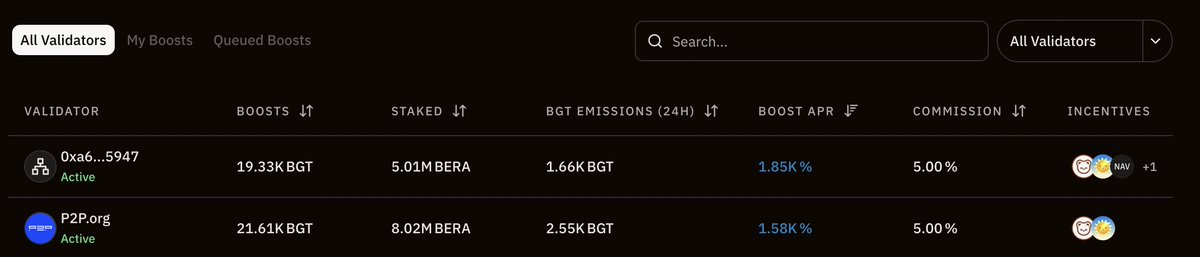
- https://t.co/VFcIY0aPNV now sorts by Boost APR by default (which validators are earning the most for their Boosters), instead of by their Bera stake
- Added FE warnings for people trying to boost validators with a high commission rate (ie. LSTs which take the full commission then distribute within their dApp
- More QoL improvements are in the pipeline especially for incentivization UX + estimating length of time that an incentive will last etc, and some other small UI fixes
In the meantime, PoL looking good here. I'm really happy to see people playing the game.
Berachain.
Berachain has launched and the market has responded with a resounding "who gives a fuck." Game over shitheads. Your 3 year long community building process didn't even get noticed by normies. Time to find a new meme.
IMO the bottom is in for OG Berachain projects. Here’s why:
1. PoL + Bribes Go Live Monday
Protocol-owned liquidity paired with bribes for BGT emissions kicks off next week. It’s the ignition switch for the Berachain flywheel. The whole ecosystem got hammered during the market dump—just like everything else—but now we’ve hit equilibrium.
2. OG Protocols Are Loaded and Ready
Projects like Yeet, Ramen, and NAV have stacked BERA from their RFB grants. They’re set to deploy a portion of it as bribes for BGT emissions. They’ve also allocated native tokens to incentivize validators and deepen liquidity. The arms race for emissions is about to heat up.
3. Stablecoin Pools Losing Influence
Stable-only pools have been soaking up a big slice of BGT emissions, but that dynamic should shift this week. Validators now get paid more to direct emissions toward ecosystem farms paired with BERA. That’s where the BGT flow is heading next.
4. The Flywheel Effect Is Coming Online
As more BGT emissions hit BERA-paired pools, farmers will need to buy BERA to stay in the game. More buying = higher BERA price = higher prices for eco tokens paired with BERA. Higher token prices = bigger bribes, which attract more BGT… and on it goes.
This is Berachain’s version of the Curve Wars flywheel—on steroids.
Bera Monday.
The @berachain ecosystem is thriving, so @LeftsideEmiri has jotted down a list of top projects spanning several verticals that have managed to carve out a niche for themselves.
Presenting to you the first blocmates ecosystem guide. Save/bookmark this for later.
We’ve tagged the corresponding teams and projects below for your further research.
Why Berachain matters (simple version):
How normal PoS works:
- Validators product blocks
- Validators get block rewards
- Validators have no incentives to see the application / user layer succeed
- Validators are overpaid for a commoditized service
How Berachain works:
- Validators product blocks
- Validators get 15% of block rewards on average directly (cover operational cost of infrastructure)
- Remaining 85% of block rewards HAVE to go to applications
- Applications then bid to receive those block rewards
- Bids are then distributed to validators (and redistributed to stakers of BGT/BERA)
This forces validators to give a shit about the applications and usage of the chain. If the apps don't succeed validators don't get paid.
The lower application demand is, the more they get their incentive spend subsidized by the chain. This allows them to acquire users and liquidity more effectively, which raises TVL and usage, which increases application demand for network inflation. Virtuous cycle.