Agent frameworks everywhere. Every AI player's got one; some have more than one.
The companies moving fastest? They picked one and started building.
While others evaluate, they're learning what actually works.
🔗https://t.co/0bPMT7w1LR
Claude can update its own instructions when it spots problems. Live today.
But companies are waiting for the "right" framework to emerge.
Gap between capability and usage keeps growing..
🔗https://t.co/MxzF6niZ4a
For the next generation, AI isn't a tool rollout. It's how you make things. Explore ideas. Plan a date.
They didn't need training. They just started using it.
This week, Rob & Justin dig into why exposure beats instruction & what that means for your teams.
https://t.co/VNLG4uZL8t
For the next generation, AI isn't a tool rollout. It's how you make things. Explore ideas. Plan a date.
They didn't need training. They just started using it.
This week, Rob & Justin dig into why exposure beats instruction & what that means for your teams.
https://t.co/Tpvk5ZyzgY
We've been in a toxic relationship w/off-the-shelf business software for so long we forgot what healthy looks like.
It's fine, the built-in reports are fine. Normal to export everything to Excel.
Therapy costs less than you think. It's called custom AI.
🔗https://t.co/tNZOELVRS0
The custom software you build this year won't be an AI project.
Just regular code with one piece of AI dropped in the exact right spot.
The magic Lego brick. Once you see where it fits, you find room for one in almost every workflow.
���https://t.co/xtpK53u4jF
The data gene shows up when you look at a correlation the AI just handed you and immediately know it's backwards.
You can't fake that. Can't learn it from a course. You either see it or you don't.
Rob and Justin break down why in this episode.
Listen now: https://t.co/VxZJ6resjc
The data gene shows up when you look at a correlation the AI just handed you and immediately know it's backwards.
You can't fake that. Can't learn it from a course. You either see it or you don't.
Rob and Justin break down why in this episode.
Listen now: https://t.co/DgGrCuXXX9
It’s been an intense year for the data world.
A lot of noise. A lot of transformation theater. A lot of “this changes everything” slides.
We’ve been right there with you.
We’ll be back in the new year. Recharged. Ready to keep cutting through the nonsense.
The models already crossed the “good enough” line. What’s missing is everything wrapped around them.
This episode explains why AI benchmarks don’t help you decide what to do next & how to think about AI in a way that survives contact with reality.
🔗https://t.co/mLgs9g4Osn
It’s been an intense year for the data world.
A lot of noise. A lot of transformation theater. A lot of “this changes everything” slides.
We’ve been right there with you.
We’ll be back in the new year. Recharged. Ready to keep cutting through the nonsense.
The models already crossed the “good enough” line. What’s missing is everything wrapped around them.
This episode explains why AI benchmarks don’t help you decide what to do next & how to think about AI in a way that survives contact with reality.
🔗https://t.co/cwBFr7EsaG
"Build me a sales dashboard" → generic.
"Show me closed deals by rep, Q4, YoY comparison, exclude refunds, finance revenue measure" → useful.
Precision is everything now.
Read the blog to learn more:
🔗https://t.co/rsJnISSJkm
87% on the latest benchmark! Revolutionary! Game-changing!
Cool. Now explain why it still won't load customer data.
Rob & Justin dig into why AI benchmarks keep answering the wrong questions & what matters when you're trying to get real work done.
🔗https://t.co/cwBFr7EsaG
"There is no better data source for AI than a well-built semantic model."
Rui Romano is proving what we've been saying for over a decade.
Full episode live now.
is
🔗https://t.co/m4bRrtnqaJ
"Where should we use AI?"
Silence.
This blank page problem kills more AI initiatives than bad technology ever will.
How to spot opportunities that are hiding in plain sight:
🔗https://t.co/4EZP5Q9MOk
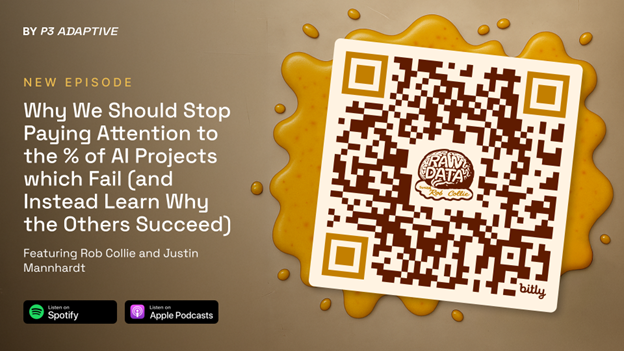
The 5% of AI projects that succeed aren't smarter or luckier.
They just understand their process first. Then they customize. Then they calibrate.
Rob and Justin explain what that means.
Listen via QR code ⬇️
The 5% of AI projects that succeed aren't smarter or luckier.
They just understand their process first. Then they customize. Then they calibrate.
Rob and Justin explain what that means.
Listen via QR code ⬇️
AI crushes simple tasks and falls apart on real workflows.
The fix isn’t more AI.
It’s smaller AI jobs with better structure.
We explain the pattern in the new episode.
🔗 https://t.co/cjLZlJc6vL