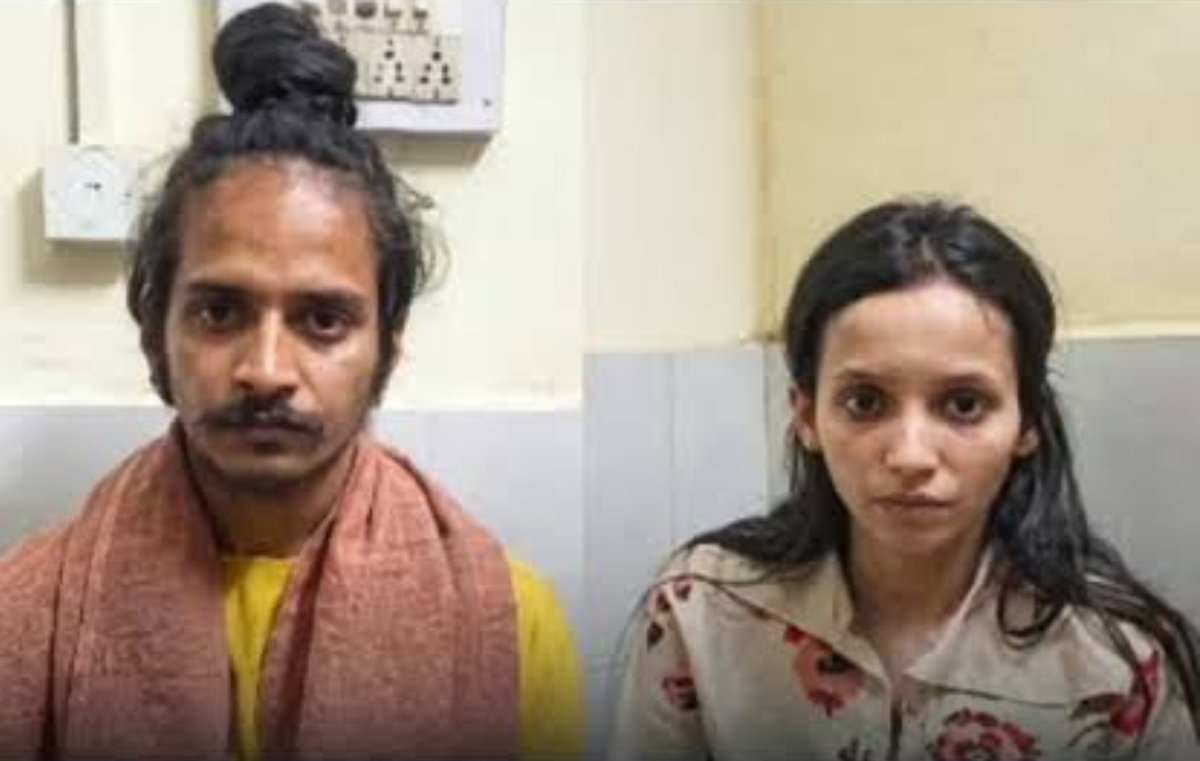
Blue Drum Case - The Meerut district court has sentenced Muskan Rastogi and her lover Sahil Shukla to the death penalty for the murder of Muskan’s husband, Saurabh Rajput.
This is the first case in which I am seeing that the family of the convict Muskan Rastogi has filed a written submission stating that they won't oppose the sentence imposed.
A Bench of Justice JB Pardiwala and K. Vinod Chandran while hearing an appeal from a Chattisgarh High Court judgement, has called out the pathetic condition of the High Court, as the judges apparently didn’t know what is Section 304 part I and 304 part II of the IPC.
I mean, if this is their condition, then is it not Collegium's fault too, for elevating them to High Court? Had this been a Trial Court judgement, an appropriate High Court bench would have chewed the judge alive.
Well, well, well, well - my first filing had only 6 defects...!! And they have 14? 😂 Glad to see the SC Registry isn’t doing “chori” by holding back on raising defects.. 😭😂
Bimal N. Patel, Vice-Chancellor of Rashtriya Raksha University and a member of the UN International Law Commission since January 2023, has been elected as a judge of the International Tribunal for the Law of the Sea (ITLOS) for the 2026–2035 term. He takes office on October 1, 2026.
An international law jurist, academician and administrator, Patel also chairs the International Law Commission's Working Group on Succession of States in respect of State Responsibility.
His appointment places an Indian jurist on the bench of an international tribunal that adjudicates disputes concerning the interpretation and application of the UN Convention on the Law of the Sea.
iPhone duo is priced at 3 lakh rupees. Samsung is out of picture now, it is directly competing with the daily appearance fee of some of the Senior Advocates of the Supreme Court.
Supreme Court in the case of LISHAM IBUNGOTOMBA SINGH has expressed shock that the Petitioner was in custody from past 8 years
And still denied him bail due to antecedents.
So why were they shocked ?
Surprising none pointed that CJI was hearing an issue which kicked off due to his own statement.
Had they refused to quash FIRs, everyone would have alleged biasness.
No one has an issue with biasness, just unfavorable orders. If biasness leads to favors, noone will bat an eye.
A bench of CJI Surya Kant, Justice Joymalya Bagchi and Justice V. Mohana invoked Article 142 to order that FIRs relating to the July 20-25 student protests shall not be pursued or investigated and shall be treated as closed. No fresh FIRs can be registered for incidents during that period either.
The Court made an exception for one FIR involving 2,873 persons who were present at Jantar Mantar and had serious criminal antecedents.
The Court said the order was being passed considering the future of students who had bona fide participated in the protests and clarified that it would not operate as a precedent.
The Centre and several States had sought quashing of the FIRs after assurances were given to the protesters. The Court has now given those assurances judicial effect, while the protest announced for September 5 has also been withdrawn.
There is a certain irony here and it's quite funny XD
The student protest fiasco began with controversy over remarks made by the CJI himself. It led to nationwide protests, police action and a series of FIRs against students. And now, those FIRs have been ordered to be closed across the country by a CJI-led Supreme Court Bench.
There is, therefore, something almost circular about the entire episode: a controversy involving the CJI, protests triggered by it, FIRs arising from those protests, and finally a CJI-led Bench bringing the FIR chapter to an end.
A son of a former police personnel has allegedly assaulted an old man following a dispute over making of Keys, with the accused stabbing the old man with the very same key in his head, causing severe serious injury.
If the allegations are true, the matter demands immediate and impartial investigation, followed by strict action under law.
What i find horrific is the mindset behind such incidents. These kal ke launde, barely old enough to understand life, law or responsibility, become drunk on power that they do not even own. A father's uniform, influence, connections or social standing cannot become a licence to intimidate, assault or commit crimes.
The matter needs serious Investigation. Establish the truth. Hold the guilty accountable. No matter whose son he is, the law must be bigger than his father's name.
Adding to the list of insane Judicial Lafdas of India, Supreme Court Justice Sandeep Mehta has written to CJI Surya Kant seeking the appointment of a Chief Justice from outside Rajasthan at Rajasthan HC, alleging serious administrative and judicial irregularities by Acting Chief Justice Sanjeev Prakash Sharma.
His letters allege manipulation of case listings, favouritism towards influential litigants, threats of transfers against fellow judges and misuse of administrative powers.
He has urged the Collegium to act before Justice Sharma's reported retirement next month.
These are extremely serious allegations, coming from a sitting Supreme Court judge. They cannot simply be brushed aside. They warrant a credible examination, particularly when the allegations concern the functioning of an entire High Court.
The manner in which the Collegium responds may be as important as the allegations themselves.
With due deference to the authority of the Apex Court, the majority and the dissent in Bhumika Trust (3-year practice rule judgment) has completely missed the point.
Making the regularisation of selected Magistrate dependent on the satisfaction of the High Court judge with whom they are attached is going to create far greater issues on the administrative side - those who have observed the system up close would understand what I am referring to.
But the argument that if senior lawyers do not entrust matters to juniors, then how can they be entrusted with deciding such matters - is nothing but an insult to hardships faced by the younger members of the Bar.
Everybody who has undergone the drill at the Bar would know how the young lawyers with up to are treated generally - intellectually starved, professionally abused.
An Assistant Public Prosecutor would have a quicker learning curve than a young member at the Bar, simply because of the number of matters that the APP would handle on a daily basis. Sadly, private chambers do not delegate that much to our young lawyers and so even after 1 year of practice they’re stuck in just drafting, complying with defects, applying for certified copies, taking adjournments and passovers.
Posting as received
Key Takeaways from 3 Year Judgment -
• Till March 31, 2027, law graduates can apply without completing three years’ practice.
• They will be deemed to have completed one year of practice for eligibility during this transition period.
• After selection, they will serve as Trainee Judicial Officers.
• They must undergo one year of intensive training at the State Judicial Academy.
• This will be followed by six months’ clerkship under the District Judge/Higher Judicial Service and six months under a sitting High Court judge.
• The training and clerkship together will count towards the practical-experience requirement.
• For recruitments notified on or after April 1, 2027, candidates must have at least one year of active practice before applying.
• High Courts must amend the relevant judicial service rules within three months.
• The new scheme will operate for five years, after which the Supreme Court will review how it has worked.
The Supreme Court has struck a sensible middle path on the 3-year practice requirement for Civil Judge Exams, reducing it to 1 year.
Instead of abruptly shutting the door on fresh law graduates, the Court has allowed candidates covered by the transition window till March 31, 2027 to enter without prior practice, while retaining structured training and clerkship.
At the same time, the future requirement of one year’s practice ensures that the new judges do not become completely detached from courtroom realities.
A pragmatic balance between access, experience and judicial preparedness.
Just we know how that one year of courtroom experience will look like 😅