Give Seedance 2.5 one sentence and it directs the rest, from the wardrobe to the camera move. Great if you like its taste.
Our new guide has five clips that show how to take those calls back, including the one where she turned toward the wrong train.
https://t.co/f4adIMeWYZ
Your retry logic and your tests stay where they are. Moving OpenAI SDK calls to deAPI only touches the client config.
After the switch, a 1024px FLUX.1 Schnell image costs $0.0027 and an hour of Whisper transcription runs about $0.05.
New on the blog: a guide to transcribing a Twitch VOD from nothing but its link.
It shows how to get a searchable transcript with a timestamp and a speaker label on every word, and what an hour of stream costs at each setting. The Python script works for Kick VODs too.
https://t.co/ohoLd40KW3
Nano Banana 2.1 is one of the most popular image models right now, and a lot of you asked us to add it. It's live on deAPI.
It runs through the same endpoint as the other image models, so trying it in an existing project means changing one string. Enjoy.
Most talk about the future of AI is about bigger models. Ours is about a solo developer who adds voice and video to an app in one evening, and can still afford to keep them running when users show up.
Everything on deAPI runs on open-source models behind one API key, billed per request. When a better open model comes out, it shows up behind that same key, and the code you wrote last year keeps working.
New on the blog: a guide to analyzing videos via API, with Marlin 2B reading the picture and Whisper handling the speech.
It shows how to turn a YouTube, TikTok, Twitch, X or Kick link into timestamped data you can search, and how to tell when a clip needs only one of the two models. Prices per video and a Python script are in there too.
https://t.co/3siUBNWZDn
FLUX.2 Klein through our @n8n_io node costs $0.0037 per 1024×1024 image. The $5 credit you get at signup covers roughly 1,300 of them. That's enough to run a product-photo workflow on a whole catalog before you spend your own money.
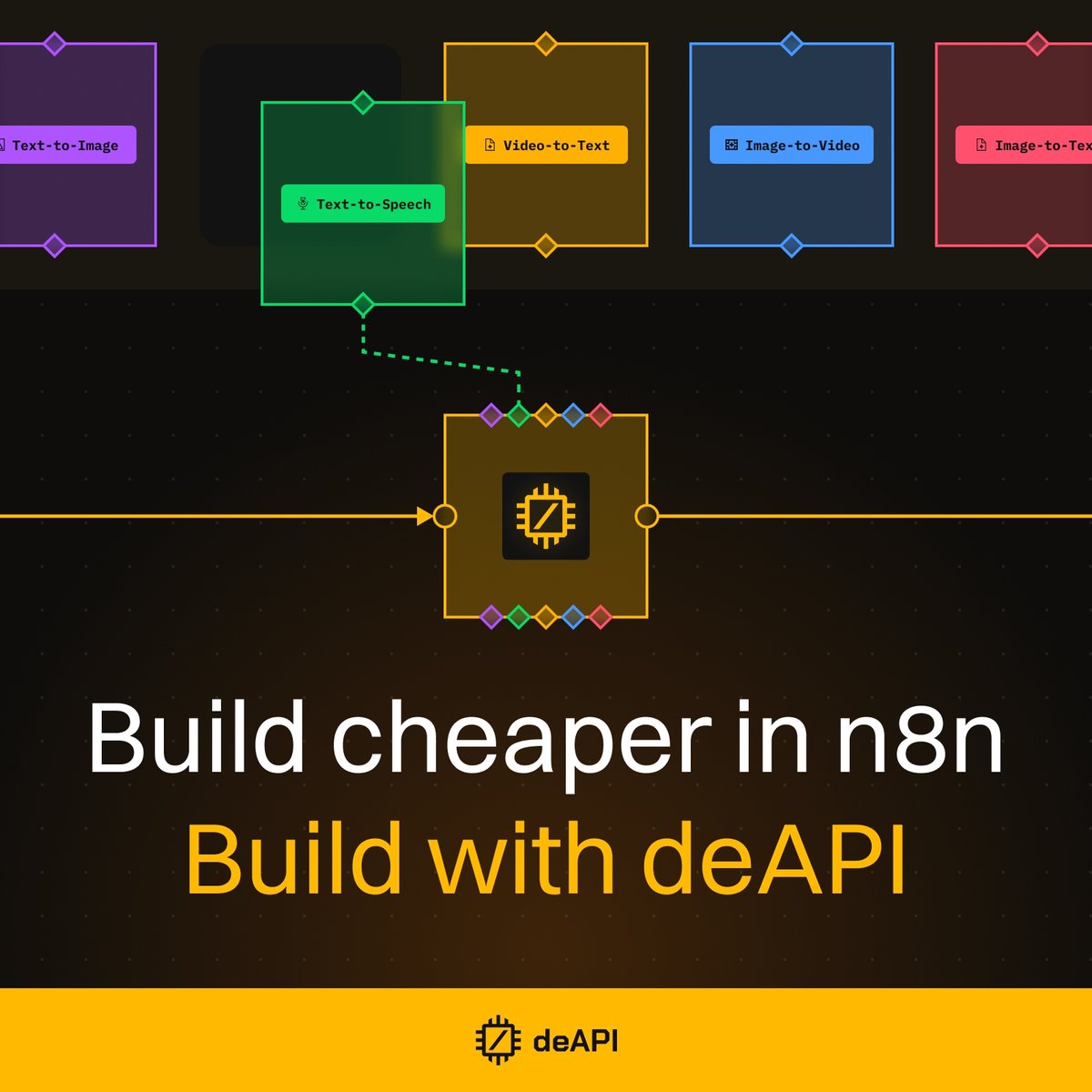
Search "deAPI" in the n8n nodes panel and paste your API key.
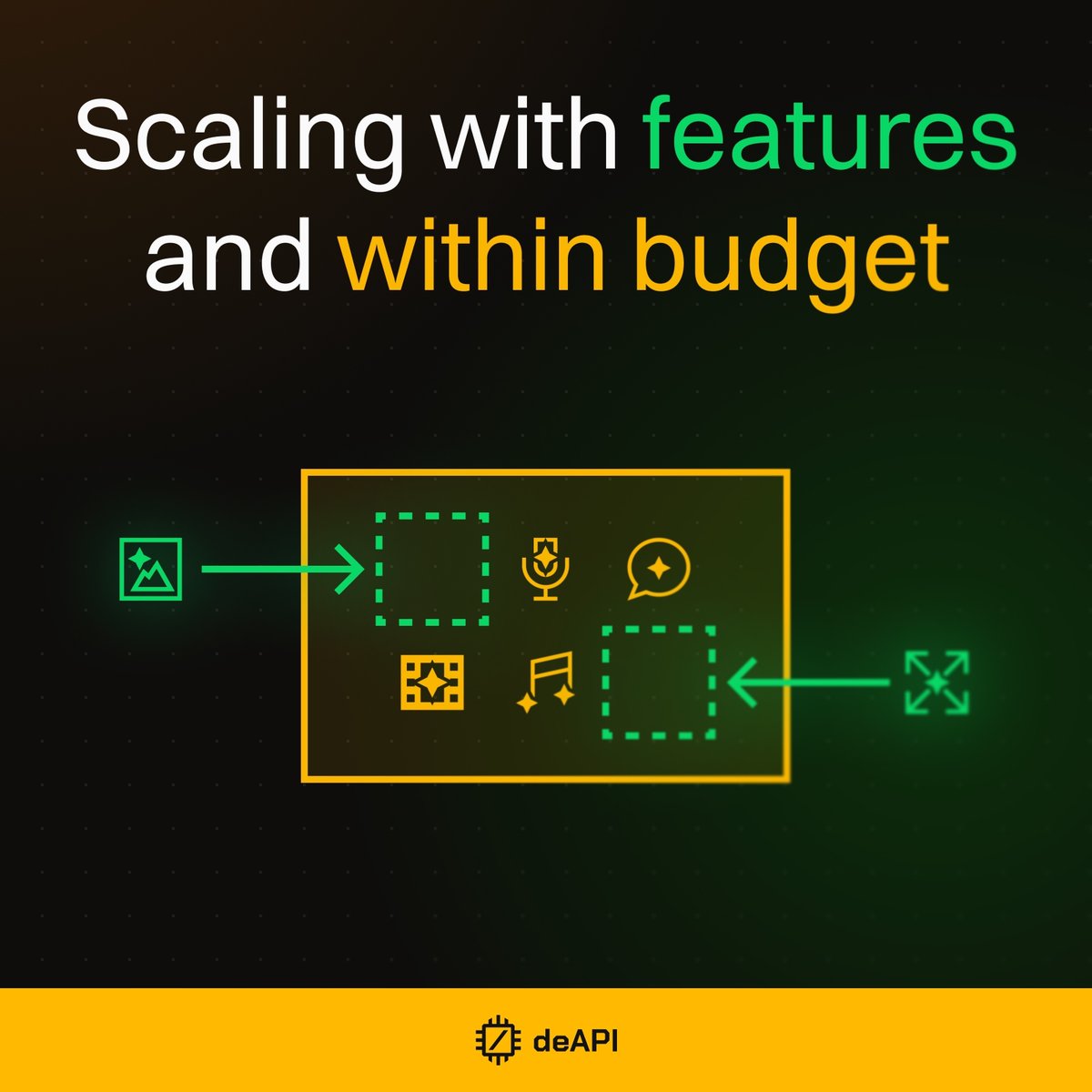
Your app launched with one AI feature. Six months later the roadmap adds three more: voice notes turned into text, a narrated version of every article and short video previews for the landing page. Usually each of those means a new vendor and another pricing page to watch.
On deAPI they run on the API key you already have, and you pay per request. A feature nobody used that month costs nothing. The ones people do use stay cheap, with an hour of Whisper transcription at $0.052 and a 1024x1024 FLUX.1 Schnell image at $0.0027.
New on the blog: Whisper API pricing on deAPI vs OpenAI, with prices checked on September 30.
It compares transcription costs for typical workloads, from a weekly podcast to a thousand voice notes a month, and shows what to change in your OpenAI SDK code to make the switch.
https://t.co/ohslCPR0JU
n8n has a library of ready-made workflows that run on deAPI. You import a template, connect your own accounts and it's ready to use.
One takes a product description and returns a video ad. Another takes a YouTube meeting recording and saves the notes to Notion. Others generate Shopify product images, dub a spokesperson video into another language, or clone a voice for a talking avatar.
The full list is in the replies.
OpenAI bills $0.36 for every hour of audio sent to its Whisper API. On deAPI, Whisper Large V3 transcribes the same hour for $0.021.
Say a podcast app needs to transcribe its 200-hour back catalog. That job costs about $72 with OpenAI and $4.21 on deAPI, which fits inside the $5 free credit you get at signup.
New on the blog: a guide to turning phone photos into product shots through an API.
It covers when a listing needs the product left exactly as photographed and when an AI-styled scene will do. Every step comes with code and a per-call cost for Ben2, Qwen Image Edit, FLUX.2 Klein and GPT Image 2.
Enjoy:
https://t.co/Ka5FLy6WAX
Agent cost talk is mostly about text. That holds until your agent has to transcribe a customer's voice note or generate a product shot, and the cost per task jumps.
deAPI covers that media part of the loop. Every capability on the graphic runs through one API key and gets billed per request. FLUX.1 Schnell costs $0.0027 per 1024x1024 image. An hour of transcription on Whisper Large V3 costs $0.021.
The $5 in free credits covers about 1,800 of those images or 237 hours of transcription, so you can check the claim on your own agent before paying anything.
Nobody ships a side project between 11pm and 1am if getting an API key takes a sales call.
One key gets you 30 models. FLUX.1 Schnell runs $0.0027 an image, so the $5 free credit is about 1,800 tries - enough to find out if the idea holds before you even name it.
New on the blog: a guide to Ben2, the background removal model on deAPI.
It covers which subjects come back clean and which ones are a lost cause, and the field in the API response that quietly hands you back a background you already paid to remove.
https://t.co/gaIoddjSYq
Every week a lab drops open weights and the timeline cheers. Then the file sits there.
Trying a 20B model yourself means renting a GPU by the hour before you know if you even like the output.
Open competes when testing it costs less than thinking about it.
You can earn on deAPI without sending a single request. Invite someone, and 10% of what they buy comes back to you.
Referral link is in your dashboard.
Getting the app built stopped being the hard part. Describe it to Codex or Rork and you have a working client by the evening.
Choosing the AI API behind it is still on you. Left alone, your agent hardcodes the first provider it remembers from training data.
Boppy went the other way and has been in the App Store since June. New on the blog, why deAPI is a good place to start:
https://t.co/9tdJSQogFO