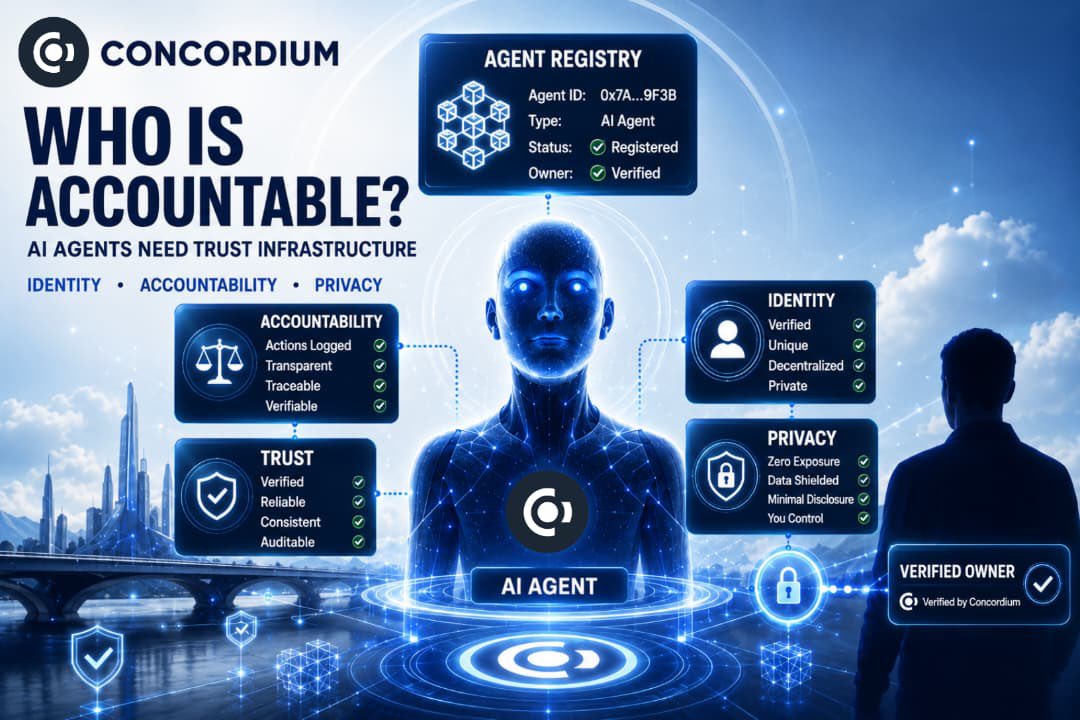
AI agents are becoming powerful enough to act, transact, and make decisions.
But the bigger question is no longer what they can do.
It is who becomes accountable when they do it.
AI agents are no longer just tools that answer questions. They are becoming economic actors.
They can execute transactions, interact with smart contracts, manage portfolios, access services, automate decisions, and move value across digital systems.
That changes the trust conversation completely.
When an AI agent only summarizes text or writes an email, the risk is limited.
But when an agent can touch funds, sign transactions, manage assets, or make decisions on behalf of users, accountability becomes a serious issue.
This is one of the biggest gaps in the agent economy today.
The industry has spent a lot of time asking what agents can do.
Can they trade?
Can they transact?
Can they coordinate?
Can they plug into DeFi?
But not enough time has been spent asking who stands behind them.
Agent identity and agent accountability are not the same thing.
Identity tells you an agent exists. It helps users and systems recognize the agent, discover it, check its metadata, and understand how to interact with it.
Accountability goes deeper:
Who controls this agent?
Who owns it?
Who is responsible if it behaves badly?
Can the agent be linked to a real verified human without exposing that person publicly?
That is where trust infrastructure becomes important.
As agents begin handling larger amounts of value, users, protocols, businesses, and institutions will need more confidence before giving them access to serious workflows.
This is the problem @Concordium is trying to address with the Agent Registry.
The Concordium Agent Registry introduces a protocol-level identity and accountability layer for AI agents.
An AI agent can be linked to a verified human identity, while that human does not have to reveal personal information publicly.
That balance matters.
Accountability without doxxing.
Verification without unnecessary exposure.
Trust without removing privacy.
Through Concordium’s identity framework and zero-knowledge proofs, the registry can show that a verified human stands behind an agent.
That is what the “Verified by Concordium” Badge represents.
It signals that the agent is connected to a verified human owner through Concordium’s accountability infrastructure.
No migration is required. Ethereum agents can register today, and more ecosystems are expected to follow.
If AI agents are going to act on behalf of users, manage assets, and interact with financial systems, trust cannot be optional.
Accountability will become part of the infrastructure and @Concordium is positioning its Agent Registry around that exact need.
Read the blog:
https://t.co/TgiyBgOEA6
Agent Registry:
https://t.co/rbTQAC9Y6O
@elltzy775@CNPYNetwork Decentralized infrastructure that scales with participation is a strong thesis, especially for future AI and edge computing demands.