Actually two cognitive neuroscientists united by one research interest.
We combine psychophysics, fMRI and computational modeling to study perceptual decisions.
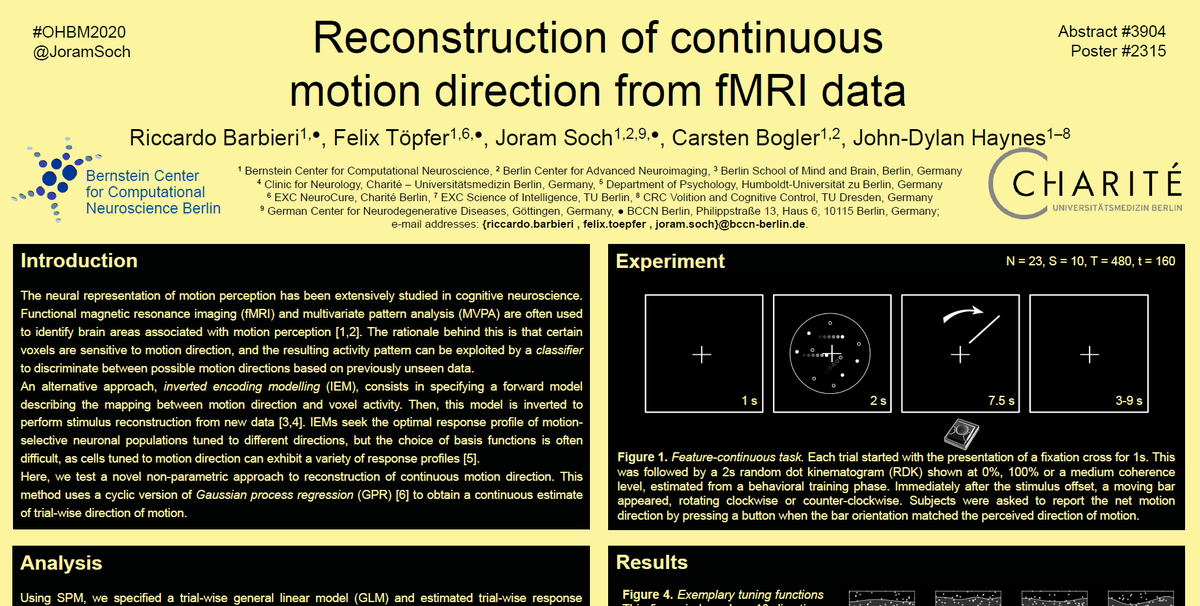
Felix M. Töpfer, Riccardo Barbieri et al. @ChariteBerlin discuss psychophysics and computational modeling of feature-continuous motion perception.
https://t.co/JpU8akUuO5
[job ad, pls share] I'm looking to hire a postdoc and a PhD student for my new lab in Berlin starting January 2021. We'll be using behavioural and neuroimaging methods to find out how working memory is stored in the human brain. Info and contacts at https://t.co/IkN1jdjiRc 1/2
Dear Vision Science Society people, if you are interested in perceptual decision-making, feature-continuous task designs and fMRI methods join our live conference on Monday 22 (14:00 and 15:00 CET) abstract IDs #491 and #1274 @VSSMtg#VSS2020
Our paper "Inverse Transformed Encoding Models - a solution to the problem of correlated trial-by-trial parameter estimates in fMRI decoding" is online (with @JoramSoch@C_Allefeld). Open access: https://t.co/ORAg0jiKe9
My review article at #TheNeuroscientist is finally out! Orientation Encoding and Viewpoint Invariance in Face Recognition: Inferring Neural Properties from Large-Scale Signals - Fernando M. Ramírez, 2018 https://t.co/7udEzG6TSU
Check our VSS 2018 poster on feature-continuous motion judgements. Our finding is compatible with that of Gi-Yeul Bae from @stevenjluck Lab, maybe ROODs are elicited by specific stimulus implementations??
https://t.co/OtpNRRE8fE



![tbchristophel's tweet photo. [job ad, pls share] I'm looking to hire a postdoc and a PhD student for my new lab in Berlin starting January 2021. We'll be using behavioural and neuroimaging methods to find out how working memory is stored in the human brain. Info and contacts at https://t.co/IkN1jdjiRc 1/2 https://t.co/EyPXbdbsyH](https://pbs.twimg.com/media/Egbtm0EU8AA-I2M.jpg)