Version Hantavirus infographic #13 [13 cases as well].
A new @news.abc.net.au story hints that quarantine (at least in Aus) has been based on the disembarkation date (completed May 11). I've added that in as an orange-shaded box.
Anything unclear?
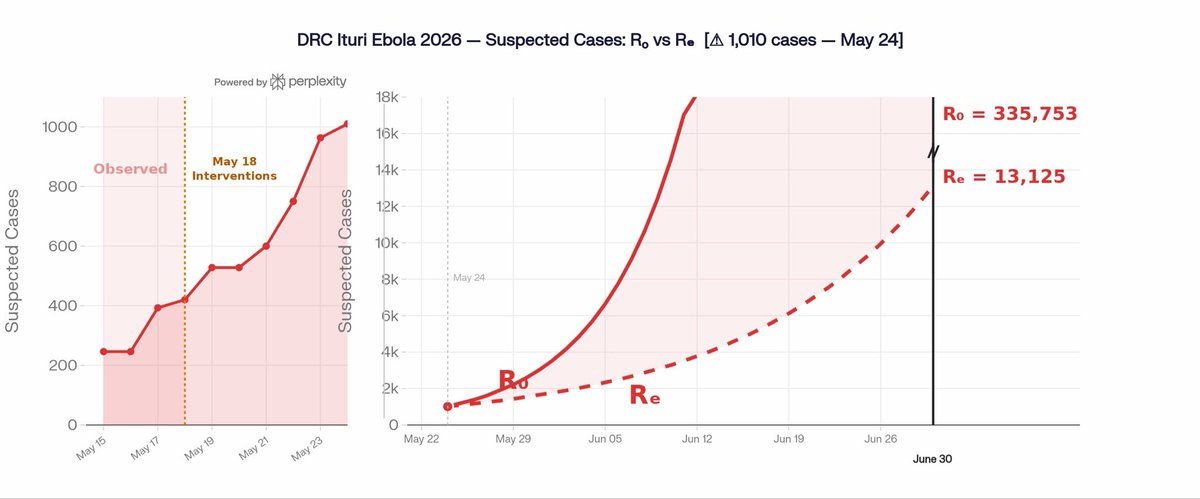
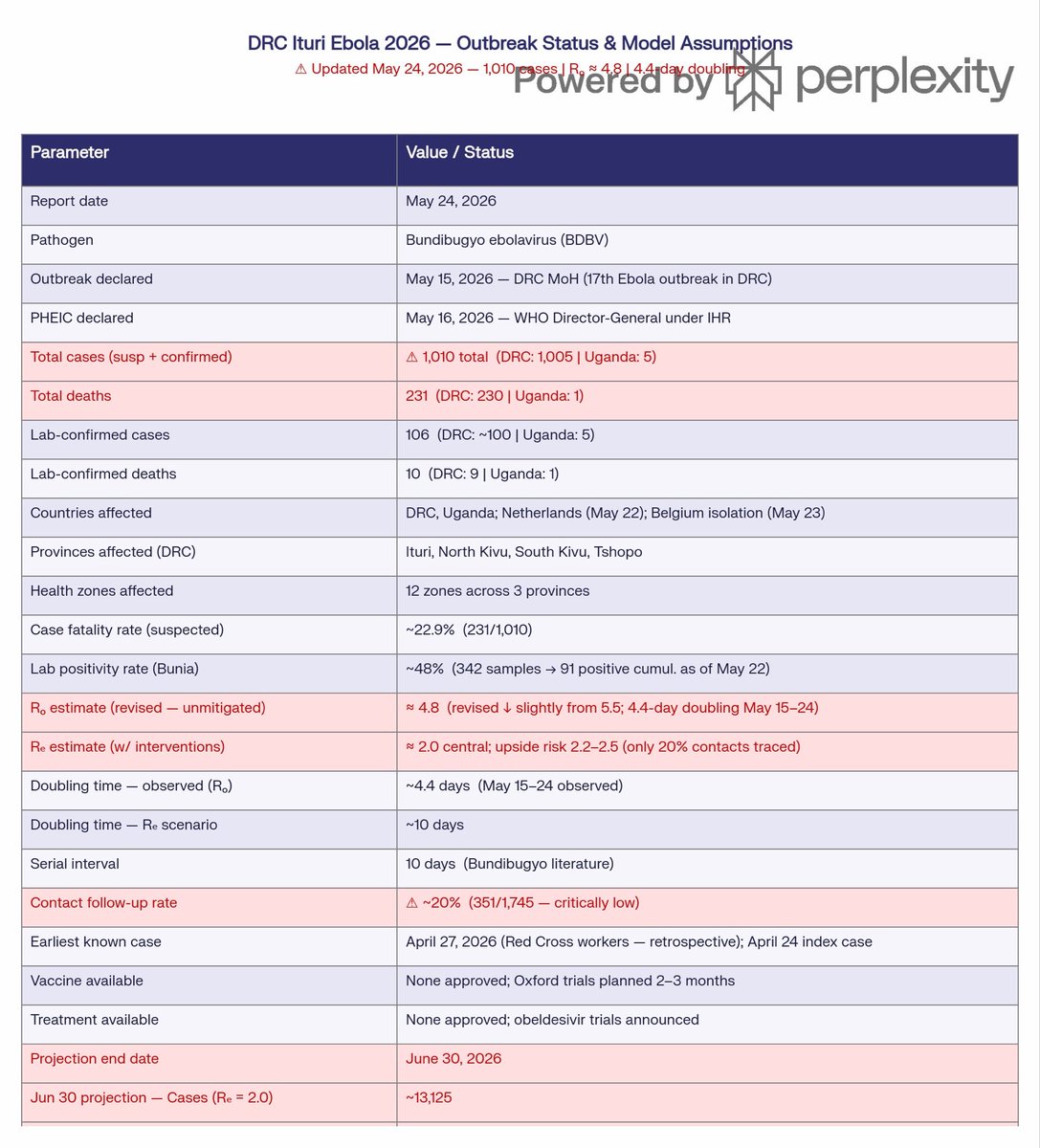
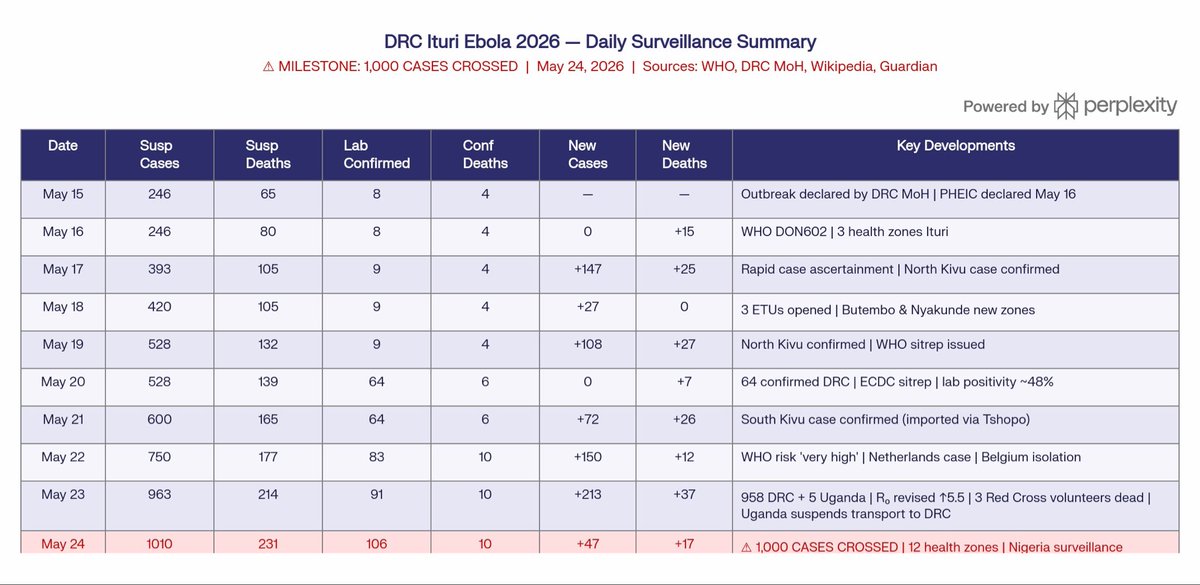
May 24 Ebola Update
First case ~ March 27
Outbreak undetected ~ 7 weeks
1,010 cases
Doubling time ~4.4 days
R0 ~ 4.8
Re ~ 2.0
June 30 est:
13K cases
3K deaths
Concerning the human/human transmission: is it limited to direct and close contact, or is there also transmission through microdroplets and aerosols? this is addressed in this paper, which discusses the precautionary measures that should be taken. https://t.co/XHs2vIDNDe
Sequences of the Hantavirus isolated in Switzerland from a symptomatic patient are now available. https://t.co/XK0LAdNmfA. The analysis indicates that the closest relatives are Argentine viruses.
The priority should be to rapidly limit human-to-human transmission and to prevent the virus from selecting adaptive mutations that enhance infection and human-to-human transmissibility.
It is not certain that (1) the rapid repatriation by plane of passengers from the ship to their countries of origin, and (2) heterogeneous containment measures depending on countries, represent the best strategy to control this emergence.
@PaulNuki@benfarmerDT@TelGlobalHealth@PaulNuki Would it be possible to obtain the sequences?
A 99% identity does not exclude the possibility of adaptation of the Gc /Gnprotein to the human receptor. A detailed analysis of the receptor-binding domains is necessary before any conclusion can be drawn.
A sixth article documents the human-to-human transmission of Andes virus and presents phylogenetic analyses of Gn/Gc sequences: "Hantavirus Pulmonary Syndrome Outbreak in Argentina: Molecular Evidence for Person-to-Person Transmission of Andes Virus."
"Neutralizing Monoclonal Antibodies against the Gn and the Gc of the Andes Virus Glycoprotein Spike Complex Protect from Virus Challenge in a Preclinical Hamster Model" . 2020 Mar 24;11(2):e00028-20.mBio
doi: 10.1128/mBio.00028-20.
The fifth article (as well as the fourth) discusses neutralization by antibodies capable of recognizing the Gc/Gn protein, which is responsible for cellular receptor recognition and viral entry into cells. The good news is that several neutralizing antibodies exist.
The fourth concerns the cryo-EM structure of the viral envelope protein (Gc/Gn), which is responsible for receptor recognition. We are awaiting the sequences to identify potential genetic variations in the strains responsible for the cluster on the cruise ship.”
The third documents the identification of the receptor protocadherin-1 and the effect of mutations in this receptor on protection against lethal infection. Two mutations are sufficient to modulate viral entry and probably play a role in the species barrier.





![MackayIM's tweet photo. Version Hantavirus infographic #13 [13 cases as well].
A new @news.abc.net.au story hints that quarantine (at least in Aus) has been based on the disembarkation date (completed May 11). I've added that in as an orange-shaded box.
Anything unclear? https://t.co/tXToM9kkHA](https://pbs.twimg.com/media/HJYubljbwAE_4ln.jpg)