Let’s even leave peter Obi alone for a minute. He’s not that important, he might not even get his party’s ticket.
As a nation, we should come together and ask ourselves what Tinubu has done to even open his mouth to ask for a second term. How has he made our lives better than what it was in 2022.
We’re making real progress. 72% of our first target reached, thanks to you.
A few more strong shares could help us cross this first target quickly.
Please keep amplifying if you can.
https://t.co/HXjyQcjGE3
Nigeria is walking into a one-chance that will shock generations.
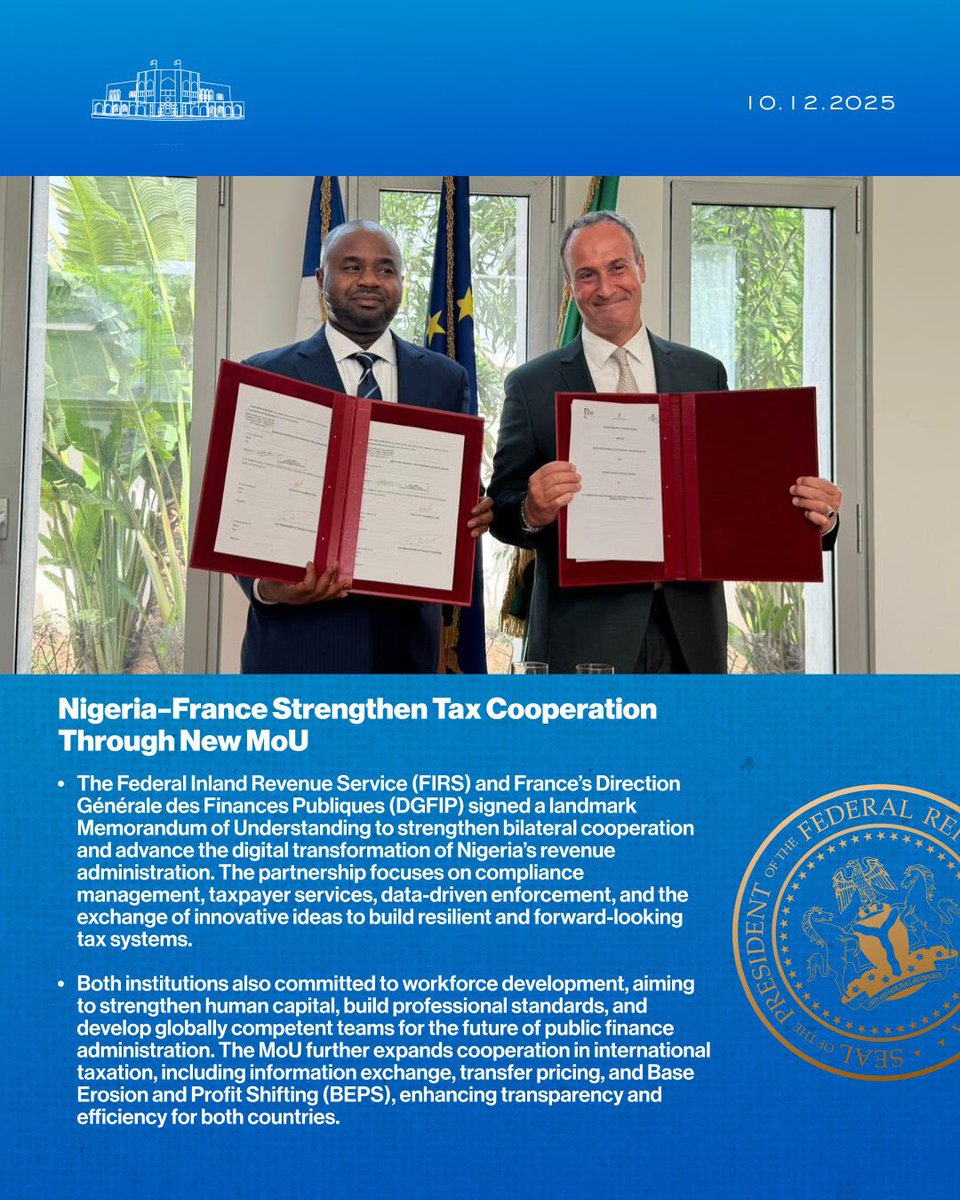
FIRS just signed an MoU with France’s DGFiP to “modernise tax administration”, “data-driven enforcement”, “information exchange”, and “capacity building”.
If you like believe sweet grammar.
Translation: Nigeria has opened the engine room of its tax system to France.
Who is advising these people?
Let’s be clear. France is not an innocent actor in Africa. France is the most aggressive economic-intelligence power in West Africa.
They hold CFA countries by the throat.
They control currency reserves.
They shape customs rules.
They monitor financial flows from Dakar to N’Djamena.
They embed “advisers” inside governments.
France does not play.
Without Africa, France would be a mid-tier country nobody sends.
Once France enters your revenue backend, they can read your entire economy like a Bible:
– Who pays tax
– Who evades
– Which sectors are weak
– Which sectors are profitable
– Where money comes from
– Where money goes
– Where wealth lives
– Where political networks hide
That is not “capacity building”.
That is POWER.
And Nigeria handed it over like a Valentine gift.
Instead of building sovereign capacity, we are outsourcing our fiscal brain to a foreign power that survives by controlling African economies.
Even Francophone countries are fighting to escape France’s grip.
Nigeria is rushing into it by itself. Incredible.
France didn’t build wealth with chains alone.
They used African tax, labour, rubber, gold, cash crops, and minerals.
Today, the chains are called:
“MoUs”
“Digital transformation”
“BEPS frameworks”
“Cross-border cooperation”
Same script. New costume.
Now imagine this as Nigeria transitions from FIRS to Nigeria Revenue Service in 2026 with foreign fingerprints already on the backend, algorithms, enforcement logic, data pipelines, and compliance structure.
Who do you fight tomorrow when your tax DNA is exposed?
Does the US give IRS backend to Mexico?
Does the UK hand HMRC to Pakistan?
Does India give its tax system to China?
Does France give Algeria its revenue architecture?
Never.
But Nigeria keeps behaving like a giant that signs away sovereignty for photo-ops.
Nigerians, your future is being auctioned in broad daylight.
Line by line.
Signature by signature.
Document by document.
“Our dear native land” is no longer poetry.
It is slipping away quietly.
Clap if you like.
Play tribal politics if you like.
But hear this truth:
Once a foreign power holds your tax system, your independence is finished.
No guns needed. Just MoUs.
Every sensible Nigerian must speak with one voice.
Not today.
Not tomorrow.
Not ever.
Fix your sleep permanently using this:
• Sleep at 11:00PM → Wake up at 7:00AM
• Sleep at 12:00AM → Wake up at 7:00AM
• Sleep at 1:00AM → Wake up at 7:00AM
• Sleep at 2:00AM → Wake up at 7:00AM
• Sleep at 3:00AM → Wake up at 7:00AM
• Sleep at 4:00AM → Wake up at 7:00AM
I want the killings to stop, but there is no world where it makes sense to threaten a sovereign country with invasion.
It won’t favour us in the end if this happens.
A man flying in a hot air balloon suddenly realizes he’s lost. He reduces height and spots a man down below. He lowers the balloon further and shouts to get directions, "Excuse me, can you tell me where I am?"
The man below says: "Yes. You're in a hot air balloon, hovering 30 feet above this field."
"You must work in Information Technology," says the balloonist.
"I do" replies the man. "How did you know?"
"Well," says the balloonist, "everything you have told me is technically correct, but It's of no use to anyone."
The man below replies, "You must work in management."
"I do," replies the balloonist, "But how'd you know?"*
"Well", says the man, "you don’t know where you are or where you’re going, but you expect me to be able to help. You’re in the same position you were before we met, but now it’s my fault."
FDI to Nigeria Declines Amidst Unending Global Galivanting and Uncoordinated Reforms
While the President, Ministers, and other government officials continue their global galivanting in search of FDI, our poor performance in key governance indicators - such as rule of law, regulatory quality, government effectiveness, and voice and accountability - continues to prove that you cannot attract sustainable foreign investment with poor leadership and governance.
According to a recent report by the National Bureau of Statistics, FDI to Nigeria sharply declined by about 70% in the first quarter of 2025, falling to only $126.29 million from $421.8 million in the last quarter of 2024. Of the total capital importation of about $5.64 billion in the first quarter of 2025, FDI accounted for only about 2.24%, compared to 8.2% in Q4 2024. Disturbingly, about 90% of the imported capital went into speculative money market instruments. With such a high proportion of capital importation flowing into speculative investments, the impact on industrial growth or job creation is highly insignificant and elusive, given the ease with which such “hot money” can exit the economy.
Let me reiterate: sustainable economic growth and development cannot be achieved through poor leadership and weak governance—problems that are clearly reflected in declining FDI and our poor performance in key governance indicators. To further illustrate our precarious situation, capital flows to the manufacturing sector declined exponentially by 32.1%, dropping to only $129.92 million in Q1 2025 from $191.92 million in the same quarter of 2023. There is no better confirmation of the lack of trust in this government, whose reforms remain uncoordinated and largely reactive.
In 2024, while global FDI flows declined, FDI to Africa significantly increased to $97 billion—a rise of about 75% compared to 2023. Europe, the United States, and China were the main sources of this FDI. Egypt attracted the highest share in Africa, with $46.58 billion. Other top recipients included Ethiopia ($3.98 billion), Côte d’Ivoire ($3.80 billion), Mozambique ($3.55 billion), Uganda ($3.30 billion), Democratic Republic of Congo ($3.11 billion), South Africa ($2.47 billion), Namibia ($2.06 billion), Senegal ($2.02 billion), Guinea ($1.83 billion), and Morocco ($1.64 billion).
Most disappointingly, our dear nation, Nigeria—the so-called “Giant of Africa”—received only $1.08 billion, about 1% of Africa’s total FDI, representing a decline of about 42% from 2023. Worse still, after this 42% drop between 2023 and 2024, FDI to Nigeria has further declined by 75% between Q4 2024 and Q1 2025. We cannot achieve sustainable growth and development with ineffective leadership and a weak government.
A New Nigeria is Possible! - PO
Dear Bola, You said leaders who think this way “don’t understand development” and that we should “invest in oil to generate sustained income to invest in education.”
let me share why I think you’ve got this completely backwards, and here’s why:
We’re in 2025 not 1975, and your argument sounds exactly like what Nigerian leaders have been saying for the past 50 years - and We’re still:
1.Importing fuel
2.Watching our economy convulse every time oil prices drop
3. With 18+ million children out of school while we chase oil export revenues
4.Losing billions to expatriate workers ‘cos we lack the skills locally
The “oil first, education later” approach has been tested for half a century. It failed spectacularly.
You’ve ignored a massive resource leak & focused on crude oil export proceeds. Consider this:
1.Most high-paying jobs in our oil sector go to expatriates
2.Their salaries leave Nigeria and circulate in foreign economies
3.We export crude oil cheap and import refined products expensive
4.Foreign companies capture 70-80% of the value in our oil sector
A skilled Nigerian workforce would plug these leaks and keep that money circulating in our economy. That’s maximizing oil sector benefits.
Bola, what you called “sustained income,” from oil, is the opposite of sustainable:
1.Oil prices crashed in 2014 and threw us into recession
2.We can’t even predict our budget because oil prices fluctuate wildly
3.The world is moving away from fossil fuels
4.Our oil reserves will eventually run out
Meanwhile, an educated population - a workforce that understands green energy- will generate income that grows over time through innovation, productivity, and entrepreneurship. THAT is sustainable.
while we’re debating whether to invest in oil or education, 10.2 million primary school children are out of school RIGHT NOW.
You’re Ignoring the Human Capital Emergency- you KNOW this because you were active in the EdTech space…
These kids can’t wait for oil revenues to materialize in 5-10 years. Every year we delay is permanent human capital lost forever.
Countries don’t develop by accident - they develop because they invest in their people’s ability to think, innovate, and solve problems.
Bola, look at the countries that actually achieved sustainable development:
1. South Korea was poorer than Nigeria in the 1960s but prioritized education, now they’re a tech powerhouse.
2. Singapore had no natural resources but invested heavily in human capital - now they’re richer per capita than most oil producers.
3. Norway used oil revenues to fund education and research m that’s why they dominate offshore technology globally.
The pattern is clear: prioritize education, everything else gets better.
Here’s the irony, Bola 👇🏾
your oil-first approach is actually bad for the oil sector! With proper education investment, Nigeria could:
1. Train engineers to work in our refineries instead of importing expertise- go and look at the workforce composition of the Dangote refinery that’s even our claim to fame right now - what do you see?
2. Develop local companies to provide oil services and improve the value chain capture - even with our local content laws, what’s the biggest challenge ? the skills just don’t exist at scale!
3. Build locally owned petrochemical industries to process our crude derivative products locally- should we talk about Eleme Petrochemicals and how / why it became Indorama ? We didn’t have the skills to run it …
4. Create indigenous technology for our oil operations- every “I’m in Oil and Gas” big boy you meet in lagos is low key a glorified technology reseller🥸. I said what I said!
Bola you’re advocating to keep Nigeria as a raw material exporter forever…
1/2
Many beginners struggle to pronounce acronyms correctly. Here is a guide to help you sound experienced:
Regex: pronounced “rejex” (short for rejular jrexpression)
Gif: “jeff”
JWT: “jaw-tuh”
CLI: “klie”
SIEM: “sigh-eem”
SQL: “squeak”
RCE: “arse”
XSS “kssSsssSssss”
K8S: “koober eight netties”
IDOR: “fuck with the uh url param”
Nginx: “An-Jinx!”
Apache: “ah pawsh”
Yaml: “oh fuck oh god what the fuck WHERE is the MISSING SPACE”
XXE: “sexsexy”
x86: “just get an M4 mac you’re poor”
GUI: “jooie”
OAuth: “oats”
CSRF: “sazerac”
Msfvenom: “I’m a skid”
HtAoE2EbJE: left as an exercise for the astute reader