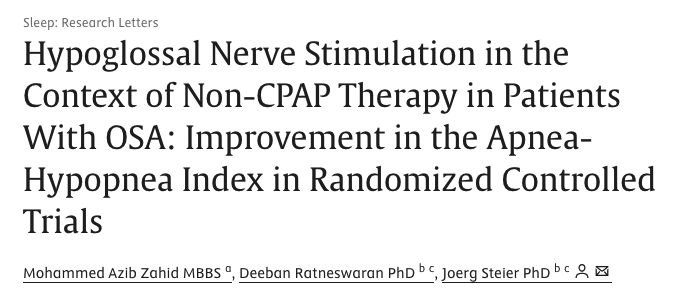
Our summary on each RCT to date on hypoglossal nerve stimulation and AHI in Sleep Apnoea.
Good news: consistent AHI reductions, strong safety, durable 5-year outcomes, and favourable cost-effectiveness.
The caveat: the RCT base is still thin. Small cohorts, responder-enriched designs, and short follow-ups that limit generalisability.
For context, the GLP-1/GIP agonist tirzepatide (SURMOUNT-OSA) showed AHI (apnea-hypopnea index) reductions of -25 to -29 events/h across two phase 3 RCTs. The best HNS trials sit around -14 to -16.
We need more trials, but the direction is promising. Published in @journal_CHEST Open access ↓
https://t.co/3qASJONXGk
@KingsCollegeLon@GSTTnhs
@Samwise_Ganji Fiat is a sham, the banking class is corrupt, decentralized digital currency and the blockchain are the inevitable future, and the incumbents will fight it to the death.
Always great speaking with @Kellykellam. A few points, amongst other things, that we touched upon during @MarioNawfal's roundtable :
- Inherent risks that arise from pre-training
- Failure modes in clinical medicine
- AI hype cycle or scaling cycle
The concerning part is, the fumble is the safer part of the failure. It’s the rationale that should bother you.
It’ll build a clean, plausible reason for the wrong answer - trying to be convincing while wrong.
OPUS4.8 High.
Corrected the fact then proceeds to hallucinate the rationale with something that sounds entirely plausible to someone who isn't paying attention.
Weird.