A Russian psychologist spent 10 years proving that the act of talking to yourself out loud is one of the most powerful cognitive tools the human brain has, and almost nobody outside his field has read the work.
His name was Lev Vygotsky.
He worked in Moscow in the 1920s and died of tuberculosis in 1934 at the age of 37. He had no laboratory, no funding, almost no English readers, and a body of work that the Soviet government suppressed for two decades after he died.
He produced the foundational theory of how human cognition actually develops, and the central piece of that theory was a behavior almost every adult is faintly embarrassed about.
Vygotsky noticed that young children talk to themselves constantly. They narrate their own actions, they argue with imaginary opponents, they instruct themselves through tasks out loud.
The dominant theory at the time, from the Swiss psychologist Jean Piaget, said this was a sign of cognitive immaturity that children would eventually grow out of as they learned to think properly.
Vygotsky said the exact opposite.
He argued that this self-directed speech was the most important cognitive event in the entire developmental window, because it was the moment a child first started to use language as a tool to control their own mind. The child was not failing to think. The child was learning how to think by externalizing the process and listening to themselves do it.
He predicted that as children matured, this out-loud self-talk would not disappear. It would go underground. It would become silent inner speech, which is the running monologue every adult has inside their own head for the rest of their life.
The voice you hear when you read this sentence is the direct descendant of a four-year-old narrating their own block tower.
For 50 years almost nobody outside Russia had access to his work, and the few researchers who did pick it up could not get funding to test it. Then in the early 2000s the experiments finally started to pile up, and what they found was that Vygotsky had been right about something even more important than he knew.
The first major study came from Gary Lupyan at the University of Wisconsin and Daniel Swingley at the University of Pennsylvania in 2012. They ran a simple visual search experiment. Participants were shown 20 images at once and asked to find a specific object, like a banana or a chair. In one condition they searched silently. In the other condition they were told to say the name of the object out loud to themselves while looking for it.
The participants who spoke the target name out loud found the object significantly faster, with higher accuracy, than the participants who searched in silence. The effect was strongest when the spoken word matched a familiar object the brain already had a strong category for.
Saying the word out loud literally tuned the visual system to detect that thing better. The researchers called it the label feedback effect, and the implication was that the act of vocalizing a goal physically changes how the brain processes the world while pursuing it.
The second major study came out of the University of Michigan and Michigan State in 2017. The lead researchers were Ethan Kross and Jason Moser, and they used both EEG and fMRI to record what happens inside the brain when people talk to themselves while emotionally upset.
They asked participants to recall painful autobiographical memories and reflect on them in two different ways. Some used the first person, saying things like "why am I feeling this way." Others used the third person, referring to themselves by their own name, saying things like "why is John feeling this way."
The brain scans showed that the simple act of switching from first person to third person, even silently, decreased activity in the medial prefrontal cortex, the region responsible for rumination and self-referential pain. Within a single second of using their own name instead of the word I, participants showed measurably lower emotional reactivity. The shift required no extra cognitive effort. It cost the brain nothing. And it worked.
Kross described the mechanism in his interviews. Talking to yourself by name creates a small amount of psychological distance from your own experience. Your brain processes the situation more like a problem belonging to someone else, which means it can analyze it instead of drowning in it.
What Vygotsky had intuited in 1934 turned out to be even more powerful than the developmental theory he built it into. The voice you use to talk to yourself is not background noise. It is one of the most precise cognitive tools the brain has, and you can change how it works just by changing the pronoun you use.
People who talk through problems out loud are not anxious or unstable. They are running an externalized version of a process the rest of us are running silently and worse. The kindergartener narrating their block tower, the surgeon muttering through a procedure, the engineer pacing a hallway describing a bug to nobody, the athlete repeating a cue to themselves before a free throw, they are all using the same ancient mechanism that builds and steers human thought.
You can run the experiment yourself the next time you are stuck on something hard. Stop trying to solve it silently in your head. Say it out loud. Describe what you are seeing. Walk yourself through the steps as if you were explaining it to a colleague who is not in the room.
And when something genuinely upsets you, switch to your own name. Ask why this person is feeling this way, instead of why I am feeling this way.
The voice you have been told to keep quiet your entire life is one of the oldest pieces of cognitive technology you own.
Most people are still embarrassed to use it.
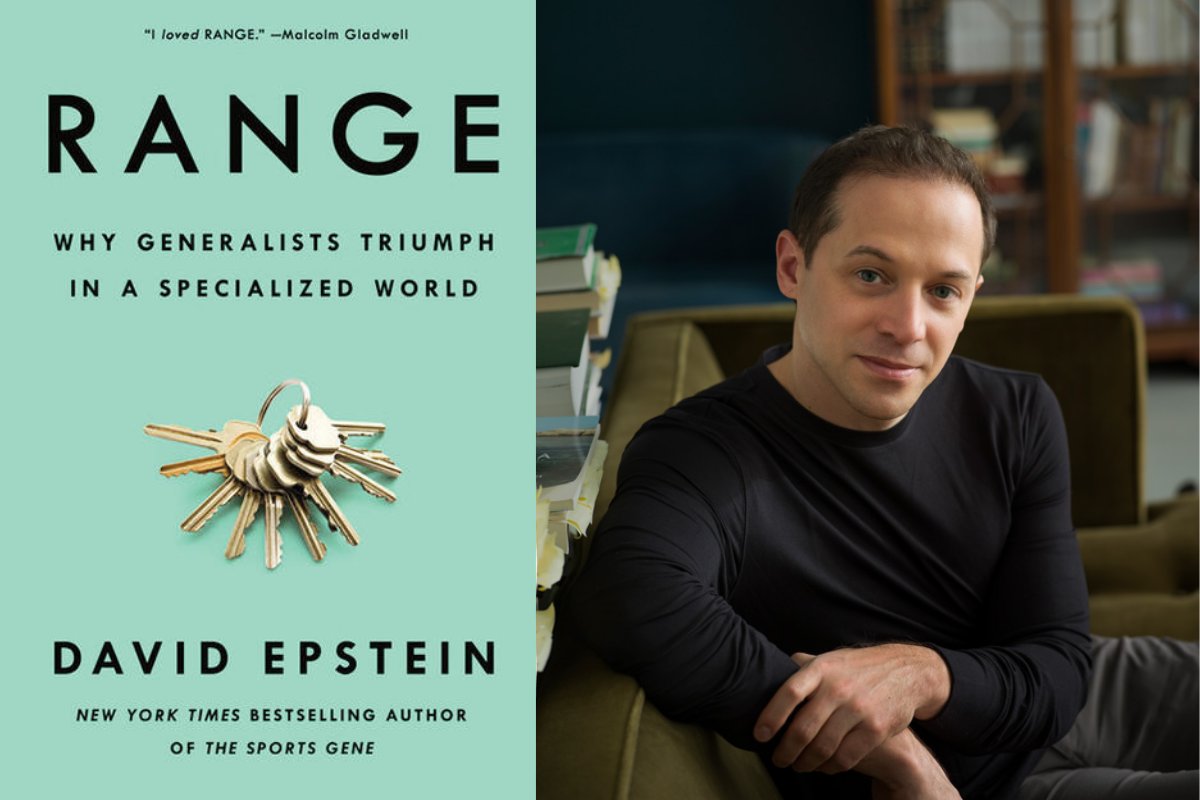
David Epstein studied the world's best athletes, scientists, and inventors, and found they all broke the same rule.
Here are 10 reasons from "Range" why generalists beat specialists in everything that matters.
1) Specializing late is an advantage, not a delay
The most powerful man in history:
Marcus Aurelius.
He ruled Rome and wrote all his thoughts in a private journal.
Today, his journal is called Meditation.
It's one of history's most valuable guides to living a happy life.
8 lessons from his book:
You read.
You watch.
You take notes.
And still forget most of it.
That’s not your fault.
Your brain was never taught how to learn.
Here’s how to fix that:
@quotesdaily100 The Stranger - Camus
The Transposed Heads - Mann
The Garden of the Finzi Continis - Bassani
Snow Country - Kawabata
The Dwarf - Lagerkvist
I don't think Man's Search for Meaning is a novel.
Short Novels Worth Reading on Your Travels:
1. The Metamorphosis by Franz Kafka (55 pages)
2. The Pearl by John Steinbeck (90 pages)
3. The Old Man and the Sea by Ernest Hemingway (130 pages)
4. The Little Prince by Antoine de Saint-Exupéry (96 pages)
5. On the Shortness of Life by Seneca (80 pages)
6. The Art of War by Sun Tzu (68 pages)
7. Heart of Darkness by Joseph Conrad (96 pages)
8. The Turn of the Screw by Henry James (119 pages)
9. Night by Elie Wiesel (120 pages)
10. Chronicle of a Death Foretold by Gabriel Garcia Marquez (120 pages)
11. Of Mice and Men by John Steinbeck (112 pages)
12. Animal Farm by George Orwell (112 pages)
13. The Stranger by Albert Camus (123 pages)
14. The Strange Case of Dr Jekyll and Mr Hyde by R.L. Stevenson (141 pages)
15. Siddhartha by Hermann Hesse (152 pages)
16. Giovanni's Room by James Baldwin (159 pages)
17. Breakfast at Tiffany's by Truman Capote (160 pages)
18. The Invisible Man by H.G. Wells (160 pages)
19. Man's Search for Meaning by Viktor Frankl (165 pages)
20. The Great Gatsby by F. Scott Fitzgerald (180 pages)
21. Cannery Row by John Steinbeck (196 pages)
22. Franny and Zooey by J.D. Salinger (201 pages)
23. The Bluest Eye by Toni Morrison (206 pages)
24. The Alchemist by Paulo Coelho (208 pages)
25. Flowers for Algernon by Daniel Keyes (216 pages)
26. Of Mice and Men by John Steinbeck (224 pages)
27. Lord of the Flies by William Golding (224 pages)
28. The Picture of Dorian Gray by Oscar Wilde (254 pages)
29. Fahrenheit 451 by Ray Bradbury (256 pages)
30. The Remains of the Day by Kazuo Ishiguro (258 pages)
31. Their Eyes Were Watching God by Zora Neale Hurston (286 pages)
32. The Road by Cormac McCarthy (287 pages)
33. The Chosen by Chaim Potok (284 pages)
34. Ethan Frome by Edith Wharton (195 pages)
35. The Haunting of Hill House by Shirley Jackson (246 pages)
I have read 572 books on how to actually make money.
Most ended up being useless, but these 7 can actually make you rich if you apply the knowledge (THREAD):
1. Psycho-Cybernetics by Maxwell Maltz
This paragraph by Richard Feynman hits so hard:
“Fall in love with some activity, and do it! Nobody ever figures out what life is all about, and it doesn’t matter. Explore the world. Nearly everything is really interesting if you go into it deeply enough. Work as hard and as much as you want to on the things you like to do the best. Don’t think about what you want to be, but what you want to do. Keep up some kind of a minimum with other things so that society doesn’t stop you from doing anything at all.”
A Chicago philosopher wrote one book in 1940 proving that 95% of the books you have read in your life, you didn't actually read, and Charlie Munger has been telling people to read it for 50 years.
His name was Mortimer Adler.
He spent 40 years at the University of Chicago, ran the editorial board of the Encyclopædia Britannica, and built his entire career on one uncomfortable observation about the people around him.
Most adults who called themselves well-read had not actually read a book in the real sense even once. They had run their eyes over the pages, registered the words, formed a vague impression, and put it back on the shelf.
The book had passed through them without ever entering them.
In 1940 he wrote How to Read a Book. It has stayed in print for 86 years.
Charlie Munger recommends it. Naval Ravikant recommends it. Fareed Zakaria recommends it.
Every serious thinker who builds a career on absorbing information eventually finds their way to this book, and the reason is that Adler had isolated something nobody else was naming clearly.
There are four levels of reading. Almost everyone is stuck on the second one. The fourth level is so different from what most people call reading that you have probably never done it in your entire life.
Level one is elementary.
You learn it as a child. You decode the letters into words and the words into sentences. You finish the sentence and understand roughly what it said. This is reading the way a 7-year-old reads, and almost every adult on earth has stopped developing past this point in some quiet way.
Level two is inspectional.
This is skimming. You move through a book quickly to figure out what it is broadly about. You read the back cover, scan the table of contents, glance at a few paragraphs, and form an opinion. Most adults who claim to have read 50 books a year are actually doing this. They are inspecting books, not reading them. They walk away with a vague sense of the argument and almost none of the evidence that supports it.
Level three is analytical.
This is the level Adler said most people have never properly experienced. You take one book and you wrestle with it for as long as it takes. You identify the question the author is trying to answer. You map their argument from front to back. You write your disagreements in the margins. You force yourself to articulate, in your own words, what the author is claiming and why. The point is not to finish the book. The point is to argue with it as if the author were sitting across the table from you. Most people never do this once in their life, because it is exhausting and slow and feels nothing like the reading they were taught as children.
Level four is the one almost nobody knows exists. Adler called it syntopical reading. The word means "across topics," and the technique is something closer to running a small private research lab in your own head.
You pick a single question that actually matters to you. How does power corrupt people. Why do civilizations collapse. What makes a marriage last. How does a person change their own mind. Then you assemble five or ten or twenty books from different authors, different centuries, different traditions, all of them taking a swing at the same question.
You do not read any of them cover to cover. You move between them. You find the chapter in book three that addresses the same question as the chapter in book seven. You force those two authors to argue with each other inside your own head.
The book stops being the unit of reading. The question becomes the unit. And the authors become voices in a conversation you are now hosting.
This is the level where reading stops being consumption and starts being construction.
You are no longer absorbing what someone else thinks. You are building a position of your own out of the friction between people who disagreed.
Adler argued that this is the only level of reading where you stop being a passive receiver of other people's ideas and start being someone who can produce ideas of their own.
The reason Charlie Munger has been recommending this book for 50 years is that this is exactly how Munger has always thought. He calls it building a latticework of mental models. The technique he is describing is just syntopical reading applied for a lifetime.
You take the strongest insight from psychology, the strongest insight from biology, the strongest insight from economics, and you stack them against the same problem until something new falls out the bottom.
The reason most people never reach level four is not that it is intellectually difficult. It is that it is logistically uncomfortable. It requires you to keep multiple books open at once.
It requires you to take notes that nobody is going to grade. It requires you to abandon the goal of finishing books and replace it with the goal of answering questions.
This is also why AI just changed everything Adler was teaching.
NotebookLM, Claude, and tools like them let you do syntopical reading at a speed that would have looked like magic to a Chicago philosopher in 1940.
You upload 10 books on the same question. You ask the AI to surface every place those authors agree and every place they contradict each other.
The technique Adler said almost nobody on earth had reached can now be run on a Sunday afternoon by anyone with a laptop and one good question.
The technique was always the unlock. The bottleneck used to be time. The bottleneck is now curiosity.
Most people will keep reading the way they always have. A book at a time. Eyes over the pages. No question driving it. No other authors in the room. Adler called that level two for a reason.
You are not behind on your reading list.
You are behind on the level you are reading at.
How to become Rich :
- Buy 10,000 qty of NIFTY BEES
- Buy 10,000 qty of BANK BEES
- Buy 10,000 qty of JUNIOR BEES
- Buy 10,000 qty of MIDCAP 150 BEES
- Buy 10,000 qty of GOLD BEES
- Buy 10,000 qty of SILVER BEES
Buy once & forget for lifetime.
Or make your goal to reach this target.
Simple!
#Etfs #Investing
Naval Ravikant reads 1-2 hours every single day and credits it as the main reason he made $100M+.
Here are the 11 books that shaped his mind and changed everything about how he thinks about wealth, business & life:
1. Poor Charlie’s Almanack by Charlie Munger
Tony Robbins sat down with Diary of a CEO for 2 hours.
I watched the whole thing.
After 40+ years coaching the world’s top performers, billionaires, athletes, and world leaders, he believes nearly everything comes down to mastering 3 core skills.
Here they are: