If there’s one thing we learnt from world leaders, it’s that
Restraint is underrated.
Restraint is not glamorous. It’s rarely visible.
In a space that rewards spectacle, the instinct is to ship fast, market louder, and keep the momentum going, even when the foundations aren’t fully there.
But the best builders we’ve seen resist that pull.
They know that early excitement can hide design flaws. That traction doesn’t always mean trust. And that the hardest problems don’t care how loud you are.
✓ They build slow when everyone’s rushing.
✓ They simplify when complexity looks impressive.
✓ They ask: What breaks in year five?
That’s a lesson we keep coming back to.
The battle for Layer 1, though, is not only about the battle to control payments, because it is about much more than stablecoins.
As Circle indicated, it is about the future of value, a future in which the continuous exchange of “real world” digital assets replaces the traditional infrastructure (and associated overheads) of clearing and settlement vanish.
In this world, the next-general financial market infrastructure of distributed ledgers, tokens and protocols (that is, “defi”) that will in essence become critical national infrastructure.
Can this really be provided Circle or Stripe? Or will it ultimately need Big Tech or governments or someone else to deliver the platform for innovation?
In a Layer-1, it's easy to mistake patchwork for innovation.
After a decade of building, iterating, failing, rebuilding, I’ll tell you this: The alchemy lies in engineering that engine… To build an integration so seamless, it just feels inevitable.
But be deliberate.
I’ve been in the trenches rewriting how an Layer-1 should work. There’s a difference between making something work and building something that evolves and endures.
And trust me, that difference shows when you must scale.
We glorify “succinct proofs” while dodging the real issue:
Generating them is heavier than the computation itself. At TAN, we confront its overhead by compressing proofs, and scaling provers without burning holes in hardware.
Verification is cheap, but making proofs practical is hard.
We’ve bled in that trench so you don’t have to.
zk at TAN is hardened, efficient, and ready for scale.
MetaMars is carving its name into the red dust by building a metaverse economy where play, ownership, and community aren’t bolted on! They’re baked in:
✓ Governance token ($MARS) integrated into staking
✓ NFTs that exist as functional primitives
✓ GameFi loops designed to reward engagement
And if a metaverse is going to thrive, it needs an infra that rewards ongoing activity, not one-off launches. That’s where TAN’s BPoS consensus mechanism aligns perfectly.
2/3
The metaverse has already passed its honeymoon phase.
Billions poured in. Visions of digital cities. Land rushes that looked more like speculation than settlement. And then? Silence. Because execution rarely matched expectation.
Our partnership with @MetaMars_Global hits different.
1/3
AGIX is building a multi-agent, heterarchical framework, a system where AI agents collaborate to complete complex, multi-step workflows across apps, browsers, and APIs.
In other words, Text-to-Action.
You don’t click buttons, you delegate tasks.
AI becomes an executor.
They’ve proven it with deployments across TON, Metis, Magic Store, and hundreds of enterprises, with 200k+ users, and backing from Amazon, Microsoft, and Intel.
2/3
When chains say “zk,” what they mean is outsourcing trust. Rollups produce proofs but the base chain remains blind. It only verifies outcomes that are bridged back.
That’s useful, but it’s not sovereignty.
We integrated zkEVM at the Layer-1. This means zero-knowledge proofs are not an optional service layered on top, they are natively embedded into consensus.
In practice:
→ Consensus is reinforced by cryptographic proofs
→ Execution is verifiable by anyone
→ Finality is cryptographic, not probabilistic
This is not a “feature release.” It’s a fundamental redesign.
By integrating zkEVM directly at Layer-1, TAN creates an environment where trust assumptions shrink and security is elevated from economic guarantees to certainty.
1/3
India's one of the largest Bitcoin giveway is LIVE!
Wishing you a very special 79th Independence day 🇮🇳 and on this special occasion we are giving away ₹79 lac worth of $BTC
The waitlist is live on our website, here is how to register👇🏻
🎰 LET’S TALK ODDS 🎰
☺️ Your odds of winning 10 TON from us just by dropping “Ambassador” in the comments = 6.25%
🎰 Your odds of winning the equivalent $30 in Mega Millions Lottery = 0.0069%
That means BabyDoge PAWS giveaways are literally 900 TIMES more winnable than the lottery.
900 TIMES!!
This wasn���t the last such giveaway 🐾🔥
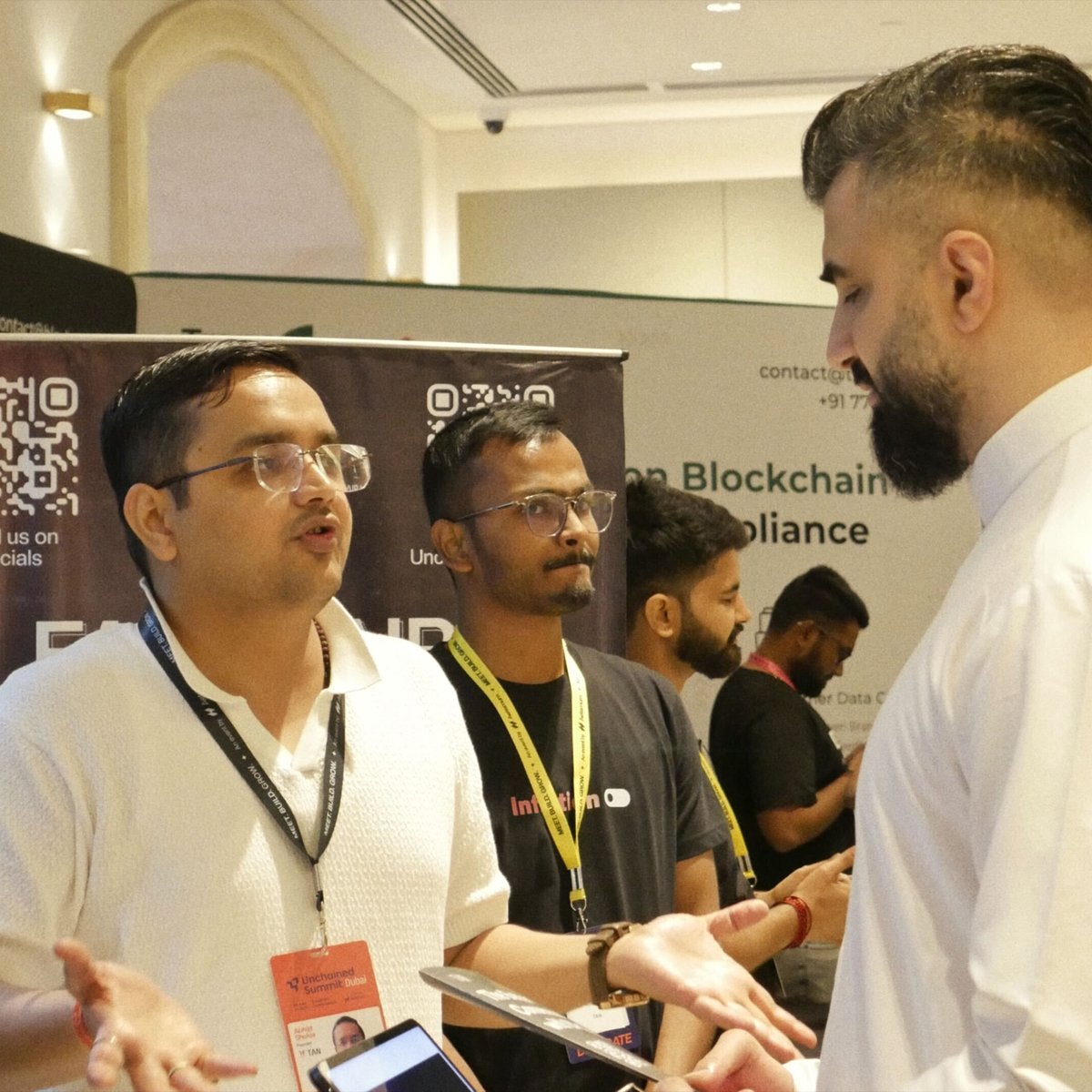
Someone came by asking about the economic logic behind TAN’s consensus, and instead of diving straight into BPoS mechanics, we simply asked them:
“How would you build a rewards system from scratch?"
What followed was a collaborative jam session:
→ Ideas around dynamic validator caps
→ Mechanisms to discourage validator cartel behavior
→ Concepts for real-time penalty calibration
At one point, a neighboring booth rep leaned over with a grin and joked, “You guys aren’t doing a product pitch: you’re running a full-on DAO workshop over here.”
They weren’t wrong.