There's a small window in life when your parents are healthy, your children are little, and everyone is happy and together. It feels like it will last forever, it won’t. Cherish every moment of it.
Any one who is privileged therefore owes it to the world to work on the most obnoxiously hard problems, not just build a life for themselves, but uplift people by building great companies and employing as many people as they can.
The privileged must risk it all, over and over again, until they are tortured to greatness.
This is my version of socialism, re- distribute risk. The rich have a moral imperative to embrace more risk.
@shantanugoel Yeah, but still I feel that limits with fable 5.1 have significantly gone down. Is opus not more verbose than fable. I find fable to be just better.
@theo@vicky_142803@QuinnyPig@mattshumer_ Yes I have gotta a hang of it as well. I like how I can use different models from subs to review my prs multiple times and then push it. Thanks a ton 🙏
Goal of Anthropic and OpenAI doomers is to force legislation making it illegal to use open-source models on the grounds they are dangerous, forcing everyone to use only theirs. That is why doomers are coming from inside companies making the models. It is not a contradiction.
Currently, the OPT program enables talented graduate students to work in the US for a period after they graduate. Eliminating this program will cause graduate students, with newly minted PhDs, to be forced to leave the US, hurting US competitiveness.
All the regulations being floated by frontier model companies must be viewed through the lens of them losing tokens to Open-Source models.
The timing of these regulations seems to line up perfectly with Open Source closing the gap significantly (but not completely) — and @nvidia going all in on open source in the last 60 days.
If we’re gonna regulate, why don’t we require that last year’s frontier models and weights be open-sourced?
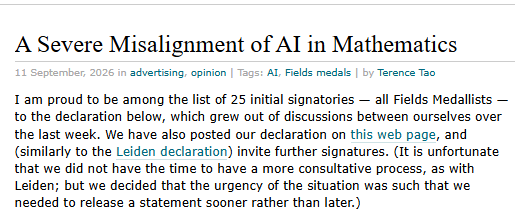
@AndrasGerlits AI is trying to solve math by solving all the problems and closing the math exploration space down
Math is trying to maximize the exploration space and uses problem solving as launchpads to open up more territory
He’s saying AI labs are Goodhart-ing mathematics but you midwits are too stupid to understand.
To put it in simple terms: millennium prize problems are *metrics* for mathematics progress. AI labs are *optimizing* the metrics and thereby making them less useful.
Get it now?
A lot of people are missing Terence Tao’s point and thinking “mathematicians are upset that AI is better than them.” That’s not what he’s saying, and some people are forgetting that Tao is one of the most AI-pilled mathematicians out there.
His point is that when people work on discovering something, along the way they invent new concepts. Those concepts later become useful far beyond the original goal, and enables further inventions. Finding a solution does matter, but the intermediate idea is often what makes the field richer, because other people can share it and build the next thing from it.
In tech, we can use the analogy of collaborative software. We started with algorithms for merging changes in a Word document, and evolved that to concepts about versions, diffs, and merges, and later to real-time collaboration tools like Git, Google Docs, and Figma. Humans built upon these concepts and developed more powerful solutions.
Terence’s worry is that a machine automating a solution robs the field of the value of developing the intermediate discoveries in the pursuit of larger discoveries.
When automating a solution, the intermediate discoveries and invention of concepts can be buried or completely hidden in the black box. We don’t learn from them to build the next thing; it’s like we never made the invention of collaborative document editing and thus could not have the conceptual understanding to invent the next version – and since it’s hidden, we also don’t socialize them to allow other people to invent, too, a core tenet of collective discovery.
So then, in both code and math, this leads to the atrophy of development of concepts in the field.
In other words: pure ‘solution extraction’ that hides the process of discovery can leave the field with a checked-off theorem but little new insight or new questions to pursue. And it might prevent us from understanding a field deeper.
I am seeing, first-hand, that atrophying of skills in software development. We push buttons and get solutions. There is much less incentive to develop new concepts and human skill. The bet most software companies are making is that LLMs are so effective in writing code that you’re still shipping overwhelmingly more value even with human skill atrophy, and it’s the right bet IMO.
However, much of the software industry is built upon building things, not necessarily novel invention and research. In such an environment, you can say that you accept some atrophying of conceptual invention and human skill for more output.
On the other hand, sectors like math and pure sciences that are focused on invention and insight might be the hardest hit by this.
Practical/applied sciences might fall somewhere in the middle. An Alzheimer’s cure, room-temperature semiconductor, or highly effective carbon capture solution are far too valuable to sandbag and say only humans can do that to develop concepts in the ‘proper’ way. The outcome matters too much to treat the preservation of concept invention as the highest goal. Even there, though, hidden intermediates can slow the next breakthrough if nobody can see how the first one actually worked.
So the question is not “is AI allowed to solve hard problems?” It is “in this field (math, science, tech, etc.), is the answer itself the main point, or are the concepts and abstractions we use to get there also the thing we need to maintain?”
In pure math, there’s an argument that the intermediates are often more useful than the solution, and atrophy in concept development is highly detrimental to the field. Solving Navier–Stokes, contrary to what some people claim, has little practical application, and pure math might be one of those fields where just finding a solution isn’t the entire point, and can actually be contrary to the field, which is what Tao is worried about.
@theabhimanyu@mattpocockuk Bro my current company is like this. I am still much junior to them that is why I don't say much, but most of times I am thinking why are you creating so many parallel stacks of projects . If can all be one product but no, different stacks just to show that work is being done 😑
What these field medalists are saying is a precursor to what most people will feel in the coming time.
Humans want to be useful. We're primed by evolution to want to feel our effort will lead to valuable outcomes.
We want to climb mountains and not just be helicoptered to their summits.
The real crisis is the deflation of motivation AI will cause in humans. Why aspire to do intellectually hard things when you'd be outdone by compute owners willing to spend a billion tokens on the same problem?
Superintelligence will create superabundance BUT:
- We don't know how to control it safely
- The world isn't setup for social security required to offset job losses
There's a reason why AI insiders are calling for pausing or slowing down further AI developments. Our society needs time to make sense of this monumental shift.
I can’t stress enough how little an idea matters compared to the agency of the people executing the idea.
I have had the privilege of knowing and sometimes even working with some of the most successful people (by various metrics).
The difference between mediocre and excellent work and outcomes is predominantly one of agency.
In practice this means: they dont wait for things to happen to them they go out and make things happen for them.
They don’t wait for someone else to do something, for someone to teach them, for someone to give them the path, etc. They just go out and find a way to do it.
I think the single biggest superpower these people have is the realization/belief that the world around them is completely mutable. Most everything that happens is because a person made it happen.
I used to tell people to look around the room you’re sitting in. Look at everything. Every noun. It almost all exists because a person willed it into existence. Nothing is stopping you from doing the same.
I see people online all the time dismissing someone else’s success because “I had that idea first” or whatever. I mean… yeah? If so then the difference is… you. So a bit of a self own whenever I hear that.
Number one tip: act with agency.