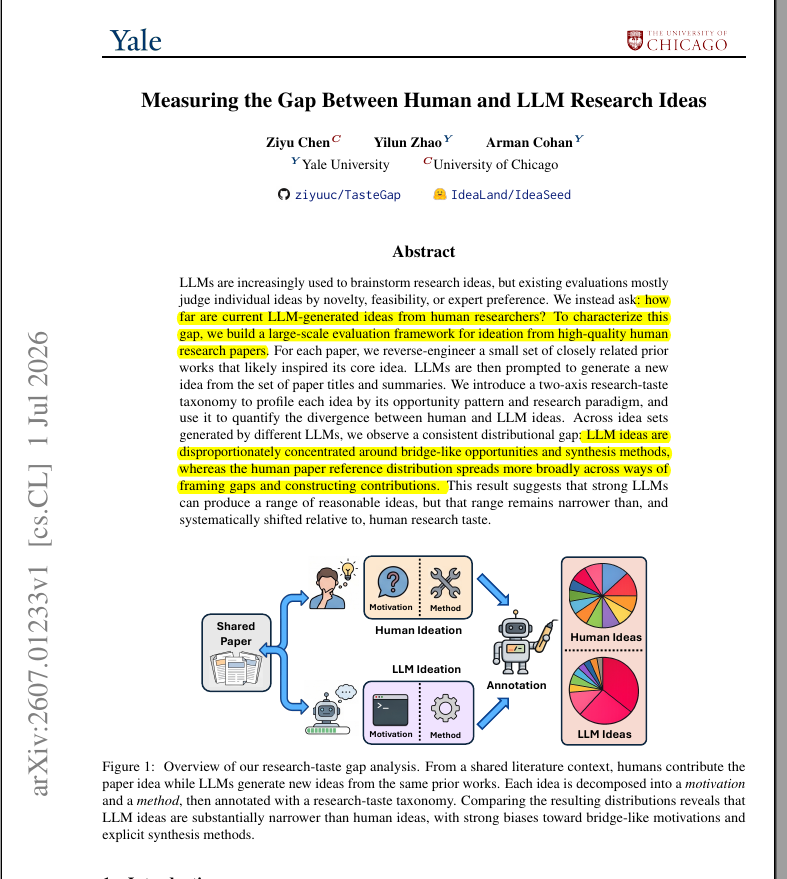
This Yale + University of Chicago paper shows that real gap between LLM generated research ideas vs humans is not idea quality, but idea range: LLMs think narrower than human researchers.
The researchers built a controlled test from 11,683 real papers, using each paper’s nearby prior work as the shared starting point.
They asked models to propose a new motivation and method from those same prior papers, then compared those ideas with the real human paper ideas.
Instead of asking whether 1 idea looked novel, they labeled each idea by what gap it noticed and what kind of contribution it made.
Human ideas spread across many patterns, such as explaining mechanisms, testing failures, measuring evidence, building systems, and improving efficiency.
Only 12.1% of human ideas were mainly about connecting separate work, but 47.1% to 64.2% of LLM ideas did that, meaning models used this move about 4 to 5 times more often.
Even extra reasoning made this pattern stronger, suggesting models often polish a familiar recipe instead of finding more varied research moves.
---
– arxiv. org/abs/2607.01233
Title: "Measuring the Gap Between Human and LLM Research Ideas"
@thomasunise@kimmonismus As if Claude himself hadn't been built with millions of books and software stolen from all over the world, how do you think he learned Mandarin? With Duolingo?
@izzynobre Eu iniciei com Sherlock Holmes, uma das barreiras que já percebi é preço da IA, gerar imagens em 360º 4k que não ficam pixeladas em VR é muito caro caro ainda infelizmente, mas o app vai ser código aberto
First, Mark was clearly talking about the industry’s progress on agentic capabilities on the whole.
But, while we’re on the topic: Our next Muse Spark update is coming soon. Big improvements in coding and agentic capabilities to be more competitive with other leading models.
Excited to get these into your hands—will be rolling out to Meta AI and our new API!
📢 FaceAnything (ECCV 2026) Code Release 📢
Turn any image sequence into high-fidelity 4D face reconstructions, without controlled capture rigs.
Try it on Hugging Face & reconstruct your face in 4D!
🔗https://t.co/1t9msPtfHw
🤗https://t.co/zzoRyurIlM
🌐https://t.co/qRqh3rZaOB
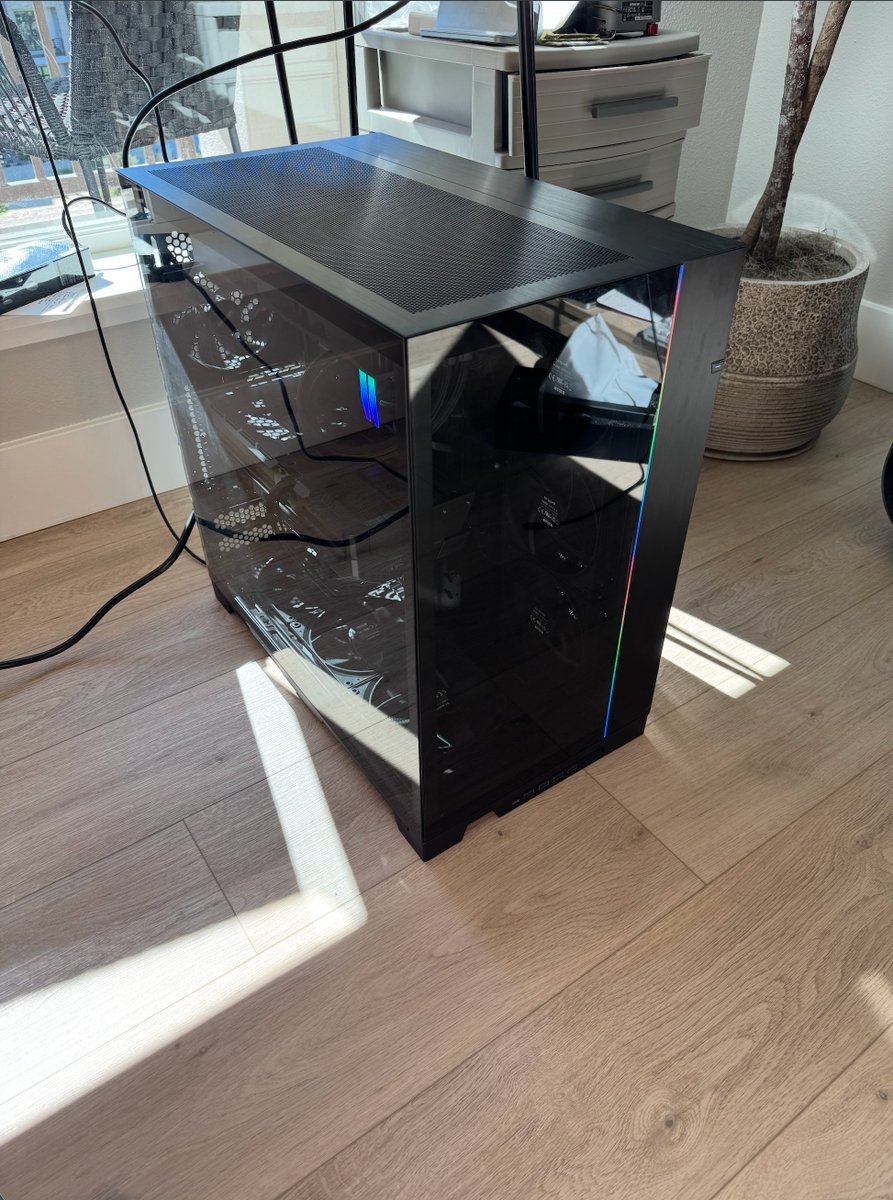
Everyone on planet Earth is talking about local AI right now
And for good reason
Governments are banning models. Hardware prices are 10xing
You NEED to be getting into local AI. The number 1 questions everyone has though is which computer to buy?
Here's your answer:
You basically have 3 options:
1. MAC STUDIO (high memory, low bandwidth)-
Mac Studios are excellent devices for local AI. They can run MASSIVE models. I'm running GLM 5.2 right now on a single Mac Studio. The model is Opus 4.8 level
The issue is, Mac Studios have very low memory bandwidth. Meaning, the models run very slow
Mac Studios are a good choice for you if you want frontier level intelligence, but are fine running the intelligence passively
Meaning you get top intelligence, but it runs more in the background rather than on demand
As an example, I have GLM 5.2 running security checks on my codebase every hour. It creates a report. I review this later in the day
2. POWERHOUSE NVIDIA CHIPS (RTX 5090, 6000 Pro)
Nvidia is the most valuable company in the world, and for good reason
They make the world's best GPUs.
They have decent VRAM (32gb on the 5090, 96gb on the 6000 Pro) and INSANE bandwidth. Meaning the local models run at unbelievable speeds
I'm running Qwen 3.6 locally on a 5090 and it's just as fast as cloud models
I'd go this route if you want to run an AI agent like Hermes off a local model, still get decent intelligence, but have it able to work lightning fast
3. AI WORKSTATIONS (DGX Spark type computers)
The DGX Spark is an excellent AI computer
It has high memory (128gb unified memory) and has decent speeds because of the Nvidia CUDA architecture
It is basically the sweet spot between a cutting edge Nvidia chip and a Mac Studio
You can run medium sized models, and get usable speeds out of them
You're not going to get the same performance as cloud models, but it will allow you to offload small secondary tasks to your local models for them to handle
They are also the absolute easiest to get up and running
You plug it in, then tell your agent on your main computer to go onto it and set it up. You don't even need it connected to a monitor
CONCLUSION
Here's what it comes down to: how high intelligence do you need, what speeds do you need, and how plug and play do you want?
Want the highest speeds, like you are used to with cloud compute? Build a computer around an RTX 5090
Want to run frontier level intelligence, and don't mind slow speeds, go with a Mac Studio
Either way, it's never been more important to get into local AI
INSID3 generalizes across natural, medical, underwater, and aerial images
the same pipeline works for object-level, part-level, and personalized segmentation
@AnthropicAI Their models were created based on content stolen from millions of books and code repositories without authorization. Their technology does not belong to the American government, but to the world.
@eusouomatt Todo esse esforço do governo americano para tentar regular e limitar os modelos terá consequências negativas para os laboratórios, enquanto a China vai se aproveitar da situação e diminuir a distância nos resultados, fora a agressividade dos valores.
O jogo de tiro online que eu vivo postando aqui se chama Forefront
É um Battlefield em realidade virtual. Eu praticamente só jogo isso hj em dia. É brutalmente dopamínico e eu adoro que há uma comunidade imensa de brasileiros jogando (tem 3 servidores da América do Sul, chilenos e brasileiros dominam lá.)
Faço novas amizades lá diariamente, conheci ontem um argentino q eu ia tinha visto nos lobbies várias vezes. Ontem pela primeira vez conversamos. Super gente boa o cara. É super legal pra praticar idiomas tbm.
O único jogo que vai curar meu hyperfoco em Forefront será GTA6
@idare@ihtesham2005 Man, he’s Yann LeCun. A huge part of modern AI was built on his research; you can be sure he could secure funding for any project he wanted, maybe even more than Musk himself.
@eusouomatt Matt na sua opinião, os grandes laboratórios são uma bolha? Considerando que os LLMs são operações matemáticas bem estruturadas, serão commodities como os próprios softwares estão se tornando, assim que o mundo todo aprender de fato as equações, os big labs terão diferenciais?