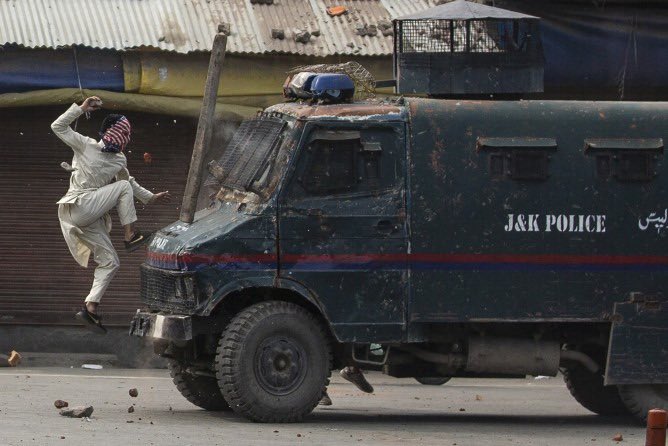
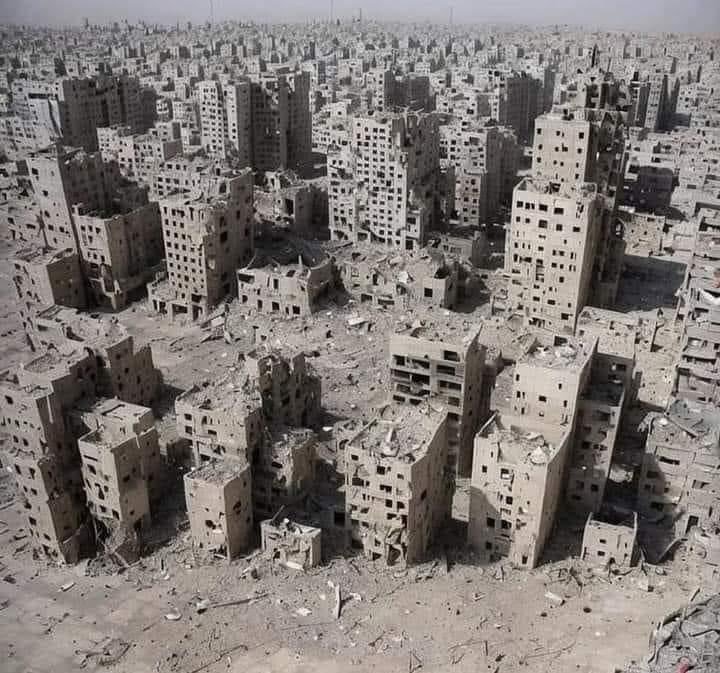
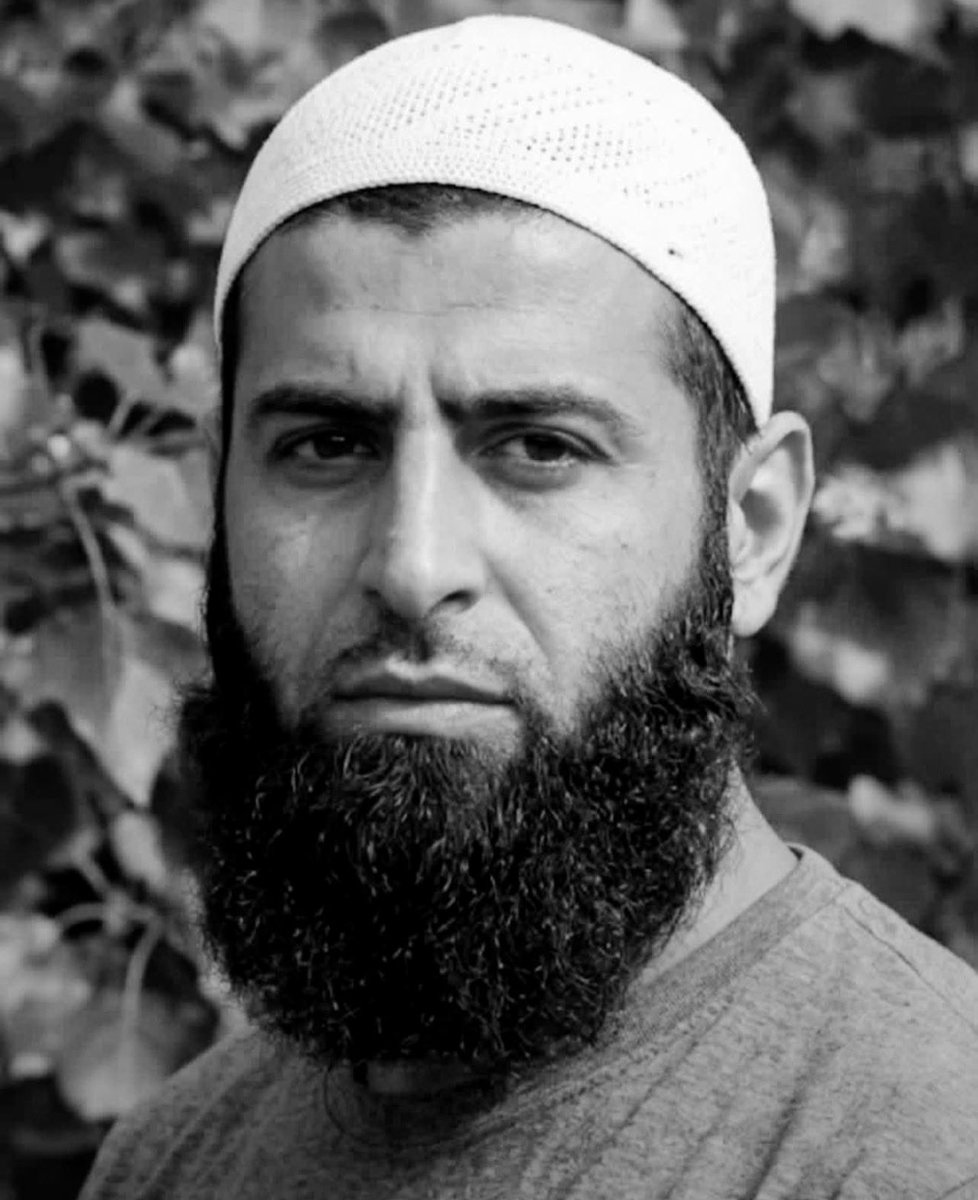
Fearless, Determined, Courageous, Bold & Brave. This picture is the face of Kashmiri Struggle for Freedom against the Hindu Oppression. Blood & Sacrifices of our Kashmiri Brothers won't go in vain, Pakistan is with them in this till the last drop of blood.
#RiazNaikoo_Our_Hero
Pakistan has lodged a strong diplomatic protest over comments made by the US Special Envoy for South and Central Asia and Ambassador to India during his tightly choreographed visit to Indian-administered Kashmir, where Sergio Gor described the portion of the disputed territory as an “important part of India”.
Right after Gor’s remarks on Wednesday, Indian media and analysts prominently headlined it and interpreted the statement as backing New Delhi’s claim to the region — a territory Pakistan disputes since 1947, when both countries gained independence from British rule.
Islamabad said it summoned the US Charge d’ Affaires to lodge a strong demarche “over the factually incorrect remarks of US Ambassador to India, regarding the status of Jammu and Kashmir, during his visit to Indian Illegally Occupied Jammu and Kashmir.”
Pakistan underscored that Kashmir is an internationally recognised disputed territory, awaiting final settlement in accordance with relevant UN Security Council resolutions and the aspirations of the Kashmiri people.
Pakistan’s angry reaction came after Gor, who is also President Trump’s Special Envoy to South and Central Asia met with Omar Abdullah, the pro-India chief minister of India-administered Kashmir, and said during a media interaction: “It’s a pleasure to be here. This is an important part of India.”
It is the first such high-level US ambassadorial visit to the region since 2019, when India annexed the region, revoked its special status within the Indian constitution, cancelled its limited autonomy, and split it into two federally administered territories — Jammu and Kashmir, and Ladakh.
I have asked the Punjab CM to ensure that every health facility in the country is made available for Nawaz Sharif to get the treatment of his choice. The federal govt will assist wherever required. I wish him good health.
Just watched India's new documentary on Sindoor. As a Pakistani, I must admit there were solid acting performances, wonderful cinematography, recreation of scenes, and suspenseful music. The most inspiring actor would indeed be Lt Gen Pratik Sharma, who not only acted well but wanted Sindoor to "unfold like a good movie."
There is one big problem though. It failed badly in hiding the failure of Sindoor that had earned the India so much bad name.
To begin with, the documentary cleverly misses out on how the attackers actually got there. It further blames the late arrival of Indian forces on difficult terrain. But does India not have nearly a million soldiers, and was it not a popular spot as per Gen Ghai? How was it utterly unprotected?
Moreover, the senior most actor Ajit Doval said they determined that Pakistan was behind it because "attackers left some communication equipment." The attack happened between 1:50 PM and 2:20 PM, yet an FIR was registered at 2:30.
It was determined that Pakistan was behind it in those ten minutes. The question here is: if the attackers were adept enough to reach, escape, and remain undetected till date, is it convincing that they would leave communication equipment behind?
Similarly, the strategic communication guy says they wanted videos so that "our information warriors" could play that up. Yet the Indians forgot to show the "communication equipment" that established Pakistan's involvement.
Pakistan even produced the communications of downed Indian pilots. India had to request MAXAR to disallow imagery of damage on the Indian side. All India had to show were some craters on empty runways.
Likewise, the most suspenseful part of the film was how carefully and meticulously the Indians planned the attack on "terrorists", actually places of worship, and its timing. Yet the same intelligence failed to know the range of PL-15 missiles.
Then there was the unimpressive and desperate filmi dialogue from Gen Ghai, attributing to the DGMO that "sir, you have fired enough missiles."
Come on!
Your show-woman Col Sofia is on record saying Pakistan kept targeting and injuring your personnel while India wanted to cease hostilities.
In short, the film was crafted according to the taste of the Indian audience for Modi's promotion. It failed to answer critical questions, which will continue to haunt India.
More than a year after Marka-e-Haq, India refuses to face the harsh reality. Instead of conceding defeat in a failed venture, India has decided to colour history in her preferred hues. To achieve this mutilation of history, Indian content creators have produced a highly dramatised, coloured and factually inaccurate account of so-called Operation Sindoor, packaged as a documentary featuring senior political and military leadership of India. For its lack of nuance and seriousness, the documentary can be characterised as a tragedy and a comedy at the same time. Selectively edited interviews, emotional narration and cinematic Bollywood style reconstruction have been used to alter established facts and rewrite the operational outcome.
Tellingly, the documentary’s account contains fundamental contradictions, exposing a belated attempt to manufacture a domestically palatable version of events.
The documentary attempts to establish a deliberate linkage between an address by the Pakistan’s Chief of Army Staff on 16 April 2025 and the Pahalgam incident of 22 April 2025, conjuring a conspiracy theory out of nothing. More significantly, India subsequently claimed that the three alleged perpetrators of Pahalgam were identified and eliminated on 28 July 2025, 82 days after so called Operation Sindoor. Yet the documentary presents so called Operation Sindoor as the punishment for those responsible for Pahalgam. If the alleged perpetrators were eliminated on 28 July, India must explain, who it claims to have punished on 7 May 2025.
The claim of “100 percent mission success” is equally detached from operational record. During Marka-e-Haq, Pakistan’s Armed Forces successfully thwarted Indian aggression and shot down 8 military aircraft. Pakistan subsequently conducted Operation Bunyanum Marsoos, employing Fatah precision-guided rockets & missiles, PAF precision munitions, long-range loitering munitions and precision artillery against 26 military targets, including facilities used to target Pakistani citizens, and entities involved in fomenting terrorism against Pakistan.
The documentary itself further undermines its claim of clear Indian dominance. Indian military leadership acknowledges extensive Pakistani missile, drone and air activity, sustained engagements along the Line of Control and the activation of Indian air-defence systems. Such admissions are difficult to reconcile with its repeated portrayal of Pakistan being decisively defeated.
The documentary’s account of the cessation of hostilities is no less revealing. Its own narration confirms that hostilities ended through communication between the two DGMOs and an agreed cessation of military action. This alone contradicts the attempt to portray Op Sindoor as a unilateral Indian military triumph. A cessation of hostilities, facilitated by US, cannot subsequently be repurposed as evidence of unconditional victory.
The documentary also contradicts itself on escalation dynamics. It repeatedly emphasises surprise, precision, deep strikes and escalation dominance, while simultaneously claiming that India deliberately limited the conflict and provided Pakistan an “exit window”. These competing claims expose the production as a carefully constructed domestic narrative rather than an objective military account.
India has not declassified the truth. It has cobbled together a propaganda video to project a military blunder as a successful endeavour.
No amount of cinematic reconstruction can change the chronology, erase aircraft losses, conceal military casualties, alter the military engagements that actually took place or convert a battlefield defeat into a self-proclaimed victory.
Pakistan has no need to manufacture a narrative around Marka-e-Haq. The operational record, battlefield evidence, diplomatic exchanges and India’s own subsequent statements speak for themselves and are widely acknowledged by international community.
Pakistan remains committed to regional peace and stability. At the same time, the Armed Forces of Pakistan remain fully prepared and capable of defending the country’s sovereignty, territorial integrity and national interests. Any future military misadventure will be met with a firm, decisive and disproportionate response, after which no amount of cinematic perjury will be able to provide any face-saving to India.
Pakistan, Saudi Arabia and Turkey are to announce a trilateral defence pact today, termed as “Mecca Agreement.”
◾“Mecca Agreement” will form a joint "Muslim-NATO" like Force, amid the rapidly changing security situation in the Middle East and beyond.
◾ “Saudi financial muscle, Turkish defence tech & Pakistan's military might and Nuclear umbrella will make this a game changer alliance.”, - Experts
This is Sheikh Farouk Ramadan.
Yesterday afternoon, he and his family were attacked by settler-terrorists on their own land. Farouk managed to disarm one of the attackers. He took the settler's rifle and shot and killed two terrorists in a clear act of self-defence.
In response, Israeli soldiers murdered him and three of his family members. Israeli government and media portrays him as the terrorist, and the actual terrorists as the victims.
Don't let them push this narrative. Farouk had the full legal and moral right to resist against the genocidal terrorists who invaded his land.
The heavy-handed police response to the CJP March and the removal of Rahul Gandhi from the PM's residence signal that Modi's regime is under mounting strain, even as his electoral machanitions continues to deliver results.
Modi has long been a charismatic campaigner who galvanized large sections of Hindus, but such appeal has a shelf life. With repeated failures and advancing age, public faith is eroding. Even Nehru saw waning authority and no confidence motion in his final years.
Also, Modi has failed on key promises. The most glaring failure has been economics. Modi's carefully cultivated image as a reformist manager has been tarnished by successive setbacks, most recently the ethanol fiasco. A Peterson Institute report suggests India overstated its GDP growth by 1.5 to 2 percent during Modi's tenure, while youth unemployment still hovers around 40 percent.
The grand vision of a Vishwaguru has also faltered. Foreign policy failures like - Operation Sindoor, US tariffs, failure to secure a trade deal from US, a weak Iran-Israel stance, and the failed QUAD Summit - have exposed the gap between rhetoric and reality.
These frustrations have long been simmering beneath the surface. Now they are spilling over. NEET protests are intensifying, and farmers are marching on Delhi. All this may help the RSS which is reportedly exploring alternatives.
I just saw the body of a little girl, her skin grayed and covered in ash, being wrapped in a sheet. Her torn leg was laid next to her.
The decline in reporting isn’t because the daily horrors in Gaza are over, Israel is killing Palestinians every day.
بأي ذنبٍ يعيش هؤلاء الأطفال هذا الرعب؟ 💔
مشهد يدمي القلوب لطفل يحاول عبثاً الهروب من أصوات القصف والانفجارات. طفولتهم تضيع بين الركام.
#غزة_تحت_القصف#الإنسانية