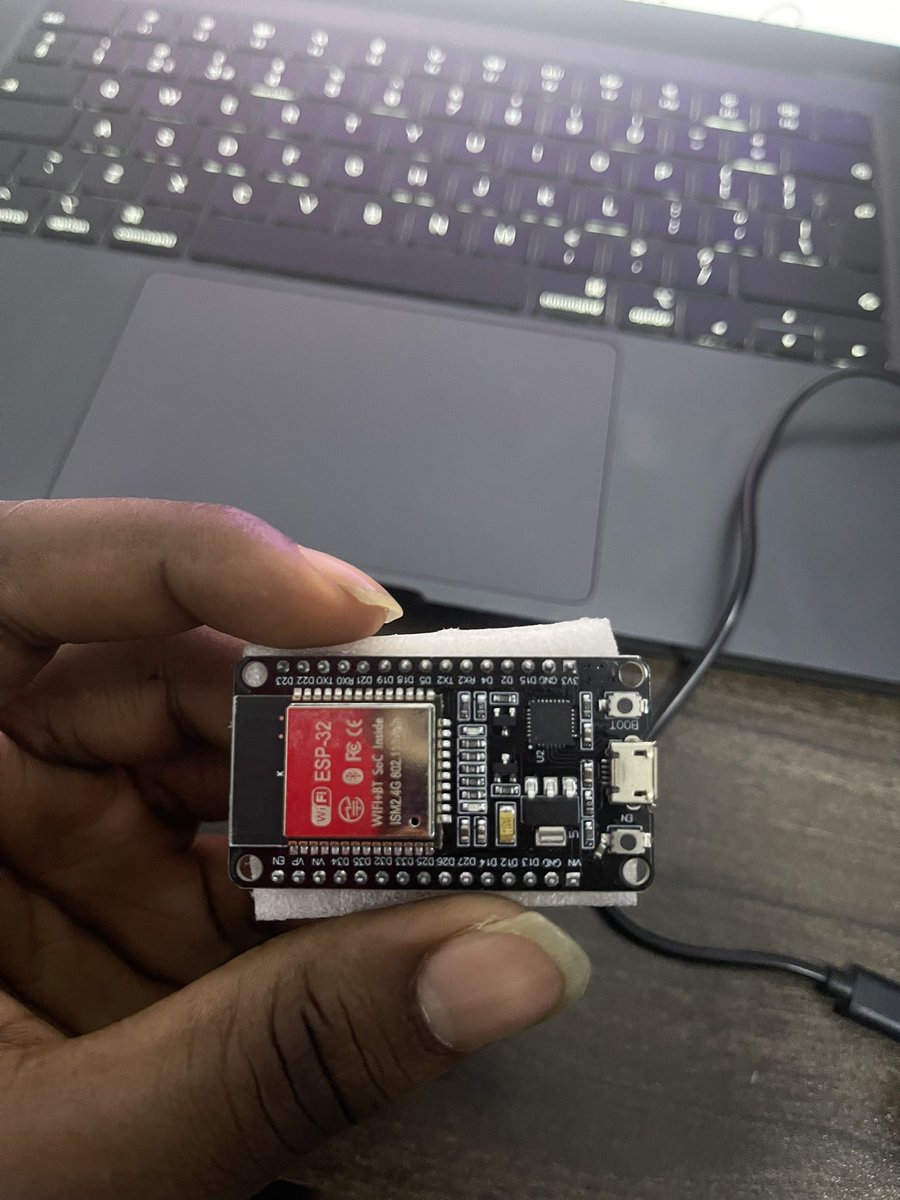
BIG milestone on my ESP32 project today.
A few weeks ago I barely knew embedded systems. Started with blinking an LED.
Now:
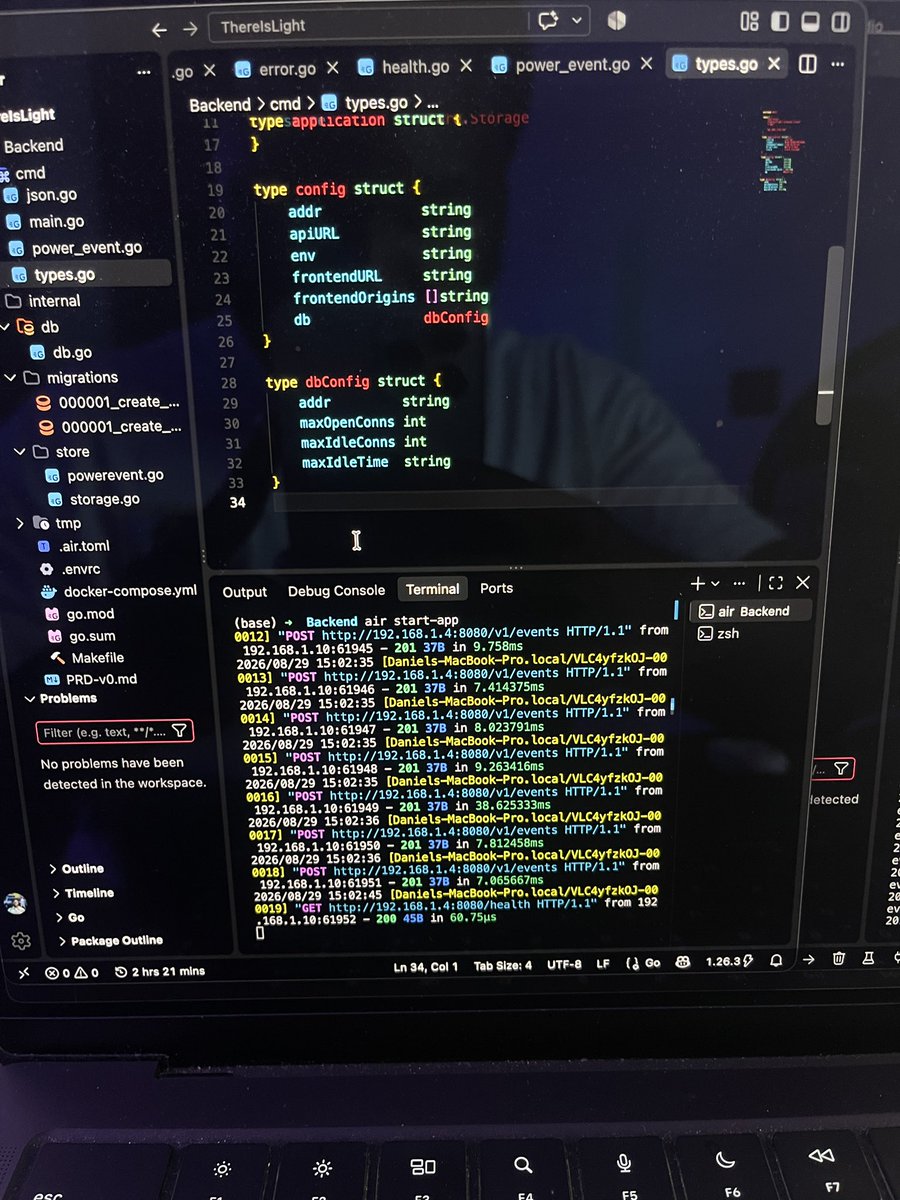
ESP32 → persistent event queue → WiFi → Go API → PostgreSQL
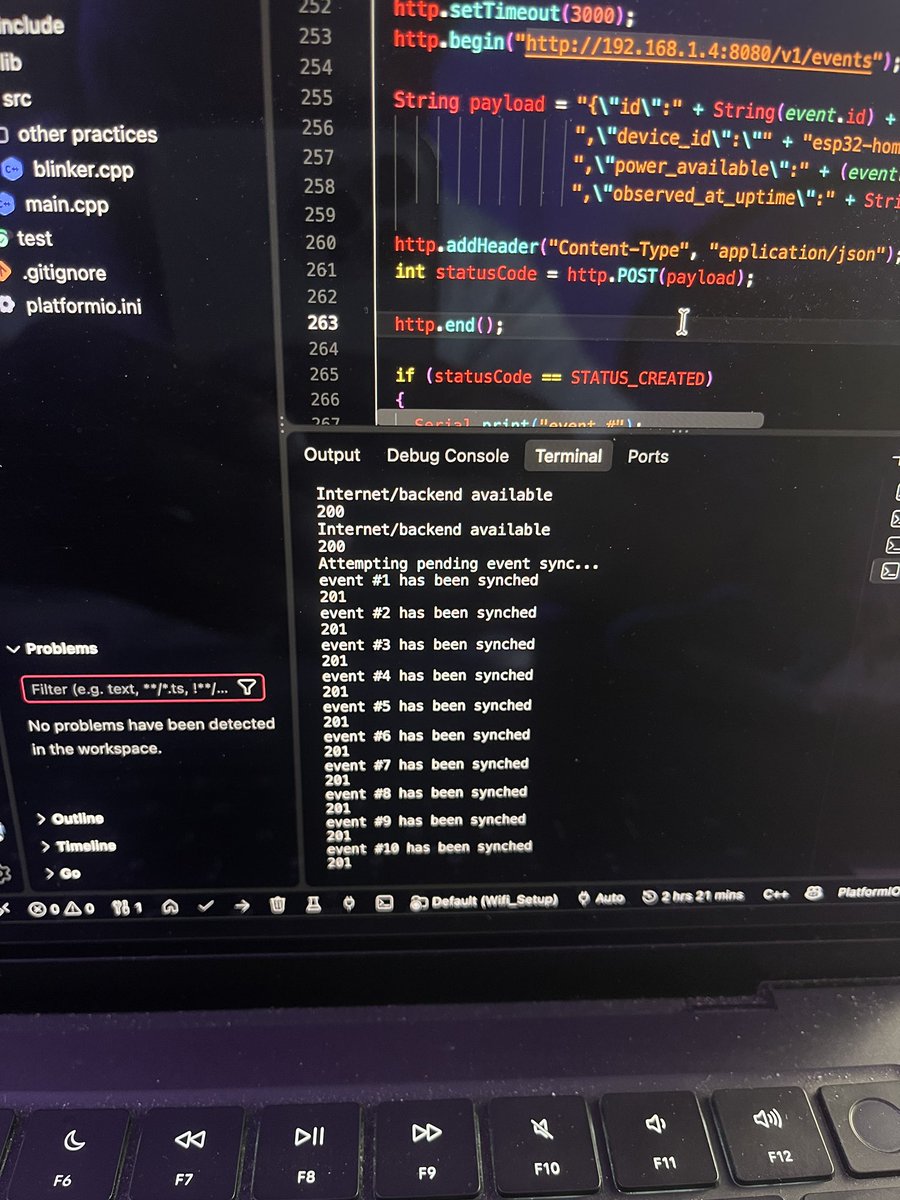
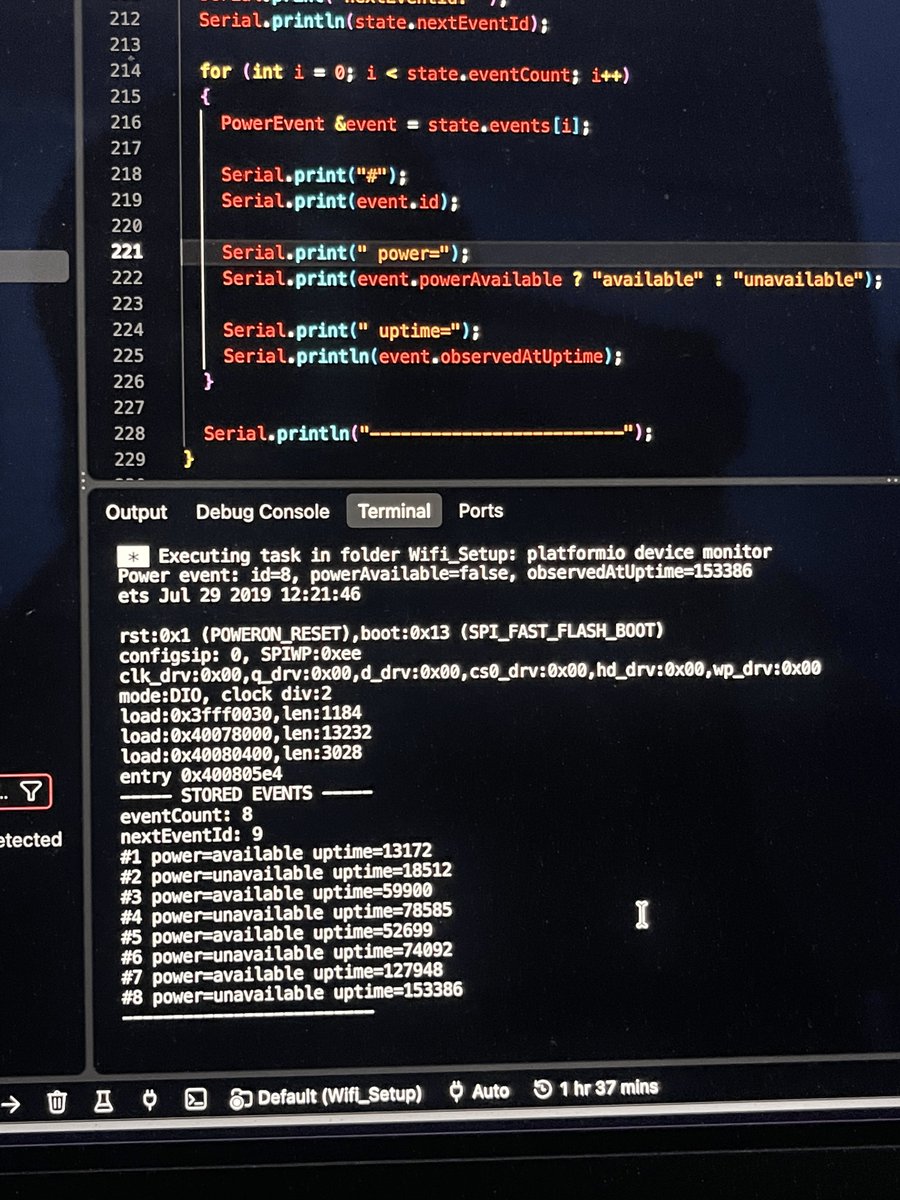
10 events survived device restarts, connected to my backend, synced in order, got 201s and were removed from the local queue.
Not without pain though 😭
localhost from an ESP32 is, unsurprisingly, not my Mac.
Then I fixed networking and broke the JSON payload.
Fixed that too.
Eventually:
All pending events synced
We are cooking 🔥
Recorded the whole thing for YouTube too.
Which I dropped yesterday.
Started with an idea that needed embedded systems, a path I barely knew.
Now the ESP32 prototype can:
GPIO power-state detection → debounce → event queue → NVS persistence → Wi-Fi reconnect → backend health check → ordered retry.
Today the test server returned 405 on event sync.
Perfect.
The ESP32 kept the failed event, rebooted, and restored all 7 pending events from flash.
Next: cooking the Go backend + idempotent ingestion, then watching the queue finally drain 🔥
Bought an ESP32, breadboard, jumper wires, LEDs… felt ready to build.
Then I realized I forgot the one thing needed to connect it to my laptop 😭
We are so back.
#BuildInPublic#ESP32#Electronics
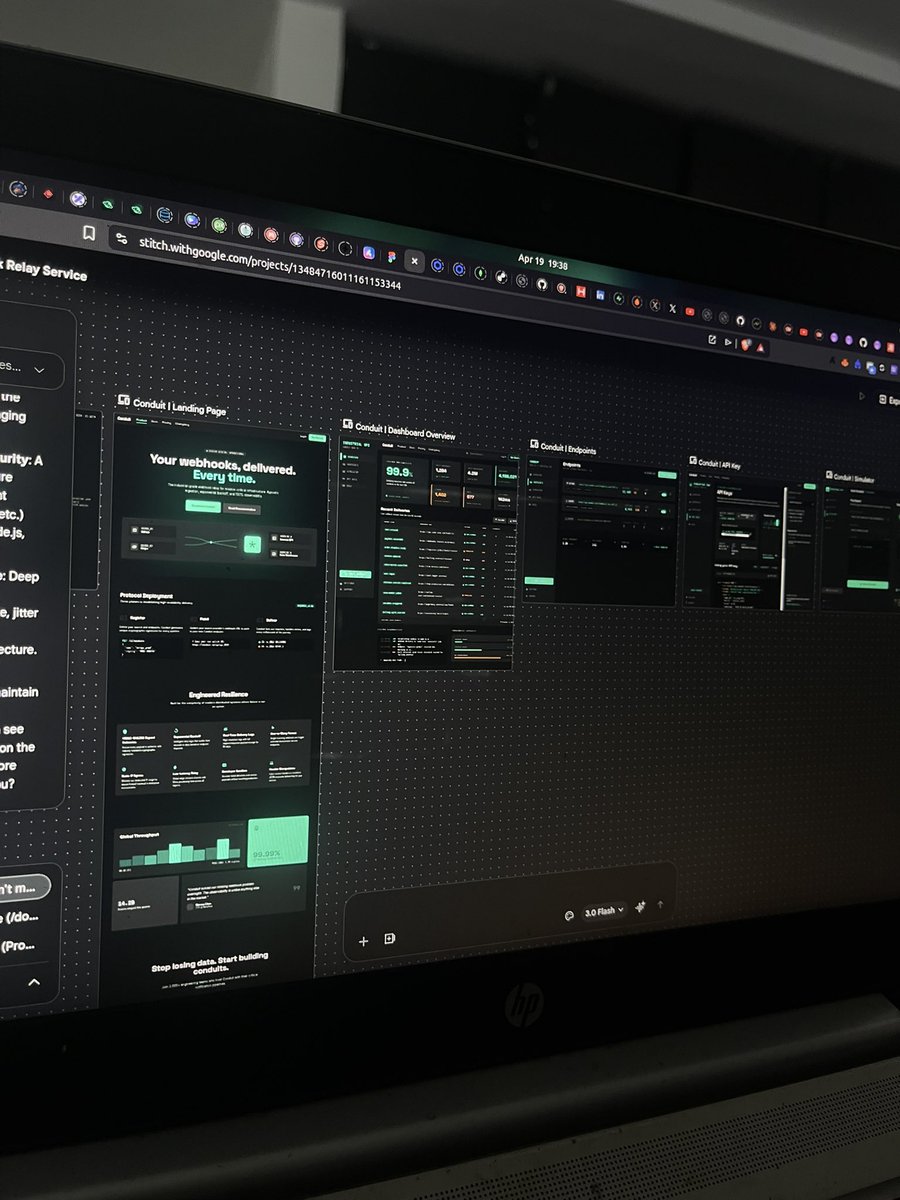
Conduit’s backend is feature-complete. Shifted to designing the frontend today.
Wrote a full PRD covering 9 pages, landing page, auth, dashboard with delivery analytics, endpoint management, delivery logs with status filtering and payload inspection, dead letter replay, API key management, event simulator, and public developer documentation.
The docs page alone has full API reference for every endpoint with method badges, auth requirements, request/response examples, curl commands, signature verification code in Node.js/Python/Go, retry schedule tables, and per-source setup guides for GitHub, Stripe, Paystack, Slack, and Shopify.
Design direction: dark industrial pipeline aesthetic. Not generic SaaS. Think infrastructure monitoring meets developer tooling. Every color token, typography scale, spacing value, and component pattern specified down to badge opacity percentages.
Generated the UI screens and started exporting to Figma. Implementation starts tomorrow.
https://t.co/82DhEwvJnb
While everyone is building for the top 1%, my team and I have been obsessed with the other 99%.
Late last year, we headed to Cape Town, South Africa for W3Node @W3Nodeofficial to build OfflineBridge.
The goal? Financial inclusion that doesn't require a $500 smartphone or a stable 4G connection. Low-tech hardware + High-tech rails.
No seed phrases. No apps. Just USSD.
I’ve been quiet on this, but speed and visibility are the only moats that matter. Huge shoutout to the team who brought this to life:
@uiuxbyvicko, @i_am_nebolisa, and @chisco_JS.
Here is the demo of OfflineBridge in action. ⚡️🇳🇬
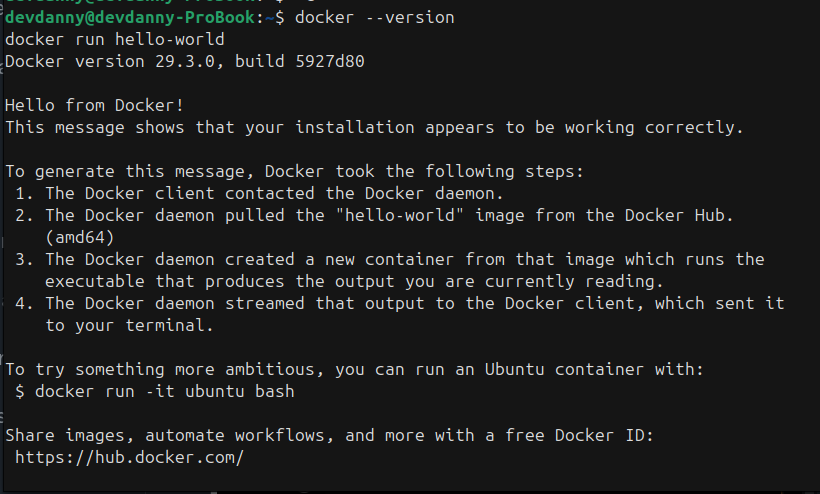
Day 39: Just finished Docker fundamentals.
Built my first image from a Dockerfile, ran containers, understood the build vs run mental model.
Starting my 3rd project — a CI/CD deployment pipeline dashboard.
GitHub webhooks → Docker containers → automated builds → real-time logs.
New tools: Docker, PostgreSQL, GitHub webhooks.
2 projects deployed in 38 days. Let's see what the next 2 weeks look like.
Currently building the frontend for my real-time chat app. Login, signup, user search, room creation, and the chat interface with online/offline status all working.
Using Zustand for state management. The mental model is clean, one store for auth with persistence, one store for chat state with room-specific message arrays and pagination tracking.
Backend has 28 tests, WebSocket events confirmed working, and now a frontend consuming every endpoint I built.
Day 33.
Some devs think bcrypt’s “12” means 12-word salt or don’t even know what it is.
It’s actually the cost factor — 2¹² (4,096) hashing iterations.
Higher number = slower hash = harder to brute force.
The salt itself is auto-generated and embedded in the hash output. You never set it manually.
Day 4 of going deep on backend.
Two days ago I realized I’ve been in tech for 5 years and still can’t hold my own in conversations about system design, caching, or API architecture.
So I’m going back to fundamentals. No new frameworks. No new courses. Just depth.
Day 2: Covered REST API principles, solved my first DSA problem 3 different ways, and landed a paid fullstack gig.
Building in public from here.
Day 3: Built a REST API with Express that handles validation, error handling, and MongoDB persistence.
The thing nobody tells you about error handling, it’s not just try/catch. It’s designing a flow where errors propagate cleanly from:
validation → controller → centralized handler.
Sounds simple. Took me 5 years to actually learn it properly.
Merry Christmas everyone 🎄
What better way to talk about my 2025 wrapped as a developer
> I started working on Open source project on @OnlyDust_com
> I worked on over 40 Open Source projects across the @Starknet , @StellarOrg, and evm projects
> I got into the first edition of @OnlyDust_com fellowship (similar to that of @outreachy )
> I got a new device (take a guess 😅)
> I got into @suioncampus mentorship program
> I worked on several projects on @SuiNetwork, @base and @Celo
> I worked on both the frontend and backend of several enterprise projects like @GainstyI44975
> I worked on the frontend experience on @wagerdao_ (the onchain bet platform for the bnb platform)
> I won some hackathons, of recent should be the cello @minipay hackathon (was part of the top 30 project, the 8th to be exact)
> Graduated from Uni
Hoping to do more next year 🙌
Two days ago, I was scrolling X and saw @0xJay247 drop BlockWrap for Solana.
I thought: "The Sui ecosystem needs this." 💡
48 hours later, it’s live.
Introducing Sui Wrapped 🌊
Check your year on-chain:
🔗 https://t.co/IDa73eFzjL
#Sui#SuiNetwork#Suinami#BuildInPublic #Web3 #MoveLang #Crypto