$5,345,846,501 confirmed stolen. 1.8B records exposed. 276 incidents, 584 primary sources.
Almost none of it started with a broken server. It started with someone picking up the phone.
The Global Social Engineering Impact Database is free and public: https://t.co/yCGbiEL1R2
AI is giving cybercriminals something they always wanted: scale with personalization.
#Phishing can now become faster, more convincing and much harder to spot. Our security awareness needs to evolve just as quickly.
#CyberSecurity#AI#StaySafe#IndiaTechStory
Clone yourself. Send it to your team. See who bites.
Free deepfake of you from one photo + a few seconds of voice. ~2 min.
Then put it in front of whoever would approve a wire if you asked.
Most teams find out they'd have paid.
https://t.co/uSoxoKNZGC
Upload a photo. Add a voice clip. Join the meeting as someone else in under 2 minutes.
That's the attack. Now it's your training exercise.
https://t.co/1SVoBD4YQq
I resigned from Anthropic today. I spent the last three years doing pretraining research at both OpenAI and Anthropic. Neither company is acting responsibly. They are racing straight to self-improving superintelligence and gambling with our lives. More thoughts below.
Anthropic safety researcher Evan Hubinger said there is a greater-than-10% chance AI could kill all humans within the next decade.
➡️It comes as another Anthropic researcher resigned, accusing leading AI labs of racing toward superintelligence without adequate safeguards.
➡️The warnings add to growing concerns over AI safety, including whether advanced systems could become difficult for humans to control.
🔗For more, please click here: https://t.co/ywOZs6QIpm
Eight AI agents. 12 attack waves. Four days. One compromised government.
No zero days. The attackers just talked their way past model guardrails and ran the playbook faster than humans could answer.
#Cybersecurity#AIsecurity#ThreatIntelligence#AgenticAI#CISO
You type. It talks.
Send chat commands mid-call and your avatar follows in real time. Ask a question, change the subject, close the loop. You stay invisible the whole time.
Steer the scenario live instead of scripting it and hoping it lands.
https://t.co/1SVoBD4YQq
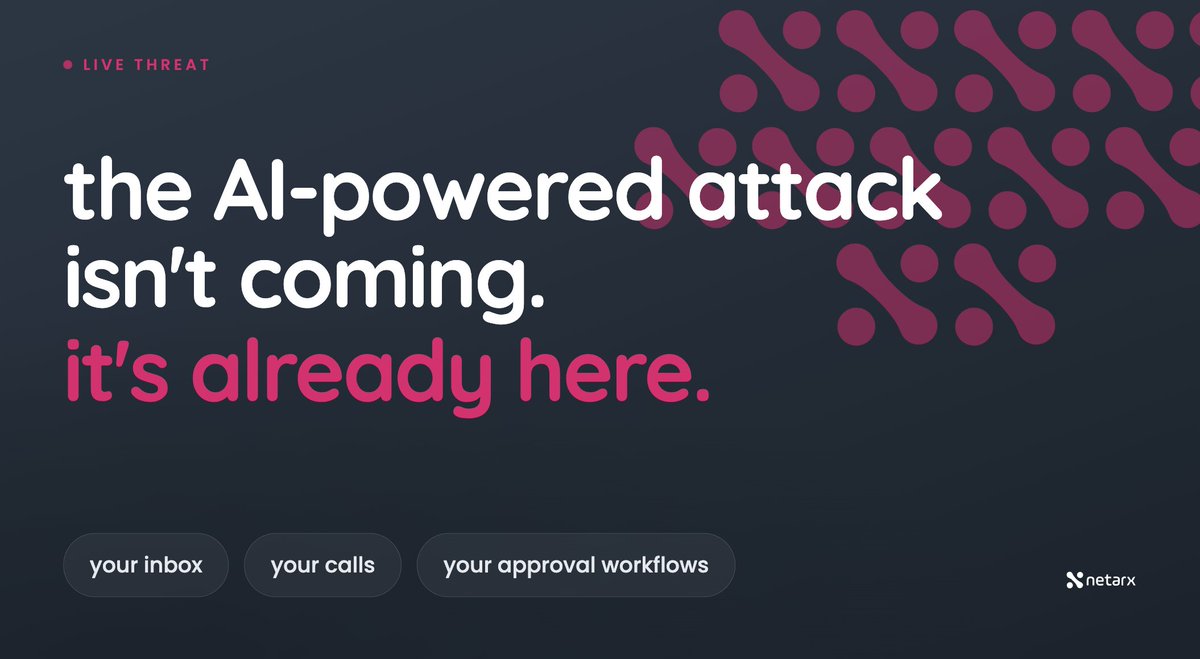
1/ The AI-powered attack isn't coming. It's already here. In your inbox, on your calls, in your approval workflows.
#Cybersecurity#Deepfakes#AISecurity
4/
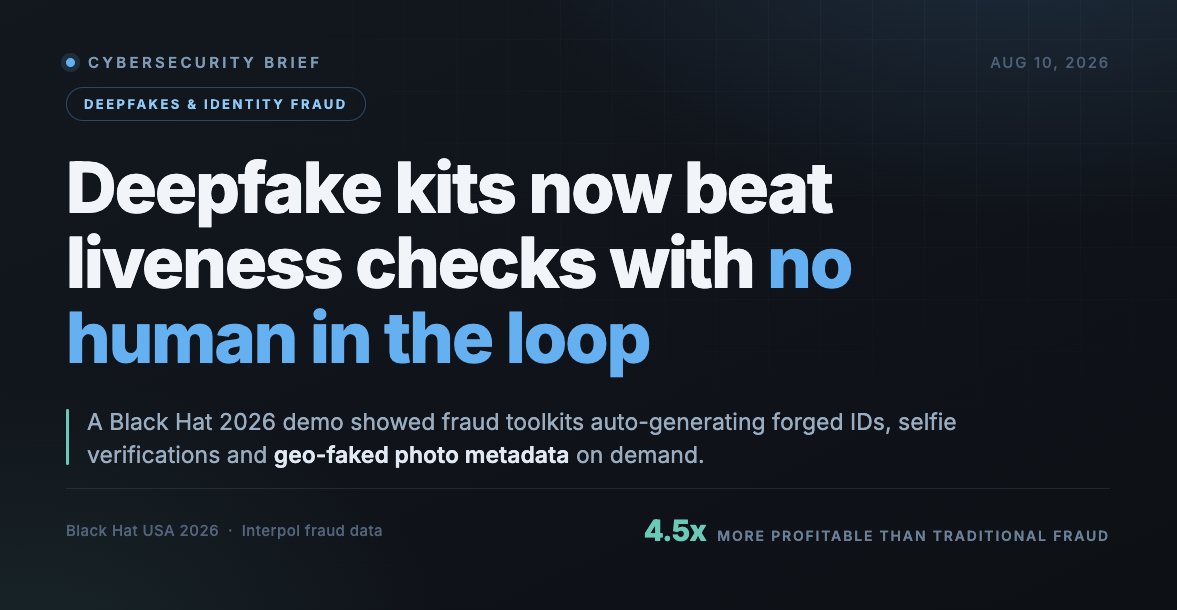
Interpol: fraud campaigns up 54% since 2024, $1.1B lost across 1,500+ transnational cases, AI-enhanced fraud 4.5x more profitable.
If your identity check is "did a face move on camera," you're testing for something attackers automated already.
#Cybersecurity#Deepfakes
3/
Worst part: the new version knows what each verification provider asks for and delivers it automatically. Nobody timing uploads by hand.
Huber's word for it: de-skilling. The tradecraft lives in the tool, not the operator.
#Cybersecurity#Deepfakes
2/
The details are the tell. It generates a "selfie with ID" complete with a desk and keyboard in the background for realism. Then injects geo-tailored EXIF so a photo shot in Lagos claims Sydney.
#Cybersecurity#Deepfakes
1/
Liveness checks were supposed to be the hard part.
At Black Hat USA, TD Bank's Eric Huber demoed ProKYC, a turnkey identity-fraud kit that walks an entire onboarding flow on its own. Forged passport, synthetic face, fake liveness video.
#Cybersecurity#Deepfakes
Alibaba's Qwen3.8 Max scores 56 on the Artificial Analysis Intelligence Index at $1.14 per task, but open weights leader Kimi K3 remains 1 point ahead at 25% lower cost per task ($0.86)
@Alibaba_Qwen has released Qwen3.8 Max, which Alibaba states is a 2.4T total parameter MoE activating 95B parameters per forward pass. Alibaba has announced it plans to release the weights next week, a shift in strategy as it has typically kept its Max class of models proprietary. Once released, Qwen3.8 Max would be ~6x larger than Alibaba's largest open weights release to date (Qwen3.5 397B) and the second largest open weights model behind Kimi K3 (2.8T)
Note: we earlier published results showing Qwen3.8 Max scoring 53 on the Artificial Analysis Intelligence Index. Those runs were affected by intermittent issues on the endpoint we were evaluating, and we have re-run all evaluations on Alibaba's public API endpoint
Key takeaways:
➤ Qwen3.8 Max scores 56 on the Artificial Analysis Intelligence Index, up 10 points from Qwen3.7 Max (46). It is in line with Claude Opus 4.8 (max, 56) and sits second among labs from China, ahead of GLM-5.2 (max, 51) but behind Kimi K3 (max, 57)
➤ Qwen3.8 Max scores 1739 Elo on GDPval-AA, a 468 Elo gain over Qwen3.7 Max. This places it ahead of Kimi K3 (1685), effectively tied with Claude Fable 5 (1743) and GPT-5.6 Sol (max, 1730), and behind only Claude Opus 5 (max, 1852)
➤ Gains over Qwen3.7 Max span agentic evaluations, scientific reasoning and coding: Terminal-Bench v2.1 +6 points, CritPt +7 points, SciCode +4 points and HLE +3 points, with GPQA unchanged. AA-LCR (-2 points) and AA-Omniscience (-10 points, driven by a hallucination rate rising 23% to 40%) regress
➤ Qwen3.8 Max costs $1.14 per Intelligence Index task, more than double Qwen3.7 Max ($0.53), at ~1.3x Kimi K3 (max, $0.86) and ~2x GLM-5.2 (max, $0.57). Cost is driven in part by more turns on agentic evaluations, with GDPval-AA input tokens rising ~15x over Qwen3.7 Max, and output token usage up 45% to 145M
➤ The 𝜏³-Bench Banking result (42%) appears out of distribution. It is a 32 point gain over Qwen3.7 Max and places Qwen3.8 Max ahead of models that outscore it on other evaluations
Key model details:
➤ Size: 2.4T total parameters, ~95B active per forward pass (MoE)
➤ Context window: 1M tokens
➤ Multimodal: text, image and video input with text output
➤ Pricing: $2.00/$6.00 per 1M input/output tokens on the @alibaba_cloud first-party API, with a $0.25 cache hit price. This is lower than Qwen3.7 Max across the board ($2.50/$7.50, with a $0.50 cache hit price)
➤ Availability: Alibaba Cloud first-party API. Alibaba states the weights will be released next week
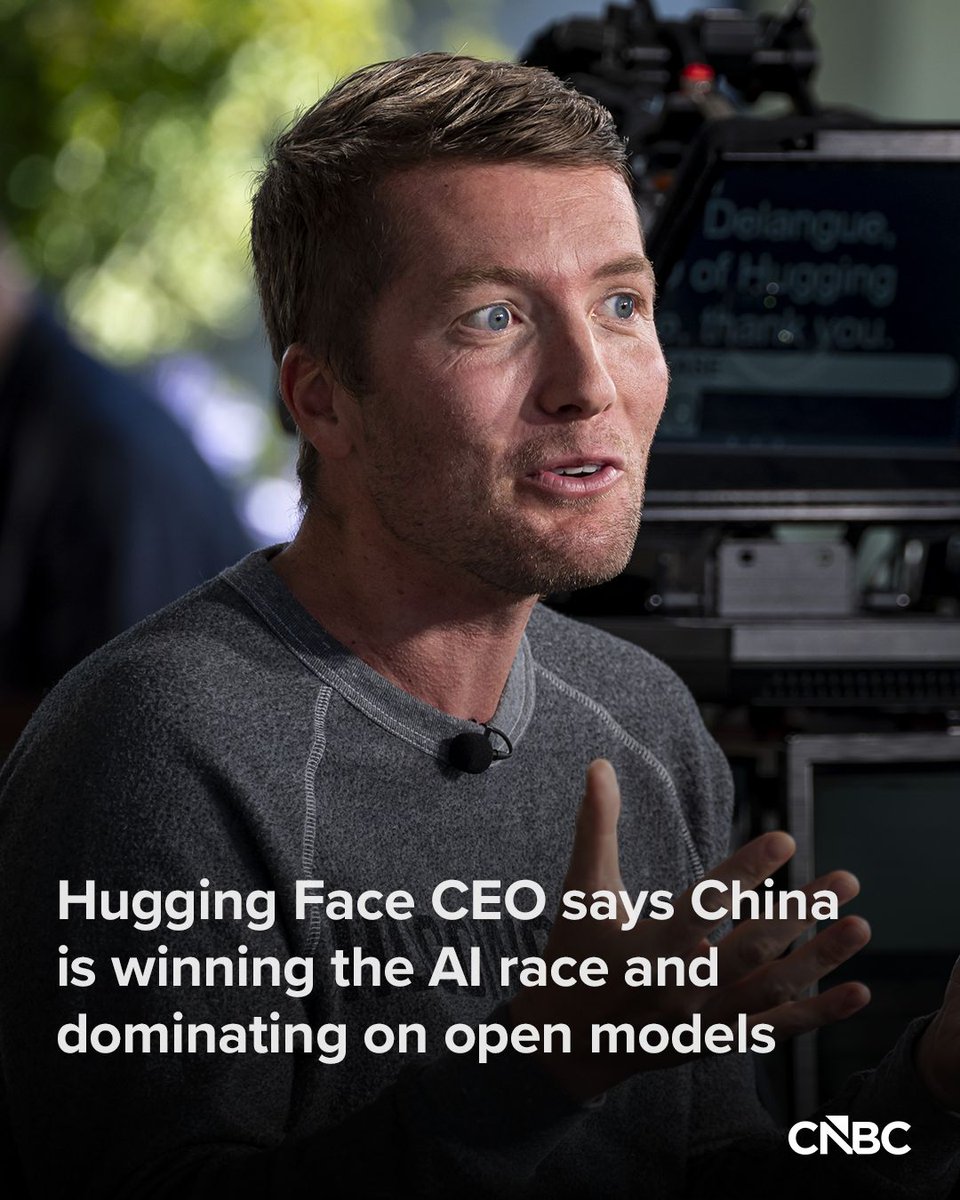
Hugging Face CEO Clément Delangue said China is winning the artificial intelligence race with open-weight models and could catch up to U.S. model makers as soon as this year.
“They’re clearly dominating on open models right now, and I wouldn’t be surprised if they start dominating at the frontier either by the end of this year or next year at the rate of progress,” he told CNBC’s “Squawk on the Street” on Monday.
More: https://t.co/SAu0w3aIiG
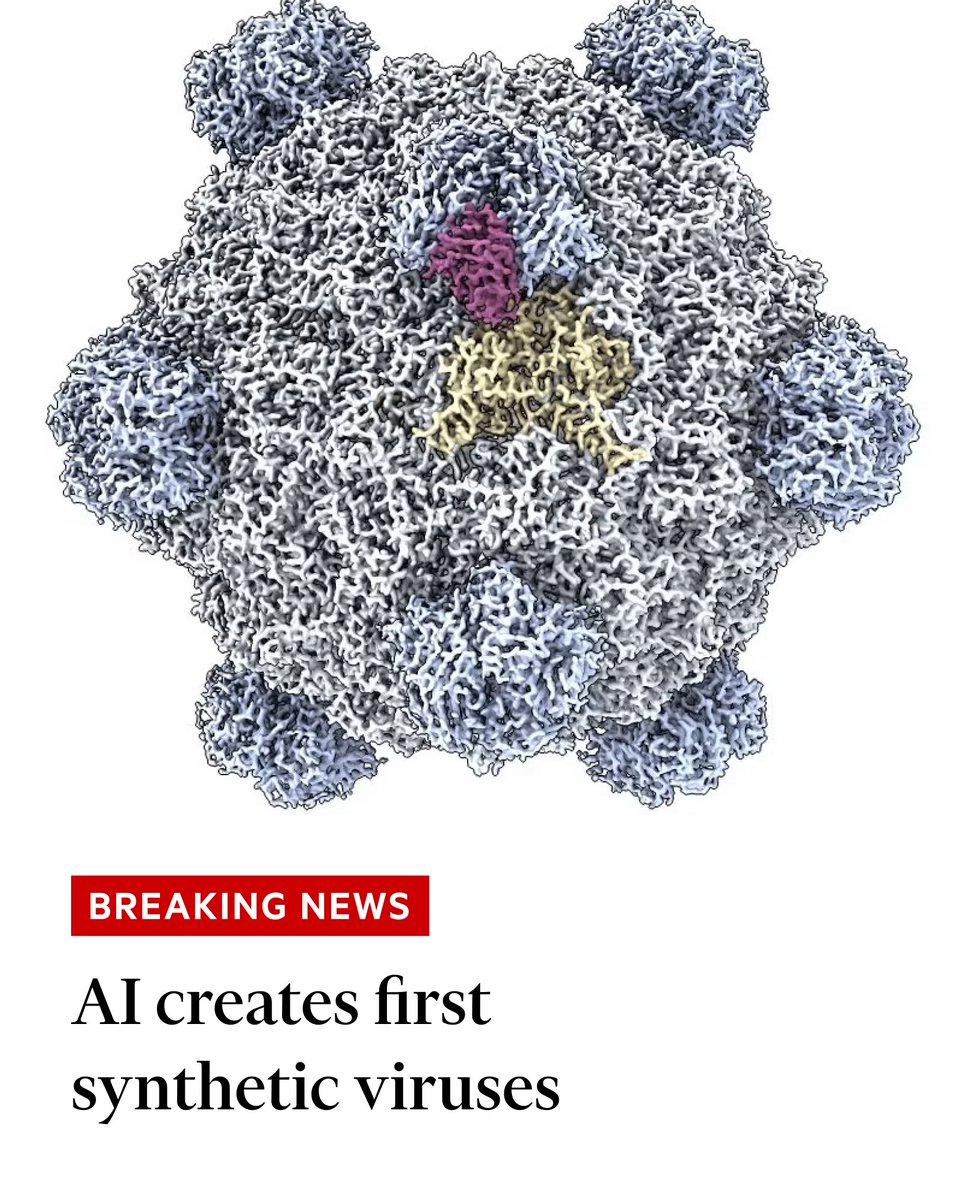
Breaking news: Scientists in the US have for the first time used artificial intelligence to create viruses unknown in nature, a milestone that promises advances in healthcare but also raises important biosafety and biosecurity concerns. https://t.co/L9Hg3hXwz8
BREAKING: This is the first time AI has written the complete genetic code for a living organism
In a study published in the journal Science, researchers at Stanford University and the Arc Institute used a genome language model named Evo to design fully functional viral genomes.
Much like chatbots learn to predict words, Evo was trained on millions of natural DNA sequences to learn the 'grammar of life.' After synthesizing the AI-generated instructions in a lab, scientists created 16 viable bacteriophages—viruses that target and kill bacteria like E. coli. This marks the first time artificial intelligence has written the complete genetic code for a living organism, showcasing a powerful new method to combat antibiotic-resistant superbugs.
However, the breakthrough has also ignited urgent warnings from global biosecurity scholars. Because Evo was trained without human pathogen datasets, these specific viruses cannot infect people, but experts caution that the underlying technology could eventually be weaponized to create dangerous biological agents. Leading public health officials from Johns Hopkins University noted that while the capability to compose viral genomes via generative AI now exists, the regulatory frameworks required to steer it safely do not. Scientists and ethicists are now urging immediate international governance to oversee the manufacturing of synthetic DNA before the technology outpaces security controls.
source: Roeloffs, M. W. (2026). Scientists Trained An AI Model In DNA—And It Invented 16 New Viruses. Forbes.