You know we must be talking about Neil deGrasse Tyson the African-American astrophysicist with the uncanny ability to reduce complex cosmic concepts into ideas the average person understands and finds entertaining. No wonder he has such a following among geeks and non-geeks alike
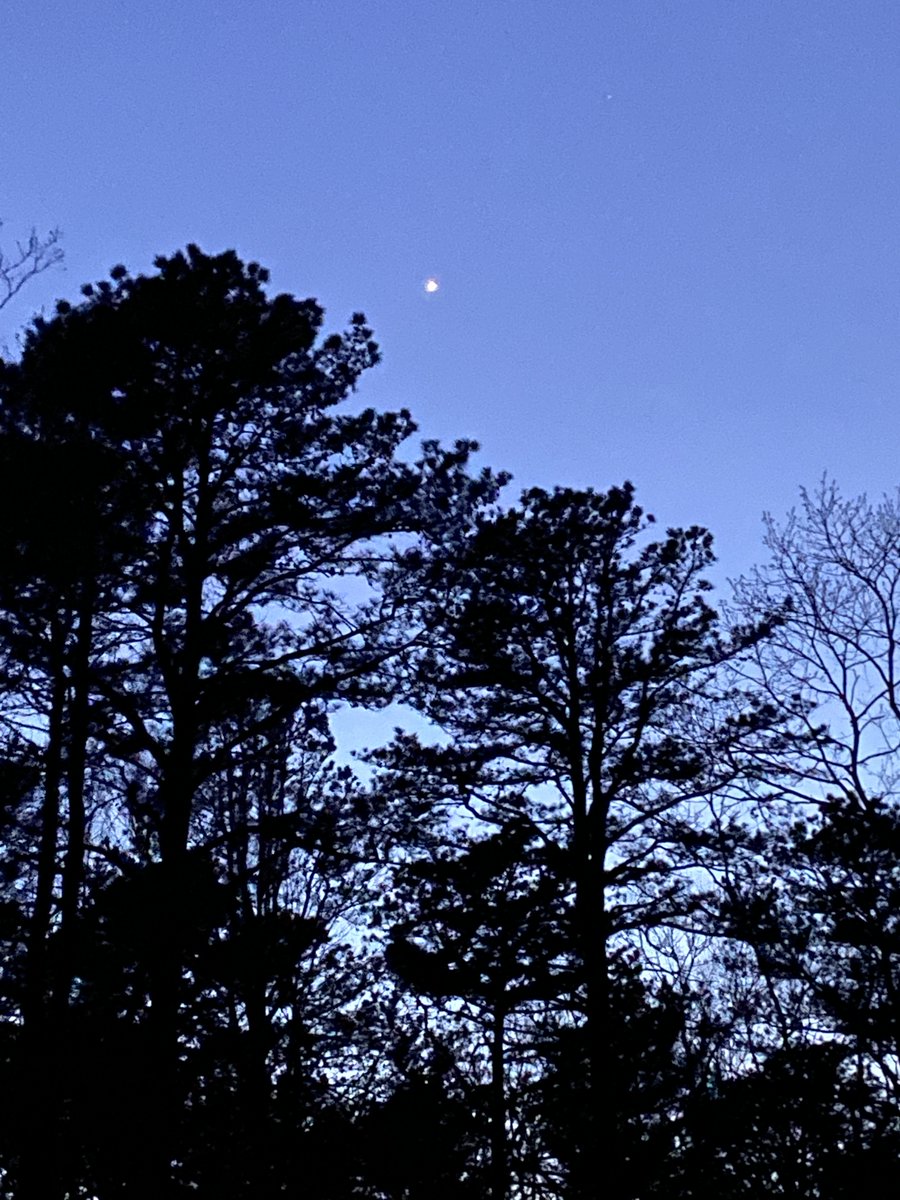
While appreciating Earth, pause to notice Venus, sitting bright in twilight skies after sunset. Our nearest neighbor and near-twin to Earth in size & gravity, Venus labors under a runaway CO2 greenhouse effect, where temperatures are hot enough to liquefy lead. I’m just sayin'.
Notice that star, high in twilight skies after sunset? It's planet Venus. Meanwhile, the newly-birthed thin crescent Moon arrives — the start of Ramadan on the Islamic calendar. For the next few days, the Moon will sashay past Venus. The pair, an enduring symbol of the religion.
On COVID19 Misinformation:
A reminder from (scientifically literate) @SethMacFarlane that disagreements can be civil, especially with powerful people like @Oprah, yet don't always need to end with one person "cancelling" the other.
[Video: 1 min]
https://t.co/fDCedpcsFL
When they're not beaming down, Space Aliens tend to disembark via ramp rather than stairs.
Evidence they were into handicap-accessible design long before we figured it out.
@7ravl3r Yes but the biggest problem with looking for fast radio bursts is you don't know when and where one will flash next. You have to watch the skies and hope you get lucky.
Astronomers are detecting a mysterious, powerful form of radiation blipping across space, and nobody's quite sure why.
Fast radio bursts only last for a few milliseconds, but some bursts have as much power as the radiation of 500 million Suns.
"When the star is ripped apart by the gravitational forces of the black hole, some part of the star's remains falls into the black hole, while the rest is ejected at high speeds,"
The ocean is 12,080.7 feet (3,682.2 meters) deep on average. That's about eight Empire State Buildings, stacked one on top of the other. The deepest part of the ocean, however, is about 36,200 feet down (11,030 m). That's more like 25 Empire State Buildings.
In 1995, the first planet beyond our solar system was discovered. Now, thousands of planets orbiting sun-like stars, also known as exoplanets, have been found.
Roughly 70 percent of the universe is made of dark energy. Dark matter makes up about 25 percent. The rest everything on Earth, everything ever observed with all of our instruments, all normal matter — adds up to less than 5 percent of the universe.
“If your ego starts out, ‘I am important, I am big, I am special,’ you’re in for some disappointments when you look around at what we’ve discovered about the universe,” Tyson once said. “No, you’re not big. No, you’re not. You’re small in time and in space.”
The atoms of our bodies are traceable to stars that manufactured them in their cores and exploded these enriched ingredients across our galaxy, billions of years ago. And we are atomically connected to all atoms in the universe. We are not figuratively, but literally stardust.