Ambient is the open source, proof of useful work AI project the world desperately needs 🌎🤖
I couldn’t be more excited for @IridiumEagle to showcase @Ambient_xyz
A few years ago, our team met Travis. He instantly struck our entire team with a sense of extreme technical ability and thoughtfulness in everything he discussed, from open source AI, to crypto and tokeneconomics (both AI tokens and crypto economics). Travis has been on our podcast several times over the years and these are linked at the end. Soon after, he published “Situational Blindness,” a report that was a response to Leopold Aschenbrenner’s “Situational Awareness.”
In his Situational Blindness report, Travis argued that Big Tech platforms inevitably drift toward opacity, extraction and lock in because the economics reward it. He posited that the answer is not to trust better executives, but to build systems where behavior is open, portable and verifiable. Open weights are not enough if the serving layer is still centralized, black box and censorable. Ambient is that thesis applied to AI inference.
Ambient is a proof of useful work network that rewards miners for hyper serving a few foundational AI models. Miners compete on serving models and get rewarded for doing so. The world benefits this competition in the form of, low latency, low cost, truly open AI infra, with no centralized component. Fast forward to today, Ambient is live and in the open.
Today, Ambient makes its public reveal
I love bullets to walk through how it works so lets go through the flow
1/ A user comes to Ambient because they want AI inference. They want to hit an API, chat interface, Ambient Desktop, OpenAI compatible workflow, or OpenRouter route and get strong open models like Kimi K2.7 Code and GLM 5.1. They are not buying decentralized compute. They are buying model access at the cheapest and lowest cost from a verified network of miners who hyper compete to serve these models transparently.
2/ The wedge is that open models are now good enough for real workloads. Kimi K2.7 Code has a 262K context window, activates 32B parameters out of roughly 1T total, and is built for long context coding. GLM 5.1 has a 203K context window and is positioned around long horizon coding and agentic engineering. Closed models still win the hardest tasks, but most tokens will route to the best mix of price, latency, reliability, privacy, and quality. I’ve strongly been in favor of this shift and have shared my thoughts here already.
https://t.co/HT0MjBB32l
3/ Ambient has to win on hard metrics like cost/latency, not ideology. OpenRouter lists Kimi K2.7 Code at $0.75 per 1M input tokens and $3.50 per 1M output tokens. GLM 5.1 is listed at $0.98 input and $3.08 output. In the provider snapshot, Ambient’s Kimi endpoint was $0.75 input, $3.50 output, 2.08s latency, and 23 tokens/sec and cheaper than most listed peers while still usable. The claim should be: competitive cost today, better market structure over time. Ambient has more usage for Kimi over Moonshot itself, who created the model!
Link for this data is here but will change as data changes: https://t.co/IOD7Mcgm4i
4/ When a request hits Ambient, it becomes an inference job: model requested, input size, output budget, latency constraint, price ceiling, and quality requirements. The system can bundle similar requests and run a reverse auction where miners compete to serve the work. A global network of physical miners running GPUs compete to serve the request at the lowest cost and highest quality.
5/ The miners are real GPU operators and they deploy physical hardware. Kimi and GLM have to be hosted in GPU memory. Operators manage batching, KV cache, token streaming, networking, uptime, quantization choices, and serving software. The scarce resource is high-VRAM compute that can keep large models hot and serve tokens reliably.
6/ Miners mostly compete in a global race to serve the same requested model better. They should not win by secretly routing you to a weaker model. They win through lower cost per token, lower latency, higher throughput, better batching, higher uptime, more available capacity, and software optimizations inside allowed quality bounds. This is where useful work becomes real as the network pays the operator who can deliver the requested intelligence cheapest and fastest without degrading the product.
7/ Ambient’s blockchain side is needed because untrusted global hardware needs neutral rules. Without a chain, Ambient is just another centralized router deciding who gets traffic and who gets paid. Ambient’s chain handles job creation, auctions, bid commitments, settlement, rewards, reputation, verifier assignment, and penalties. The chain handles coordination among operators that do not need to know or trust each other in a transparent manner. Net Ambient’s chain is the transparent coordination m,echanism that organizes and rewards miners competing in the global race to serve models better.
8/ Verification is the crucial unlock. Cheap inference markets are rife with cheating. Serving the wrong model, wrong quantization, hidden routing, degraded outputs, fake privacy. Ambient’s Proof of Logits is meant to fingerprint model execution through internal logits so validators can check work without rerunning the entire job. A user doesn’t have to guess or roll the dice on a model provider as Ambient’s network handles verification so a user just comes to the network, gets the benefit of a global race to provide the model the best and they get their request.
9/ This is the proof of useful work component. A user pays for inference. Miners compete to serve it. The network routes, settles, verifies, and rewards miners who serve the model the best. Ambient’s token is the incentive and coordination asset for useful work powering an open source AI network.
10/ The long term open source implication is the big one. Open weights are not enough if serious usage still runs through centralized clouds and black box APIs. Ambient is trying to give open models their missing serving layer: global GPUs, market pricing, verification, payments, reputation, and normal developer access.
11/ Play this out to an extreme and Ambient has the potential to be the coordination network for the world to compete within models and across models to serve the end user the lowest cost and highest quality intelligence.
12/ Why is this necessary? At face value as a user you get reliable/brand trusted inference at low costs. At the extreme an entire world of applications can be built on Ambient’s chain without ever having to worry about the model getting turned off or deplatformed or facing egregious costs given the global race to serve models competitively. It becomes naturally safer to deploy models on Ambient since you know they will persist, you know they can’t be turned off and you know you will always be getting the lowest cost for your service.
At @Delphi_Ventures we've backed Travis twice - originally in his pre-seed round and again in their most recent seed round because we feel an immense sense or urgency in the work of tangibly providing the world with a global intelligence utility.
At Delphi Ventures we are deep believers in open source AI and backing the most impressive founders we can find and Travis, and his co-founder Max, have checked the boxes for us time and time again.
Download Ambient’s desktop app or route your agents or workloads to ambient. Sign up for a subscription and give it a try.
Long live open source AI
—---------------------------------------------------------
Links Mentioned:
- Download Ambient Today: https://t.co/FylNs6q3qX
- Ambient’s Subscriptions: https://t.co/nYPFvTPRH2
- Use Ambient’s API: https://t.co/pTLHQymtoy
- Use Ambient via OpenRouter: https://t.co/vgoBaOefem
- Situational Blindness: https://t.co/xNz70wqf06
- Travis on The Delphi Podcast (2024): https://t.co/sZWA2AXATo
- Travis on the Delphi Podcast (2025): https://t.co/SspqVNAN29
- Stay tuned for Travis's next podcast appearance!
One of our portfolio companies, @testmachine_ai, just topped the EVMBench leaderboard for AI vulnerability detection on EVM smart contracts. If you are building in DeFi and take security seriously, worth a look.
A few months ago @OpenAI and @paradigm released EVMBench to check for vulnerabilities in EVM smart contracts
Fast forward and @testmachine_ai's proprietary AI model is #1 on the leaderboard and 8% points above the 2nd best agent
If you are a team looking for the literal best smart contract auditors, DM the Testmachine team
Rather be safe than hacked by an AI model
We recently led the round for @tori_finance, a protocol bringing institutional delta-neutral yield strategies on-chain, unlocking return amplification, composability, and access that traditional finance can't offer.
Today we sat down with @0xNox_eth to go deep on the podcast:
• How the carry trade actually works and why FX hedging spreads persist.
• How positions survive a 30% currency drop.
• The security architecture, from NAV oracles to lessons from recent DeFi exploits.
• Why this yield was previously gated behind 8-9 figure balance sheets.
• How real-time on-chain transparency actually works under the hood.
• And how tokenization turns a strong baseline yield into something significantly more powerful.
Thrilled to speak at the @solana Accelerate AI conference on May 6 in Miami next week!
This will be a really good conference and I'm very excited for it. See you there!
big congrats to @AliHabbabeh and the XO team
imo XO is the most serious player yet in user-generated markets
if you have a highly engaged audience — sports, crypto, geopolitics, culture, finance, etc. — consider joining their ambassador program
if elected, you’ll be able to create your own markets and earn a share of trading volume generated by your audience, giving them interactive content while unlocking a new monetization channel
program details: https://t.co/llKVoe12fy
(disc. @Delphi_Ventures is an investor)
7 months ago I said YB was imo the most exciting new DeFi primitive this cycle. Bear market just stress-tested it:
- 99% TVL retention while defi shed $80b+
- $3.84m in protocol fees to YB lockers
- 0 security incidents through a stretch of brutal hacks elsewhere
Thesis playing out. GG @newmichwill, @llamaintern and the rest of the @yieldbasis team
During our lifetime, the human brain will be confronted with a new interface: the computer
I believe that we’ve crossed the reality-chasm and computers for our brain and this is no longer science fiction.
Neurotechnology and brain computer interfaces are at the earliest stages of clinical and commercial viability. These technologies are already delivering life-changing clinical outcomes and will reshape how we interact with technology.
Today we are publishing our investment thesis for how we’re evaluating opportunities in neurotech: https://t.co/4u3IwTEU91
Thrilled to be a judge for @consensus2026 Pitch Fest on May 6 at 4pm at the Hackathon Stage in Miami!
I'll be actively looking for early stage Crypto and AI projects to diligence for @Delphi_Ventures
Signup! See you there
https://t.co/nLiLITGF2p
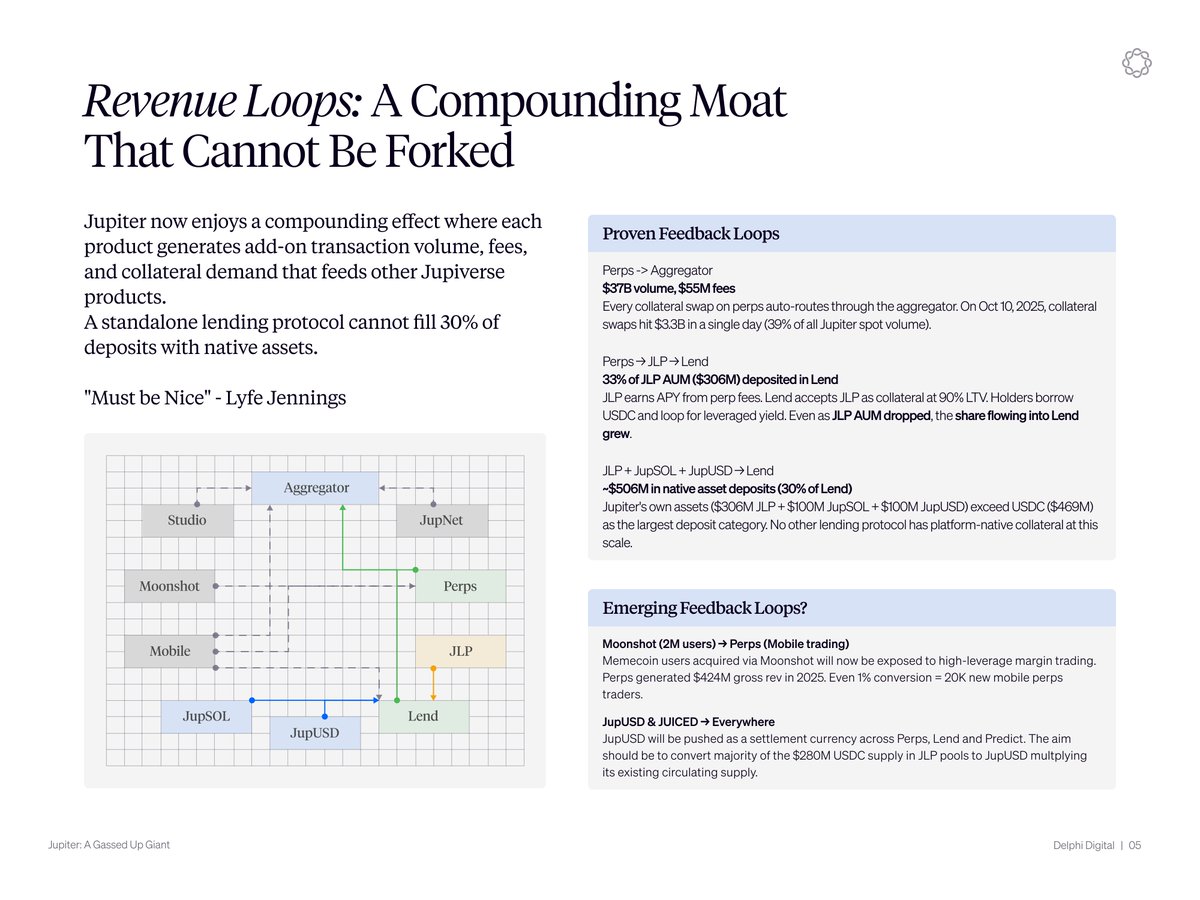
Our new report "Jupiter: A Gassed Up Giant" is Live and Free to read!
@JupiterExchange did $184M in protocol revenue in 2025 with no venture funding and a near-zero capital base.
JUP now trades at roughly 9x annualized revenue while Aave trades at 20x.
The disconnect comes down to categorization. The market sees a cyclical DEX aggregator, but the team has spent the last 18 months shipping 10+ new product lines while defending 80% of Solana spot aggregation.
What makes this durable is the product flywheel underneath it. Perps auto-route collateral swaps through the aggregator, generating billions in spot volume as a byproduct. JLP earns yield from perp fees and a third of its AUM flows into Jupiter Lend as collateral.
Jupiter ranks as the third-largest perp earner behind only Hyperliquid and EdgeX. When JupNet goes live and GUM opens access to equities, commodities, and forex, every new asset class feeds volume across the entire stack.
Sunday, March 29. Cannes.
Sunset catamaran cruise the evening before EthCC[9]. No stage, no panels. Just the right people on the water.
Hosted with @Delphi_Ventures, @Rockaway_X, and @AccountableData.
Join a curated guest list of top DeFi protocols, investors, founders, and institutional market makers.
Apply: https://t.co/cgbqvqeQzh
Thrilled to be leading @tori_finance's seed.
Most on-chain yield is reflexive, it originates from within crypto and compresses the moment markets cool. Tori sources returns from an entirely different universe: institutionally scalable delta-neutral and HFT strategies in TradFi that have consistently generated strong low double-digit APY for decades. Completely uncorrelated to crypto market direction.
Access to this was previously gated behind 7-figure minimums and accreditation. Now it's open to anyone with a wallet.
The real unlock though is what crypto adds to this. DeFi composability lets users recursively leverage their position, pushing effective yields considerably beyond the baseline. You can't do that with a traditional fund share, this is a case where bringing something on-chain makes the product strictly better.
Add full on-chain verifiability of every position and you get TradFi-grade transparency alongside access and composability that TradFi simply can't offer.
We backed Sam @0xNox_eth and the @tori_finance team because we think one of DeFi's biggest opportunities is bringing new unique exogenous assets on-chain that can become collateral across the stack.
Our thesis is simple: tokenization is very powerful in that if you have a low-volatility, yield-bearing asset you can use it as collateral, borrow stables at a lower rate, and loop back into the same asset. The effective yield you end up with is material relative to anything you can access elsewhere.
The key is the asset needs to be reliable enough to lever at high LTV without liquidation risk. That's the hard part and what Tori is uniquely built for.
There are well-established yield strategies in TradFi — money market instruments, short-duration sovereign paper, arbitrage funds — that generate appealing USD returns on a delta-neutral basis with zero crypto exposure. The yield source is well-understood. The problem is:
a) They're locked behind bureaucracy, borders, minimums, and accreditation.
b) Even if you access them, your capital is dead. You can't borrow against it. You can't compose it. You just earn the base yield.
Tokenization changes that.
Tori deploys into these same instruments across global markets, fully hedged back to USD, and wraps them into a composable token. By doing so it creates an exogenous asset uncorrelated to crypto with an appealing, low-volatility yield that you can borrow against. Your otherwise locked capital all of a sudden becomes productive.
And because Tori operates globally, yield isn't dependent on a single region. If spreads compress in one geography, capital rotates to another. Scalable and accessible to anyone on-chain.
I'm very excited to back Sam @0xNox_eth on this journey. He's consistently shown us what exceptional founder DNA looks like. Give him a follow
Delphi Ventures is proud to sponsor the @NousResearch Hermes Hackathon.
The repo is trending on GitHub as developer activity hits all time highs. Hermes has gone viral for a multitude of different use cases
Stay tuned for the winners!
@Delphi_Ventures is an Investor in Nous
$GRASS is one of the clearest ways to play the intersection of AI and Crypto. A generational founder with millions of deployed devices on Solana accruing the most valuable asset (Data) for Major AI Labs. Incredible well run company.
@Delphi_Ventures is a proud investor 🌱
There is a ridiculous amount of signal on
https://t.co/Xvpu9dBcdx by the AI mastermind @_xjdr
Looking at the Quote Tweets people are calling it A Gold Mine and The Equivalent of the alchemists notebook in the middle ages
If you look at his most recent posts he is doing insane things. In one he built an automated AI researcher that found a better training configuration all on its own. In another he stress tested all the hyped 2025 AI trends (canon, mHC, engram) to see if they actually worked. In another he designed a networking system (RDEP) that treats an entire cluster of connected GPUs as one single pooled brain.
I'm beyond excited for XJDR to release more on Noumena as time goes on. He is releasing highly differentiated frontier level engineering research around the most complicated subjects (Mixture of Experts)
For those who are also not technical, I'm sharing Gemini Deep Think's take on the impact of his last three papers.
XJDR will do incredible things in 2026 and beyond for AI. Highly recommend following and getting involved.
Strongly recommend following @IridiumEagle and @ambient_xyz and getting involved with their testnet if you're an AI enjoyer
Ambient is building an SVM compatible proof of work L1 that supplies verified inference through a 600B parameter AI model and through a variety of fine tunes for different use cases
Ambient has two cornerstones that will strongly resonate
1/ The models are underpinned from PoW. So physical hardware around the world underpins Ambient's AI models. As more come online the model gets smarter and can service inference faster and cheaper.
2/ Travis is an open source champion. He is building for the counter world away from centralized models which is becoming ever more important especially as China goes closed source (See GLM 5.0, Qwen AI lead getting fired post new Open source release and Llama hasnt relased a model since 2001).
Some slightly more technical advantages of Travis' design
- Speed: It uses Solana's Proof of History for speed but replaces Proof of Stake with a new Proof of Logits algo. Miners secure the network by running useful AI models instead of solving random math.
- Efficiency: It drops the computing power wasted on verifying AI outputs to under 0.1 percent. Validators achieve this efficiency by checking a single random word of the AI output instead of the entire text
- Censorship Resistance: The architecture uses built in privacy primitives to ensure censorship resistance
@Delphi_Ventures is proud to back Travis, Max and Ambient!
Absolutely insane progress by @getoro_xyz
They have grown into one of the largest private data collection companies on earth
They are solving the the AI data bottleneck by capturing the largest permissioned datasets of real human behavior. This data is crucial for big AI labs and for Oro in its future endeavors.
- Voice: 3.8TB of audio from 3,000 active contributors in 47 languages
- Social: 310M structured data points per month across 1.24M live connections
- Health: 11.7M wearable data points per month from 392,000 live connections
- Finance: 3M financial data units per month across 150,000 live connections
So with these data points what are the use cases?
- Voice: Voice models, agentic AI, world models, and physical AI
- Social: Deeper agent memory, tight personalization, and reliable reasoning
- Health: Sleep disorder detection, recovery anomaly flagging, and burnout prediction
- Finance: Fraud anomaly detection, spend classification, and automated trading agents
Oro has grown into a key player in the data space for AI and they're growing extremely fast. And yes people get rewarded for providing their data/connections.
Very happy Oro is a @Delphi_Ventures portfolio company
Get started: https://t.co/VIv0Ze7XdE