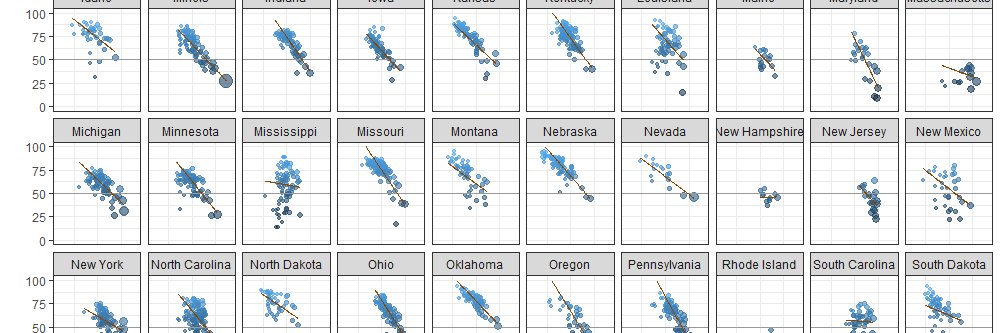
There was a moment when it looked like very high levels of development might fuel a fertility rebound, but that has passed. Higher development brings persistently very low fertility - in the cross section and the trends among high-development countries. … https://t.co/LmIMUJ8YmP
Now you know: UN population always forecasts fertility rates increasing starting tomorrow. What difference does it make? The "median variant," which has TFR rising from .72 to 1.3, adds 4.8 million to the projected population for 2100, compared with TFR just staying at .72.
Most people think the Baby Boom in the United States was “officially” from 1946 to 1964, and yet neither of our two principal candidates for president in 2024 are Baby Boomers. How is this possible?
https://t.co/45kFePPmVG
https://t.co/89V09V9hun
We have no experience of countries climbing from very low birth rates back up to replacement-level fertility, so we can’t say how that might be accomplished (or even if it’s a good idea to try).
https://t.co/YZbzosSAdf
https://t.co/LENaTfgzuB
Almost every country that ever fell below 2.1 births per woman is still below this "replacement" rate now (except Mongolia and Kazakhstan, among those with 2 million people or more). Now you know: Tomorrow's blog post graph today. #fertility#demography
https://t.co/1D7xeplXsF
I am often asked about fertility rebound "success" stories. So, here they are. All the countries that fell below a total fertility rate of 2.1 and then, at least 10 years later, got back to 2.1 or higher at least once.
https://t.co/3xhQHAt8yF
Now you know: In 1970 there were a million children born in the years 1960-1964 -- BABY BOOMERS -- whose parents were also Baby Boomers (born in 1946 or later)! The Baby Boom was 18 years. A lot of people had kids younger than that. Amazing when parents … https://t.co/uk5ijhoVG4
Japan had 700k births last year and a total fertility rate of 1.2. By my calculation that's 24% fewer than were born in 2018 https://t.co/1ZXCj0tAV2
https://t.co/FbCgiSCNry
650,000 US adults died from a drug overdose from 2011 to 2021. From those, 323,000 children lost a parent, and the rate of losing a parent more than doubled from 27 per 100k in 2011 to 63 per 100k in 2021.
2021 disparities:
Am Indian: 187.1 per 100k
Whit… https://t.co/KJ2dmXmCOv
Population zero in 3255? By this scenario (in which the global total fertility rate falls rapidly to 1.66), by 2205 — 181 years from now — we would be back down the the global #population level of the year 2000. #demography
https://t.co/Z3nBRY9BZU
https://t.co/fk9NpVt8rq
Sterilization in Puerto Rico reached epidemic proportions -- about 1/3 of married women in 1965 https://t.co/cTb9FsF2e1. Many were coerced, pressured, tricked, or not informed about the procedure. I believe Harriet did not know the extent of that, and co… https://t.co/O6y8QjHa4I
In Puerto Rico's sterilization campaign, they sterilized women with more children earlier in marriage. Overall, though, sterilized women had fewer children, which I guess made them consider it a success. This is 1965 data from Harriet Presser's classic s… https://t.co/usuo1Il4hk
Total US births down to 1970s levels, when population was 1/3 smaller. Birth rates currently lowest recorded #demography#fertility
https://t.co/rZEPeNgNR9
Looking since the last peak in 2007, birth rates have still risen above age 35, but not offsetting lower rates at young ages. As they say, births delayed and foregone. #demography#fertility
https://t.co/OTaLmIcNzV
Zoom out a little and the pandemic looks like a blip, barely interrupting the trend. The US crude birth rate in 2023 was the lowest ever recorded. The number of births was the lowest since 1979. #demography
https://t.co/X1yDFakVvR
That post-COVID birth rate bounce was small and short. General fertility rate fell 3% in 2023 (provisional). Total fertility rate for 2023 is 1.617. #demography#population https://t.co/HQHF0mqgRC
https://t.co/F4mU7HS4sZ