29 août 1941, rappel à Dieu d'Honoré d'Estienne d'Orves, catholique et royaliste, héros de la résistance, fusillé par les allemands.
« Je ne vous demande pas de prier pour moi, je sais que vous le ferez. Pensez que la prière pour les morts rapproche les vivants de Dieu, et par là est bonne. Que l'on continue à faire dire une messe par semaine à Verrières pour les morts de la famille. (...) Que personne ne songe à me venger. Je ne désire que la paix dans la grandeur retrouvée de la France. Dites bien à tous que je meurs pour elle, pour sa liberté entière, et que j'espère que mon sacrifice lui servira. Je vous embrasse tous avec une infinie tendresse. »
Francis Collins (né en 1950) est un médecin et généticien américain, célèbre pour avoir dirigé le Human Genome Project, qui a permis le séquençage du génome humain.
Ancien directeur des National Institutes of Health (NIH), il est également un chrétien déclaré et défend depuis longtemps la compatibilité entre science et foi.
Dans son livre The Language of God, il explique comment sa recherche scientifique a renforcé, plutôt qu’affaibli, sa conviction en l’existence de Dieu.
Il a quelque chose à vous dire.
Amoureux du patrimoine, Bernard et Isabelle (de Carling) ont racheté une petite chapelle à l'abandon à Macheren (57) pour la restaurer ! Un projet fou qu'ils espèrent mener à bien avec l'aide du public. 🙏⛪️
[L'Est Républicain
Unplanned pregnancies can be intimidating, and facing the unknown can be scary.
But killing your innocent baby in the womb will not make things better.
Women need to know the truth.
Every child is a gift.
There is hope in every situation, and there are always people ready to help.
Kurt Gödel (1906–1978), mathématicien et logicien austro-américain, fut l’un des plus grands penseurs du XXᵉ siècle. Profondément théiste, il considérait Dieu comme une réalité personnelle et chercha à montrer, par la logique mathématique, qu’un être divin nécessaire pouvait être démontré rationnellement.
Il a quelque chose à vous dire.
'Everything about Mary directs us to her Son, our only Savior, in anticipation of whose merits she was immaculate and full of grace. Everything about Mary raises us to the praise of the adorable Trinity'
Pope Pius XII
USA 🇺🇸
The Salt Lake City Tribune has reported this week on the large numbers of Mormons converting to Catholicism
It cites online outlets such as the 'Pints with Aquinas' podcast as influential in the decision making
Merveilleux !
Ajoutons que, en 1917, grâce au nouveau Prince au pouvoir à Vienne, un armistice satisfaisant était possible. Clemenceau le refusa. Les Républicains aiment la boucherie - surtout quand elle liquide la paysannerie, gardienne de l’Ancien monde catholique et royal…
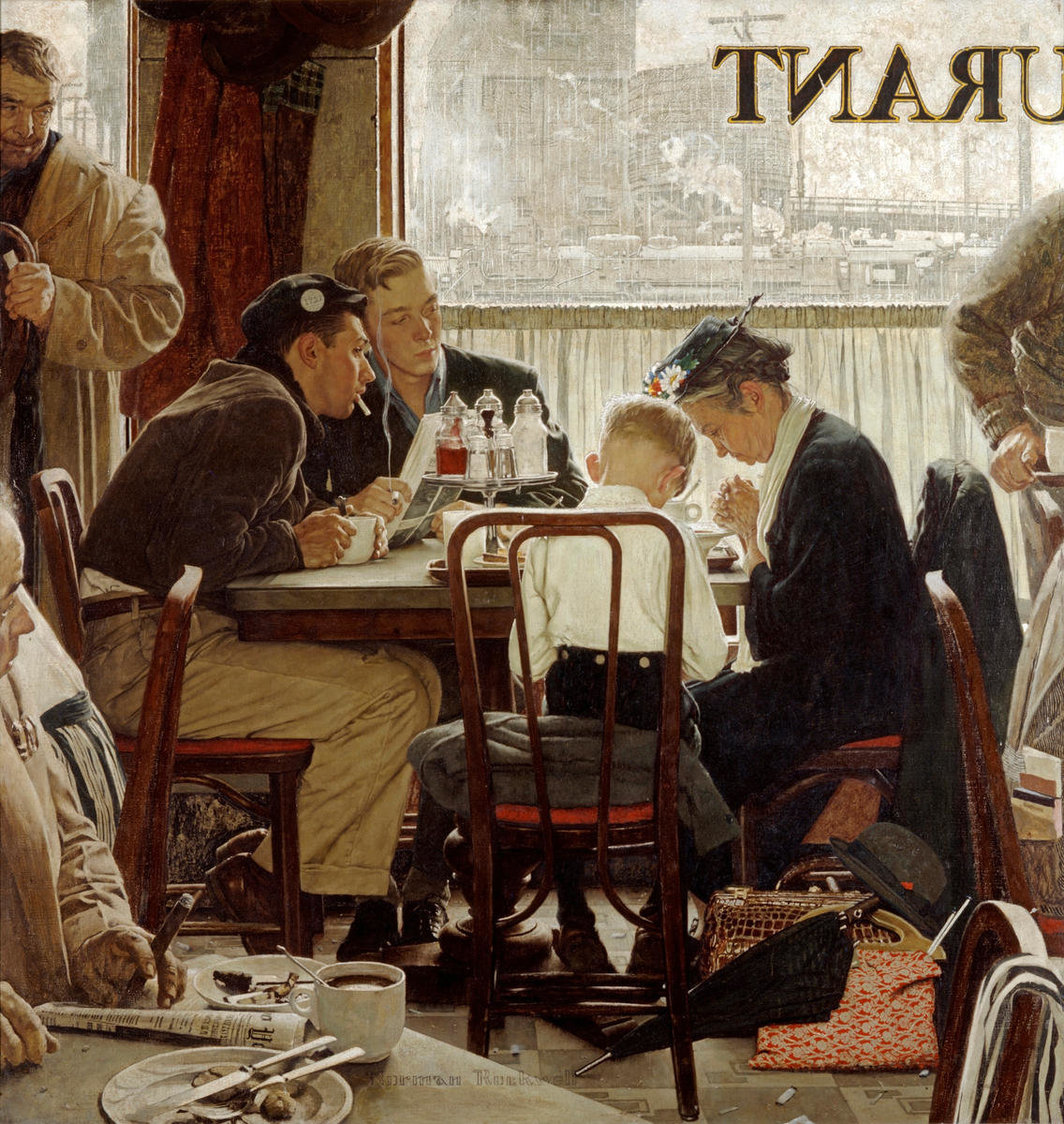
This is one of the most beloved paintings in America, and it captures something we rarely see anymore: a person unafraid to be exactly who they are, in front of a room full of strangers...
The painting is Saying Grace, made by Norman Rockwell for the Thanksgiving cover of the Saturday Evening Post in 1951. In a crowded railway-station diner, an old woman and a small boy sit at a table, heads bowed, hands folded, saying grace before they eat.
At the same table, two young men pause and look at them, and you can see the whole range of a human emotion crossing their faces, curiosity, awkwardness, maybe a flicker of something they had forgotten and just remembered…
The little island of faith at the center of the room has commanded the whole space.
What Rockwell captures here is a kind of courage we do not usually call by that name: the courage to be openly, unashamedly yourself in a world that is watching and might not approve. The old woman is not performing her prayer and not hiding it either. She is simply doing what she has always done, with a child at her side learning to do the same, and her calm dignity is so complete that it turns a filthy train-station diner into something like a chapel.
In 1955 the readers of the Post voted Saying Grace their single favourite Rockwell cover of all time. And decades later, in 2013, this picture of two strangers praying over a meal sold for 46 million dollars, a record for Rockwell and, at the time, for any American painting ever sold at auction.
Of this painting Rockwell himself said he had "just naturally made the people respectful." He had spent his life among ordinary people, and he believed that is what most of them, given the chance, truly are. And he was right. If most of us were cruel, the world would not last a single day. It lasts because of what this old woman knows, and what the strangers around her remember when they see her: that most people, most of the time, are good...
Hundreds of Mormons are converting to Catholicism in Utah, where the Latter-day Saint faith remains the dominant religious tradition, according to reporting by The Salt Lake Tribune.
Here is a man who helped win the Revolution without ever leading a charge. His weapon was money, and he poured so much of it into the cause that he died penniless while the United States owed him what would be millions today. His name was Haym Salomon, and he is one of the most important people almost nobody remembers.
Salomon was a financial broker with a rare gift for markets and languages, and when the colonies caught fire he threw himself into the rebellion completely, joining the Sons of Liberty and betting everything on the American cause.
It nearly killed him early. The British arrested him as a spy. Because he spoke several languages, they forced him to work as an interpreter with their hired German troops, the Hessians, and Salomon used that position like a knife in the dark. He quietly urged Hessian soldiers to desert, helped American prisoners escape, and worked against his captors from inside their own operation. When they caught on, he was sentenced to death. He escaped, fleeing to Philadelphia with nothing and starting over from zero.
And in Philadelphia he became something the war desperately needed: a financial genius at the exact moment the Revolution was going broke. This is the part people forget. Armies do not run on courage alone, they run on money, and the Continental government was drowning, its currency nearly worthless. Salomon rebuilt himself and became the right hand of Robert Morris, the man in charge of financing the entire war. Salomon sold government bills, raised cash from a skeptical market, handled the money of America's French allies, and again and again advanced his own funds to keep the whole enterprise afloat.
There is a famous story, and historians debate the exact details, that in 1781, as Washington prepared the march to Yorktown, the government simply did not have the money to move the army. When told the treasury was empty, the response was, "Send for Haym Salomon." And Salomon, the story goes, raised the funds that helped put Washington's army on the road to the victory that won the war. Even if the tale grew in the retelling, the bones of it are true: Salomon's money and credit were woven right through the finances of the Yorktown campaign.
He also quietly kept the government itself running. He lent money, often with no interest and no real expectation of repayment, to members of the Continental Congress who could not afford to stay in Philadelphia and do their jobs. James Madison, a future president, was among the men Salomon carried, and Madison admitted in his letters that he survived on the kindness of a broker who never pressed him to pay it back.
And here is the heartbreak. When the war was won, the young United States was itself nearly bankrupt and could not repay its debts. The government owed Haym Salomon an enormous sum, hundreds of thousands of dollars, a fortune. It was never paid. His health, wrecked by his time in a British prison, gave out, and in 1785 he died at just 44 years old, leaving his family not wealth but debt. The man who had helped fund a nation died with almost nothing, and his heirs spent generations trying, and failing, to collect what the country owed him.
So when you picture the heroes of the Revolution, do not only picture the men with muskets. Picture also a broker at a desk in Philadelphia, spending his own last dollars and his own health to keep a struggling country solvent long enough to win its freedom, asking for little and receiving less. Haym Salomon bought a piece of American independence with his fortune and his life, and America never paid him back.
For eight years the most wanted man in California robbed 28 stagecoaches with a shotgun that most accounts say was never loaded, said please every time, and walked to every single robbery, because he was afraid of horses.
His name was Charles Boles. He was born in England, brought to New York as a small child, came out for the Gold Rush in 1849, failed at it, went home, and fought in the Civil War with an Illinois regiment, where he was wounded and came out an officer. Then he headed west again, wrote to his wife for a while, and then stopped writing. She assumed he was dead. She would go years believing that.
He was in San Francisco, going by Charles Bolton.
In the city he was a small, tidy, well-spoken man in good clothes with a neat white mustache and a walking cane, who lived quietly in a boarding house and told everyone he was in mining. He was well liked. He dined out. He was known for having excellent manners and for never once cursing. Every so often he mentioned that he had to go inspect his properties, and he would leave for a few weeks.
The properties were stagecoaches.
He worked a specific way. He picked a steep grade where the team had to slow to a crawl going uphill, put on a long linen duster and a bowler hat, pulled a flour sack over his head with two holes cut in it, and stepped out into the road with the shotgun. Then he asked the driver, politely, to please throw down the box.
He never fired it at anyone. He never robbed the passengers. On one job a woman held out her purse to him and he refused it and told her he only wanted the Wells Fargo shipment. Drivers who were robbed by him described him as courteous.
Which is funny, because at two of the robberies he left a poem behind in the emptied box.
I've labored long and hard for bread,
For honor, and for riches,
But on my corns too long you've tred,
You fine haired sons of bitches.
He signed it "Black Bart, the Po8."
And then he walked home. He could not ride and was reportedly terrified of horses, so he did all of it on foot, hiking through the mountains of Northern California between jobs like a man on a very long errand.
He got away with this 28 times across eight years. Wells Fargo had no idea who he was.
On November 3, 1883, he went back to Funk Hill near Copperopolis, where he had pulled his very first robbery eight years earlier. It went wrong. A 19 year old named Jimmy Rolleri had hopped off the stage earlier to hunt along the road and came up on the holdup carrying a rifle. Bart was hit in the hand and ran.
He left things scattered on the ground getting out of there. One of them was a handkerchief with a laundry mark stamped on it. F.X.O.7.
A Wells Fargo detective named Harry Morse took that handkerchief and started walking into laundries in San Francisco and asking. He did that roughly 90 times. Eventually a laundry on Bush Street looked at the mark and said yes, that is one of ours, that belongs to a gentleman named Charles Bolton.
This was 1883. Fingerprints were not in use in American police work yet. They caught the most prolific stage robber in California history by checking laundry tags door to door.
He pleaded guilty to the last robbery only and got six years at San Quentin. He was let out early for good behavior in January 1888, by then going deaf and losing his sight.
Reporters were waiting at the gate. They asked if he was going to rob any more stagecoaches. He said, "No, gentlemen. I'm through with crime."
Then one of them asked whether he would write any more poetry.
He said, "Did you not hear me say I would commit no more crimes?"
A few weeks later he checked out of a hotel in Visalia and was never seen again by anyone who knew who he was. Nobody knows where he went or when he died.
He left on foot, which was the only way he ever traveled.
Cette femme a mis au monde 11 enfants en 15 ans.
Résultat : les féministes accusent son mari de l’avoir transformée en machine à bébés.
Curieux comme le « choix » d’une femme est respecté quand il s’agit d’avorter…
mais devient suspect dès qu’elle décide d’avoir une grande famille.
C’est vraiment le libre arbitre des femmes qui compte… ou seulement certains choix ?