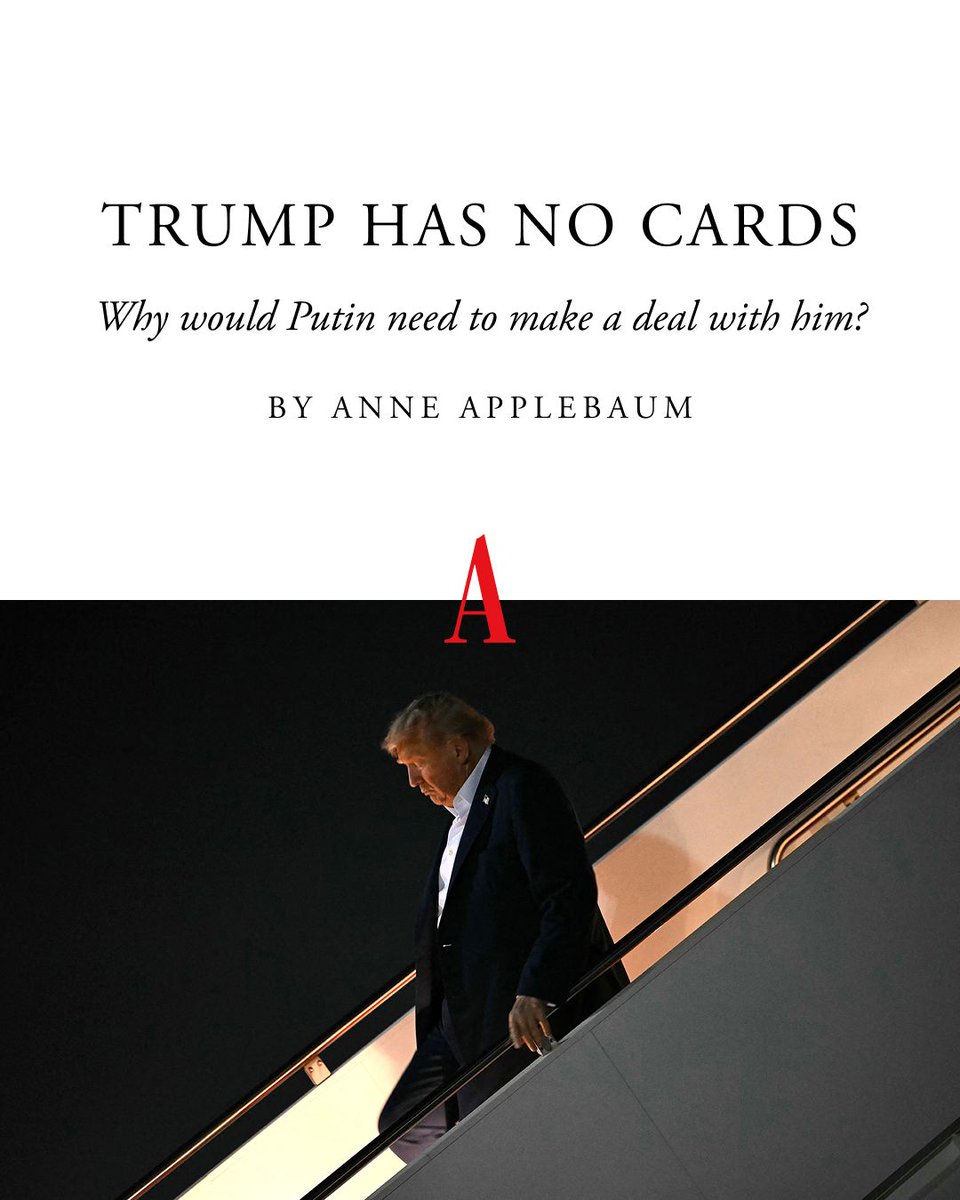
Vladimir Putin has clearly made a calculation, @anneapplebaum argues: Donald Trump, to use the language he once hurled at Volodymyr Zelensky, has no cards, and his fond wish to be seen as a peacemaker can be safely ignored. https://t.co/0SLCp7Figr
@thegeneralboard On the other side there is plenty of bad revisionism, claiming non existent effectiveness, focusing on small tactical problems and ignoring strategic ones. Also British historians, like Gooch and Hammond, provided balanced views of Italy in #WWII
@Mauro_Gilli@EmanueleFelice 2/2 La "mandopera" sovietica può imporre uno stallo ai tedeschi e impedirgli di completare questo consolidamento. Ma senza il potere aeronavale anglo-americano l'Europa restava in mano fascista.
@Mauro_Gilli@EmanueleFelice 1/2 Il problema è si immagina WWII come un conflitto human intensive, quando è in realtà uno tra potenze human intensive (URSS, Giappone, Italia), capital intensive (USA e UK) e una che è a metà strada e conta sul costruirsi uno spazio vitale per ascendere a un livello superiore
@Mauro_Gilli@EmanueleFelice Poi c'è la questione logistica, ovvero la grande quantità di armamenti distrutti mentre venivano spostati in Europa dagli attacchi aerei. Insomma, la questione è un po' più sfumata.
@Mauro_Gilli@EmanueleFelice Ni. Tra il 1942 e il 1944 la produzione andò per la maggior parte agli armamenti terrestri. Diverso è come questo influisse sulla distribuzione delle risorse complessive. Il bombardamento della Germania sortì effetti economicamente decisivi soprattutto a partire dal 1944.
@Mauro_Gilli La visione di @emanuelefelice è errata, ma anche questa è una semplificazione.
O'Brien, tra i principali sostenitori della maggiore importanza del potere aeronavale angloamericano, dice che è solo nel 1943 che la guerra aerea comincia ad assorbire il grosso delle risorse ted.
@ITM_archives Regia Marina enters east med (which comprehends the Aegean), disasters happen, did not try again. These are the facts. Also, subsequent studies for ops in Eastmed put a limit 100 miles east of your map (25 med) and focused on the problem of airpower (as I said), not DD autonomy
@ITM_archives No. The point is strategic outlook went from looking for offensive actions in the eastmed to total defensiveness focused on central. This is a strategic effect and disproves your conclusion.
@ITM_archives "Supermarina - assessment of the situation February 10, 1941
"The action against Greece had indeed been initiated with the goal of [...] recovering in the northern part of the Eastern Mediterranean and in the eastern part of the Ionian Sea a portion of that freedom of action.."
@ITM_archives 18 March 1941 - Riccardi to Reader "It follows that our naval forces, now less constrained in the west, will be able to rely once again on the bases in the Ionian Sea, which are better located for carrying out operations in the Eastern Mediterranean."
@ITM_archives Italy was fighting an offensive war to secure ocean access (Suez).
Matapan proved that the Italian Navy could not project its power east of the Ionian Sea and, therefore, could not threaten the enemy's maritime position in the area.
That is a strategic failure.
Closeup of the cruiser Garibaldi's vertical launch cells for Polaris ballistic missile (UGM-27). A project developed from the #Marinamilitare in the context of the 1906s NATO multilateral force programs
Source: Rivista Marittima, 1965
#ColdWar#nuclearweapons